



Private Discoms Turning Bottleneck for PM-KUSUM in Odisha, Leaving Grid Solarisation Stranded| Exclusive
Key Points
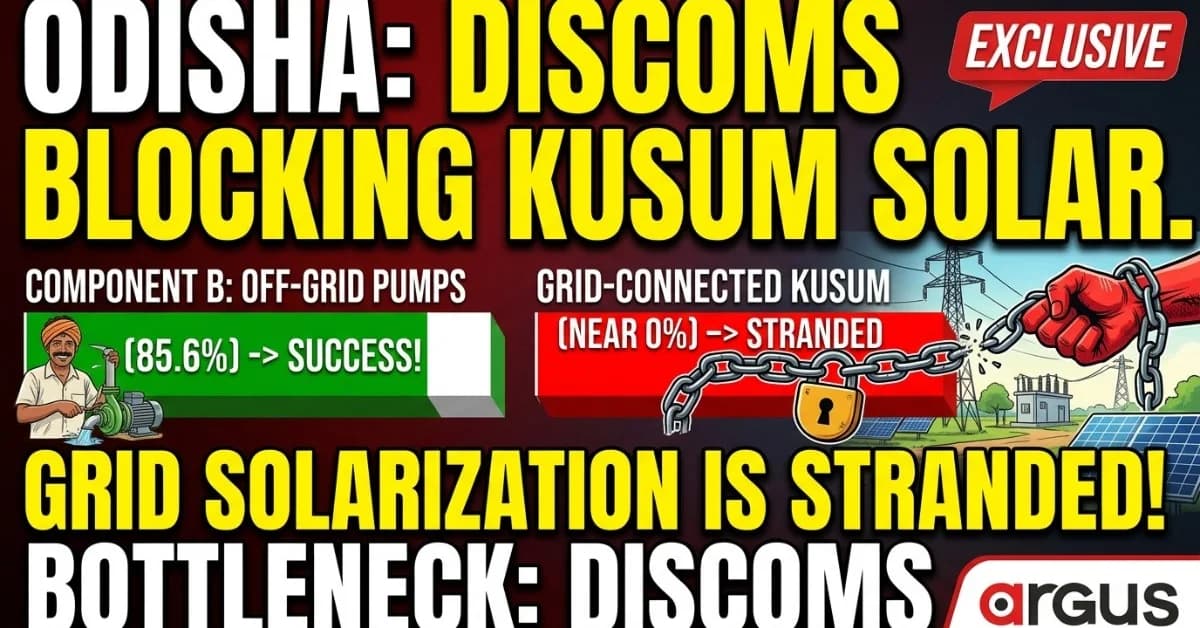
Bhubaneswar: Odisha’s PM-KUSUM story has a striking contradiction: the state has managed to deliver solar irrigation pumps to farmers at scale, but the moment the scheme enters the power grid, its progress virtually hits a wall.
The numbers expose the fault line. Sample the following.
Against a sanctioned capacity of 90 MW under Component A, Odisha has installed just 2 MW – a mere 2.2%. Under Component C, which involves solarising grid-connected agricultural pumps and feeders, the performance is even more stark: 5,223 units sanctioned, but none installed.
Yet under Component B, the off-grid segment, Odisha has installed 15,780 of the 18,441 sanctioned standalone solar pumps – an impressive 85.6%.

📱 Get Argus News App
✨The contrast points to a structural problem rather than an inability to implement the scheme. Odisha appears capable of taking solar technology to farmers; it is the grid-connected architecture, where DISCOMs become central players, that is proving to be the bottleneck.
PM-KUSUM was designed by the Ministry of New and Renewable Energy (MNRE) around three distinct interventions: decentralised solar plants, standalone solar pumps and solarisation of existing grid-connected agricultural pumps.
The DISCOM roadblock
Component A is fundamentally dependent on the distribution network. Small solar plants, typically between 500 kW and 2 MW, are expected to be established near rural substations, with the electricity generated being fed directly into the local DISCOM grid. The DISCOM then purchases the power at a predetermined tariff.
This makes the DISCOM more than a downstream utility – it becomes an essential link between the solar developer and the revenue model.
That is where Odisha's implementation appears to be struggling.
The state's four distribution utilities – TPNODL, TPWODL, TPSODL and TPODL – operate the distribution network across Odisha. For decentralised solar projects to move from sanction to commissioning, developers need viable power purchase arrangements, grid connectivity and timely approvals from the distribution system.
The extraordinarily low 2.2% installation rate under Component A suggests that the sanctioned pipeline has not translated into projects on the ground.
The problem is not merely the availability of solar technology. It is the economics and mechanics of connecting that generation to the grid.
Component C is the bigger red flag
If Component A exposes the commercial bottleneck, Component C exposes the infrastructure bottleneck.
Odisha has 5,223 feeders sanctioned for solarisation but zero installed.
Component C is meant to convert farmers who already use grid electricity for irrigation into producers of solar power. At the feeder level, entire agricultural feeders can be solarised instead of treating individual pumps separately. Excess power can then flow back into the grid under the net-metering model.
But feeder-level solarisation requires the distribution network to be technically prepared.
Agricultural feeders have to be identified, separated where necessary, upgraded and integrated with solar generation. That requires substantial coordination from the DISCOMs. The zero installation figure therefore raises a fundamental question: has Odisha's distribution network been adequately prepared to absorb large-scale agricultural solarisation?
Why Component B is succeeding
The performance of Component B provides perhaps the strongest clue.
Standalone solar pumps do not require the same grid integration. They are specifically intended for areas where reliable grid electricity is unavailable or where extending the grid is expensive. The scheme provides substantial central and state subsidy, reducing the farmer's upfront burden.
That model has worked remarkably well in Odisha.
Of the 18,441 pumps sanctioned, 15,780 have been installed.
In other words, when implementation largely involves identifying beneficiaries, procuring equipment, providing subsidy and installing pumps, Odisha performs strongly. But when the scheme requires a functioning commercial and technical interface with the electricity distribution system, performance collapses.
Odisha versus the national picture
The contrast becomes sharper when Odisha is placed alongside other major states.
Rajasthan, for instance, has installed 1,236.05 MW out of 5,618 MW sanctioned under Component A, while Maharashtra has installed 21 MW out of 260 MW. Madhya Pradesh has commissioned 201.66 MW against 1,401 MW sanctioned.
The national total stands at 1,726.92 MW installed against 10,000 MW sanctioned.
Odisha's 2 MW therefore represents an exceptionally small conversion of its sanctioned Component A capacity.
Component C shows an even wider gap. Against 35,36,602 feeder/pump units sanctioned nationally, 16,32,880 have been installed, whereas Odisha's tally remains zero against 5,223 sanctioned.
Are DISCOM’s To Be Blamed Alone?
While DISCOMs sit at the centre of Odisha's grid-connected PM-KUSUM bottleneck, the responsibility cannot be placed entirely on them.
Land is one constraint. Component A projects need suitable land close to substations. Fragmented holdings, land-use conversion and right-of-way issues can slow projects even before they reach the grid.
Project economics are another. Developers need a bankable power purchase arrangement. If the tariff does not adequately compensate for project costs, financing and operational risks, sanctioned capacity can remain only on paper.
Grid readiness is a third issue. Component C requires substantial distribution-system preparation before feeder solarisation can be scaled.
There is also a structural Odisha factor: farmers already benefiting from relatively inexpensive conventional electricity may have less immediate economic incentive to shift to a more complicated grid-connected solar arrangement than farmers heavily dependent on diesel.
The real lesson from Odisha's numbers
The PM-KUSUM data suggests that Odisha does not have a solar adoption problem. It has a grid-integration problem.
The state has demonstrated that it can execute the farmer-facing portion of the programme. Its 85.6% achievement in Component B is evidence of that.
But the 2.2% achievement in Component A and zero achievement in Component C show that the next phase requires a different implementation strategy – one centred on distribution infrastructure, power purchase economics, feeder readiness and inter-agency coordination.
The irony is hard to miss.
A scheme designed to reduce agriculture's dependence on conventional power and make farmers energy producers is working when the farmer is disconnected from the grid. It falters when the farmer has to connect to the very grid that is supposed to make the solar transition scalable.
For Odisha,
therefore, the PM-KUSUM challenge is no longer simply about putting more solar
pumps in farmers' fields. It is about making the state's distribution system
ready to receive, purchase and manage the solar power those farmers and
decentralised plants are expected to produce.
Also Read: Odisha’s 2030 Power Plan: What the ₹16,000-Crore Grid Push by CM Mohan Majhi Means for Ordinary Consumers| Special Report
Related Topics
Explore more stories