



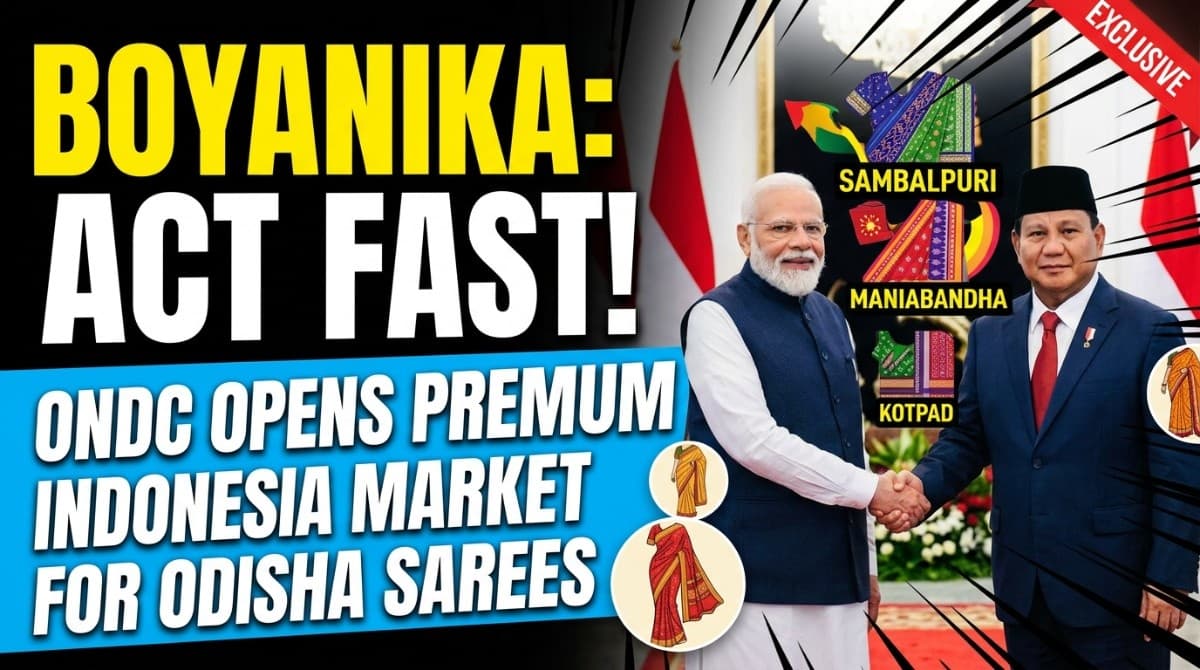
PM Modi's Jakarta Visit: India-Indonesia ONDC Pact Opens Premium Market for Sambalpuri, Maniabandha & Kotpad Sarees—If Boyanika Acts Fast| Exclusive
Key Points
The Digital Bridge: The new Indonesia Open Network (ION), built on India's ONDC architecture, allows Odisha’s handloom inventory to become directly discoverable to premium Southeast Asian buyers without relying on costly Delhi or Mumbai export houses.
The Cultural Literacy Advantage: Unlike general Western markets, Indonesian connoisseurs possess a deep, native understanding of complex Double Ikat weaving, creating an ideal high-margin audience willing to pay premium prices for authentic, GI-tagged Sambalpuri, Maniabandha, and Kotpad textiles.
The Institutional Hurdle: The diplomatic corridor is open, but actual commercial success now depends entirely on whether Boyanika can swiftly shift from a traditional marketing cooperative into a digital export aggregator with high-res catalogs and simplified international logistics.
Bhubaneswar: For decades, Odisha's trade relationship with Indonesia has largely revolved around ships carrying ferro alloys, aluminium and other industrial commodities to one of India's largest ASEAN trading partners.
But the series of agreements signed by Prime Minister Narendra Modi and Indonesian President Prabowo Subianto in Jakarta may have quietly opened the door for an entirely different export from Odisha –its centuries-old handloom heritage.
Among the strategic agreements on defence, maritime cooperation, health, digital transformation and economic collaboration, one initiative stands out for Odisha's rural economy: Indonesia's decision to build the Indonesia Open Network (ION) using India's Open Network for Digital Commerce (ONDC) architecture.
For most observers, it was another digital economy announcement.

📱 Get Argus News App
✨For Odisha's nearly lakh-plus handloom weaving families, however, it could become the first realistic opportunity to directly access Indonesia's premium textile buyers – provided the state's apex handloom marketing agency Boyanika moves swiftly to seize the moment.
A Partnership Beyond Diplomacy
India and Indonesia elevated their Comprehensive Strategic Partnership with agreements spanning trade, digital public infrastructure, fintech, health, cultural cooperation, maritime security and defence.
One of the least discussed but commercially transformative decisions was Indonesia's adoption of India's open digital commerce model.
Unlike conventional e-commerce marketplaces that operate as closed platforms, ONDC is an open protocol where buyers and sellers using different applications can discover and transact with each other seamlessly.
Indonesia's ION is expected to replicate this architecture, effectively allowing businesses onboarded on India's ONDC ecosystem to become discoverable across Indonesia's digital commerce network.
For Odisha's handloom sector, this is where diplomacy begins translating into commerce.
Odisha and Indonesia Were Trading Long Before Modern India
The irony is difficult to miss.
Odisha probably shares one of India's oldest maritime relationships with Indonesia.
Centuries before modern shipping routes emerged, traders from ancient Kalinga sailed to Bali, Java and Sumatra.
That maritime legacy continues to be celebrated every year through Bali Jatra, commemorating the voyages of the legendary Sadhabas.
Cultural influences still survive across Indonesia.
Yet, despite these historic links, Odisha's handloom products have remained virtually absent from Indonesian retail markets.
Why Ancient Ties Never Became Modern Trade
The reason was never lack of cultural acceptance.
It was economics.
Indonesia itself is home to one of the world's richest textile traditions.
Its Batik and indigenous Ikat (locally called Hol in several regions) occupy the same cultural space that Sambalpuri, Maniabandha or Kotpad textiles enjoy in Odisha.
Selling handcrafted textiles into another country equally proud of its weaving heritage has always been commercially difficult.
For Boyanika to enter Indonesia through conventional channels meant navigating export houses based in Delhi or Mumbai, appointing local distributors, investing heavily in overseas marketing or paying steep commissions to global e-commerce platforms.
Each intermediary reduced the artisan's earnings.
The business model rarely justified the effort.
The Digital Agreement Changes That Equation
The ONDC-ION integration removes precisely those structural barriers.
Instead of building a dedicated Indonesian storefront or negotiating with Jakarta-based retailers, Boyanika can onboard its catalogue on an ONDC-compliant application in India.
Once integrated, that inventory can become discoverable across Indonesia's connected digital commerce ecosystem.
The transformation is significant.
Traditional Model
Odisha Weaver → Boyanika → Export House → Overseas Distributor → Global Marketplace → Indonesian Buyer
New Open-Network Model
Odisha Weaver → Boyanika ONDC Catalogue → Indonesia Open Network → Indonesian Consumer
The difference is not merely technological.
It substantially lowers entry costs while reducing dependence on multiple intermediaries.
The Biggest Opportunity Lies in Products Indonesia Already Understands
This is where Odisha enjoys an advantage few realise.
The state should not attempt to flood Indonesia with ordinary fabrics.
Instead, it should target one of the world's most specialised textile markets.
Globally, Double Ikat weaving survives in only a handful of regions.
India—particularly Odisha's Bandha tradition and Gujarat's Patola—Indonesia, and Japan are recognised centres of this extraordinarily complex craft.
Indonesian collectors already understand the painstaking process of aligning tie-dyed warp and weft threads before weaving.
That cultural literacy creates an ideal premium market for Odisha's finest products.
Authentic GI-tagged Sambalpuri silk, Maniabandha Double Ikat and naturally dyed Kotpad textiles are not merely garments – they are collectible textile art.
Unlike many Western buyers who often purchase such fabrics primarily for fashion, Indonesian connoisseurs appreciate the technical mastery behind every motif.
That significantly improves Odisha's ability to command premium prices.
A Market Odisha Has Never Truly Entered
Current trade statistics underline the scale of the opportunity.
India's bilateral trade with Indonesia exceeds $28 billion, but exports remain dominated by petroleum products, engineering goods, chemicals, vehicles and industrial commodities.
Odisha contributes substantially through shipments of ferro alloys, aluminium and other metallurgical products.
Handloom exports barely register.
Not because demand is absent.
Because the route to market never existed.
The ONDC-ION ecosystem creates that missing digital bridge.
But Technology Alone Will Not Help Weavers
The agreement itself will not automatically generate export orders.
Success depends almost entirely on execution within Odisha.
That responsibility falls squarely on Boyanika and allied state agencies.
Build a Digital Export Catalogue
Boyanika must become the principal ONDC merchant aggregator, creating professionally photographed, high-resolution catalogues linked directly to certified weaver cooperatives.
Every listing should highlight GI certification, weaving cluster and artisan identity.
Sell Heritage, Not Commodity
Indonesia already produces everyday Ikat fabrics.
Odisha must therefore avoid competing in low-value segments.
Instead, the catalogue should focus on premium Sambalpuri silk, Maniabandha Double Ikat and Kotpad natural-dye collections where Odisha enjoys global recognition.
Simplify Cross-Border Logistics
ONDC's logistics ecosystem can integrate shipping partners that manage customs documentation and international delivery.
If implemented efficiently, Indonesian orders can trigger domestic pickup from Odisha, leaving weavers free from handling complex export procedures.
Ensure Seamless Payments
Cross-border settlements remain one of the biggest deterrents for small artisans.
Digital payment integration must ensure Indonesian buyers pay in Rupiah while Boyanika receives the equivalent amount in Indian Rupees without cumbersome foreign exchange processes.
Use Storytelling as a Selling Tool
Premium textile buyers do not merely purchase fabric.
They purchase authenticity.
Every product listing should include videos of the weaving process, QR-based traceability, artisan profiles and GI certification.
This differentiates Odisha's handcrafted textiles from machine-made imitations while justifying higher prices.
The Ball Is Now in Boyanika's Court
For years, Odisha's exports to Indonesia have been measured in tonnes of minerals.
The Modi-Prabowo digital commerce partnership presents an opportunity to begin measuring exports in metres of heritage textiles.
The irony is poetic.
Ancient Kalinga merchants once crossed the Bay of Bengal carrying handcrafted goods to Southeast Asia.
Centuries later, another route is opening – not through sailing ships, but through interoperable digital commerce networks.
Whether Odisha's legendary weaves once again find buyers in Bali, Jakarta and Sumatra will depend less on diplomacy and more on how quickly Boyanika transforms itself from a traditional marketing cooperative into a digital export aggregator.
The diplomatic corridor has been opened.
The
commercial voyage now awaits Odisha's handloom sector.
Also Read: Odisha Bags India's Largest Metal FDI: Adani-IHC Partner for ₹1.08 Lk Cr Aluminium Plant to Fuel Downstream EV, Solar Hub in State| Special Analysis
Related Topics
Explore more stories