



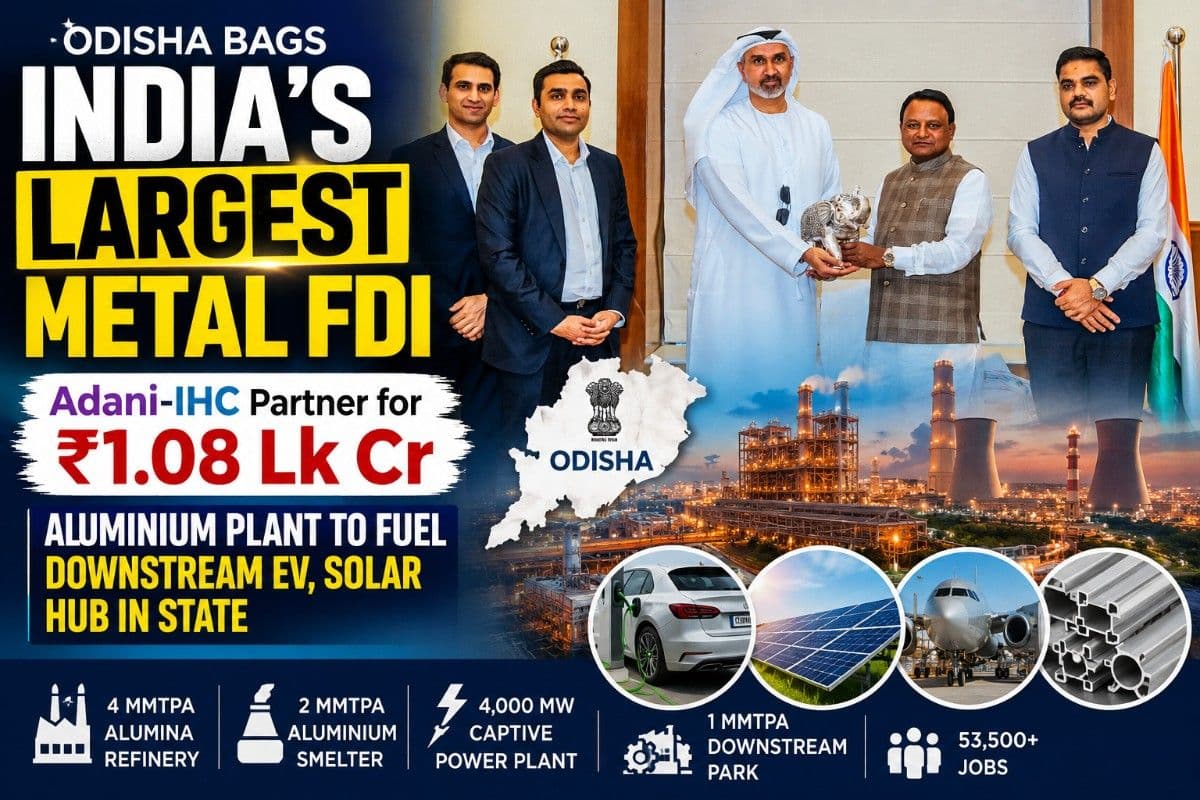
Odisha Bags India's Largest Metal FDI: Adani-IHC Partner for ₹1.08 Lk Cr Aluminium Plant to Fuel Downstream EV, Solar Hub in State| Special Analysis
Key Points
* Bypassing simple commodity smelting, the project features a massive 1 MMTPA downstream manufacturing park dedicated to high-value EV components, solar module frames, and aerospace alloys.
* The mega industrial ecosystem is projected to create over 53,500 jobs across its split hubs in Rayagada and Sundargarh, fueling a vast local MSME vendor network.
Bhubaneswar: Odisha has once again found itself at the centre of India's industrial map.
On Wednesday, Adani Enterprises Ltd (AEL) and International Resources Holding (IRH) – the Abu Dhabi-based natural resources investment platform backed by IHC Group – signed a Memorandum of Understanding (MoU) with the Odisha government to establish an integrated aluminium ecosystem involving an investment of nearly Rs1.08 lakh crore (US$11.5 billion).
The project includes a 4 million tonnes per annum (MMTPA) alumina refinery, a 2 MMTPA aluminium smelter, a 4,000 MW captive power plant and a 1 MMTPA downstream manufacturing park, besides supporting infrastructure. Around 53,500 jobs are expected to be generated during construction and operations.
However, the biggest story is not the investment amount.

📱 Get Argus News App
✨The real significance lies in the downstream manufacturing park, which has the potential to fundamentally change Odisha's industrial identity – from being India's largest supplier of raw aluminium to becoming one of Asia's major manufacturing bases for electric vehicles, solar equipment, aerospace components and advanced engineering products.
Unlike previous mega metal investments that largely focused on mining and primary metal production, this project seeks to retain value addition within Odisha itself.
That could become its biggest economic legacy.
From POSCO to Adani-IHC: A 21-Year Industrial Journey Comes Full Circle
For Odisha, July 2 may well become a defining date in its industrial history.
The announcement inevitably evokes memories of June 2005, when South Korean steel giant POSCO signed an MoU with the then Odisha government to establish a US$12 billion steel plant, then considered India's biggest foreign direct investment proposal.
The project had dramatically elevated Odisha onto the global investment map.
But years of land acquisition disputes, environmental litigation and political opposition eventually forced POSCO to abandon what had once been described as India's most ambitious industrial investment.
For nearly two decades thereafter, the shadow of POSCO became synonymous with Odisha's inability to execute mega projects.
Now, that narrative appears to be changing.
The Rs1.08 lakh crore Adani-IRH proposal, adjusted for present-day exchange rates and inflation, becomes Odisha's largest single-investment FDI proposal ever and India's largest foreign investment in the metallurgy sector.
Beyond the numbers, it signals that global institutional capital once again views Odisha as a credible long-term manufacturing destination.
More Than an Aluminium Plant: An Entire Industrial Ecosystem
Unlike conventional aluminium projects, the proposed investment is designed as a fully integrated industrial ecosystem.
It spans the complete value chain:
- Mining
- Alumina refining
- Aluminium smelting
- Captive power generation
- Downstream manufacturing
Instead of exporting raw alumina or aluminium ingots, the project intends to manufacture higher-value finished products within Odisha itself.
That distinction changes everything.
Because every tonne of aluminium converted into EV battery casings, solar panel frames, aerospace alloys or electrical conductors generates substantially higher economic value than exporting primary metal.
Why the Downstream Park Could Become the Biggest Winner
The proposed 1 MMTPA downstream manufacturing park deserves special attention.
Historically, Odisha has exported minerals.
It has produced aluminium. But much of the value addition happened elsewhere.
Automobile manufacturers purchased aluminium.
Electronics firms fabricated components.
Solar companies produced frames.
Engineering firms manufactured specialised alloys.
Most of these industries developed outside Odisha.
The Adani-IHC project attempts to reverse that equation.
The downstream park is expected to attract industries manufacturing:
- Electric vehicle components
- Solar module frames
- Aerospace-grade aluminium products
- Electronics housings
- Construction systems
- Railway components
- Defence-grade engineering products
Once anchor industries arrive, hundreds of MSMEs generally emerge around them supplying fabricated parts, machining, casting, logistics, maintenance, packaging and industrial services.
This multiplier effect – not merely aluminium production – could reshape Odisha's manufacturing landscape over the next decade.
Where the Mega Project Will Come Up
Given its scale, the integrated project has been strategically divided across Odisha's mineral and industrial corridors.
Rayagada: The Refining Hub
The proposed 4 MMTPA alumina refinery will be established over nearly 3,200 acres in Rayagada district.
Its location places it close to Odisha's rich bauxite reserves.
Raw material will be sourced from:
- OMC's Sasubahumali mines
- Adani's Kutrumali mines
- Bahalda mining blocks
The objective is straightforward.
Move bauxite through conveyor systems and rail links directly into the refinery, reducing logistics costs significantly.
Sundargarh: The Manufacturing Hub
The second industrial cluster will be established in Sundargarh district.
This will house:
- 2 MMTPA aluminium smelter
- 4,000 MW captive power plant
- 1 MMTPA downstream manufacturing park
Sundargarh offers stronger industrial infrastructure, established coal connectivity and efficient transport access to domestic and export markets.
Together, the two locations form what industry experts describe as a "pit-to-port-to-product" manufacturing model.
Market Dynamics
Today's aluminium market is no longer about producing more metal.
It is about producing better products.
Vedanta currently remains India's largest aluminium producer.
NALCO continues to be among the world's lowest-cost integrated producers.
Adani's strategy appears different.
Rather than selling large quantities of primary aluminium, much of its output is likely to feed its own downstream manufacturing ecosystem.
That shifts competition from commodity metal towards high-value industrial manufacturing.
SWOT Analysis: What This Means for Odisha
Strengths
Odisha possesses nearly half of India's bauxite reserves and over one-fourth of the country's coal resources.
This provides an unmatched raw material advantage.
Unlike earlier extractive investments, the project integrates mining, refining, smelting and downstream manufacturing within the state.
Equally significant is the partnership structure.
The 50:50 venture with Abu Dhabi's IHC-backed IRH introduces deep global capital, reducing financing risks while improving access to international technologies and markets.
Weaknesses
The integrated project stretches across two geographically separate industrial clusters.
Maintaining uninterrupted connectivity between Rayagada and Sundargarh will require highly efficient logistics through rail corridors and conveyor systems.
Environmental sustainability presents another challenge.
Operating a 4,000 MW captive power plant alongside a 2 MMTPA smelter will significantly increase carbon emissions unless complemented by renewable energy investments over time.
Opportunities
The downstream manufacturing park offers Odisha perhaps its greatest industrial opportunity in decades.
It can attract manufacturers producing:
- EV components
- Solar equipment
- Aerospace products
- Electronics
- Industrial engineering systems
This would encourage the emergence of a large MSME supplier ecosystem.
Employment generation is equally significant.
The estimated 53,500 jobs – including around 35,000 during construction and 18,500 in operations – could substantially reduce migration of skilled metallurgical engineers and industrial workers from Odisha.
The project also strengthens Odisha's ability to attract future investments in Global Capability Centres (GCCs), metallurgy research, advanced engineering and specialised manufacturing.
Threats
History offers an important lesson.
The failure of POSCO demonstrated how land acquisition and environmental disputes can derail even the world's biggest investments.
The proposed acquisition of nearly 3,200 acres in Rayagada will require careful social engagement and transparent rehabilitation policies.
Another risk lies in raw material competition.
Growing demand for bauxite could increase competition among existing producers Nalco and Vedanta, potentially creating future allocation pressures.
The Global Message This Investment Sends
Beyond Odisha, this project communicates three important signals to international investors.
Odisha Can Execute
For years, the POSCO experience shaped global perceptions that Odisha represented a difficult destination for mega investments.
This project attempts to rewrite that narrative.
If implemented successfully, it would demonstrate that Odisha now possesses significantly improved institutional capacity to facilitate projects involving global sovereign and institutional capital.
Global Capital Is Betting on India's Critical Minerals Story
The participation of Abu Dhabi's IRH – backed by IHC, one of the UAE's most valuable listed companies – illustrates growing international confidence in India's long-term resource economy.
As countries compete for critical minerals needed for electric mobility, renewable energy and advanced manufacturing, Odisha is positioning itself as an integral part of global supply chains rather than merely a supplier of raw materials.
The Bigger Picture
The Rs1.08 lakh crore investment undoubtedly establishes new records.
It becomes Odisha's biggest-ever FDI proposal and India's largest foreign investment in the metallurgy sector.
Yet history may ultimately remember this project for something far more important.
Not because it builds another aluminium smelter.
But because it seeks to build an industrial ecosystem where aluminium mined in Odisha is transformed into EV components, solar structures, aerospace alloys, electronics and advanced engineering products within the state itself.
If executed successfully, the Adani-IHC partnership could mark Odisha's transition from being India's mineral warehouse to becoming one of Asia's most important value-added manufacturing destinations.
That
transformation – not merely the investment size – may prove to be the defining
legacy of this landmark MoU.
Also Read: Bhubaneswar's Biggest Urban Road Makeover Explained: What the ₹949-Crore Jayadev Vihar–Nandankanan Corridor Means for You Over Next Two Years
Related Topics
Explore more stories