



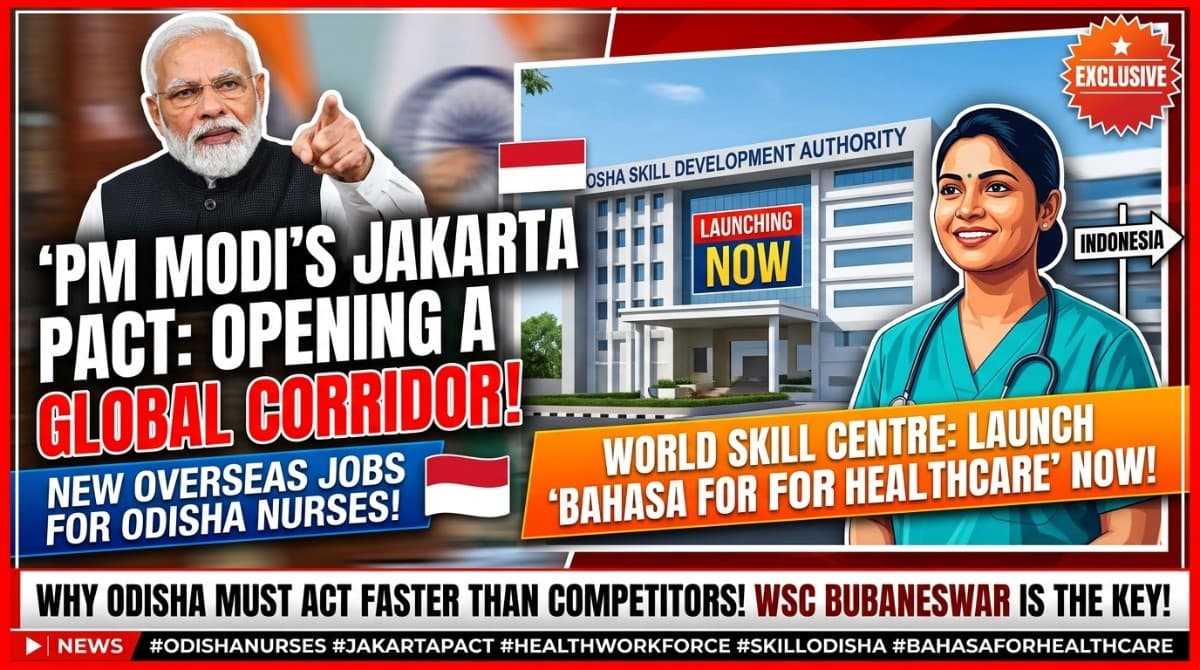
PM Modi’s Jakarta Pact Opens New Overseas Job Corridor for Odisha Nurses: Why World Skill Centre Must Launch ‘Bahasa for Healthcare’ Now | Exclusive
Key Points
The India–Indonesia Health Workforce Collaboration opens a powerful, government-backed overseas employment corridor specifically tailored for Odisha’s rising nursing pool.
Unlike southern states tied to mature Western markets, Odisha possesses an untapped, government-trained workforce uniquely equipped for Indonesia's disaster and tropical medicine needs.
To unlock this opportunity, the World Skill Centre (WSC) must urgently introduce a specialized 90-day "Bahasa for Healthcare" linguistic and cultural certification.
Bhubaneswar: Among the several landmark agreements signed during Prime Minister Narendra Modi's visit to Indonesia, one MoU has the potential to quietly reshape Odisha's skill economy far more than many industrial agreements.
The India–Indonesia Implementation Agreement on Health Workforce Collaboration is not about steel plants, minerals (rare earth) or manufacturing investments. It is about people.
And that is precisely why Odisha could emerge as one of its biggest beneficiaries – provided the state acts faster than its traditional competitors.
The opportunity now rests less with industries and more with the World Skill Centre (WSC) in Bhubaneswar and the Odisha Skill Development Authority (OSDA), which can convert Odisha's expanding pool of government-trained nurses into an internationally employable workforce by introducing one strategic intervention: a "Bahasa for Healthcare" certification programme.

📱 Get Argus News App
✨Odisha's Hidden Strength Lies in Human Capital
Unlike agreements involving critical (rare earth) minerals or industrial investments, the healthcare workforce pact is fundamentally a government-to-government (G2G) mobility framework.
Instead of exporting commodities, India exports trained professionals.
For Odisha, this fits perfectly with the state's investment over the past several years in expanding government medical colleges, nursing institutions and district healthcare infrastructure.
While the southern states continue to dominate India's healthcare education landscape, Odisha has quietly built a sizeable government-backed nursing ecosystem.
|
State |
Annual MBBS Intake
Nursing Seats
Tamil Nadu
11,500+
20,000+
Karnataka
11,000+
30,000+
Maharashtra
10,500+
18,000+
Uttar Pradesh
10,000+
15,000+
Telangana
8,500+
12,000+
Kerala
4,500+
10,000+
Odisha
2,500+
8,500+
On paper, Odisha appears much smaller.
In reality, the state possesses three structural advantages that many larger healthcare-producing states no longer enjoy.
Why Odisha May Gain More Than Tamil Nadu, Kerala or Karnataka
At first glance, Tamil Nadu, Karnataka or Kerala appear naturally positioned to dominate any overseas healthcare recruitment drive.
However, their very success has created structural limitations.
Existing Global Corridors Are Already Occupied
Kerala has spent decades building migration channels to the UK, Gulf countries and Europe.
Tamil Nadu's healthcare graduates are similarly absorbed by NHS recruitment programmes, Middle Eastern hospitals and private international healthcare chains.
Karnataka's large private medical education ecosystem feeds global corporate recruiters.
These pathways are mature.
Indonesia represents a relatively new destination.
Odisha enters without legacy competition.
Government-Trained Workforce Fits the G2G Model
Perhaps Odisha's biggest advantage lies in how its healthcare workforce is produced.
Unlike Karnataka or Telangana, where private institutions dominate nursing education, Odisha's recent expansion has largely occurred through government medical colleges and district hospital-linked nursing institutions.
That distinction matters.
Government-trained professionals align naturally with the transparent government-to-government migration architecture envisioned under the India-Indonesia implementation agreement.
The dependence on expensive private placement agencies can therefore be significantly reduced.
Odisha Already Trains for Indonesia's Healthcare Needs
Indonesia's vast island geography presents unique healthcare challenges.
Hospitals routinely require professionals experienced in:
- Emergency medicine
- Disaster response
- Tropical diseases
- Community healthcare
- Critical care
Ironically, these are precisely the competencies Odisha's public health system has developed over decades because of repeated cyclones, floods and disaster management operations.
Odisha's nurses already understand mass casualty management, public health outreach and emergency response – skills that match Indonesia's healthcare realities remarkably well.
Missing Piece Is Not Medical Knowledge – It Is Bahasa
If there is one obstacle capable of preventing Odisha from benefiting, it is language.
Most Odia nursing graduates possess clinical competence.
Few know Bahasa Indonesia, the working language across Indonesian healthcare facilities.
This is where the World Skill Centre enters the picture.
Why World Skill Centre Can Become Odisha's Global Gateway
The World Skill Centre already houses an International Career Centre created precisely to facilitate overseas employment.
Instead of building new institutions, the state can simply expand its mandate.
Industry experts believe WSC can operationalise the agreement through a three-stage roadmap.
Stage One: Launch "Bahasa for Healthcare"
Rather than offering general language training, WSC could develop a specialised three-to-four-month certification focusing exclusively on healthcare communication.
The curriculum could include:
- Clinical terminology
- Patient interaction
- Emergency commands
- Hospital documentation
- Medical conversations
- Healthcare ethics
Such a module could be developed jointly with the Indonesian Embassy or Indonesian universities.
Stage Two: Cultural and Clinical Orientation
Language alone is insufficient.
Healthcare workers also require understanding of:
- Indonesian hospital systems
- Healthcare regulations
- Religious and cultural sensitivities
- Patient communication protocols
- Public health administration
This programme could be integrated into final-year nursing education across Odisha's government colleges.
Stage Three: Government-Monitored Overseas Placement
The International Career Centre could also function as a complete migration facilitation agency by managing:
- Passport documentation
- Visa processing
- Credential verification
- Pre-departure orientation
- Employer matching
- Financial literacy
- Digital remittance onboarding
Such a model would significantly reduce dependence on private overseas recruiters, who often charge high placement fees.
Easier Than Europe
One reason the Indonesia corridor could become particularly attractive is accessibility.
Healthcare migration to countries such as the UK or Germany often requires expensive language certifications like IELTS, OET or advanced German proficiency, followed by licensing examinations that can take months or even years.
Bahasa Indonesia presents a much lower linguistic barrier.
Written in the Latin alphabet with comparatively straightforward grammar and pronunciation, it is widely regarded as one of the easier Asian languages for beginners.
As per Experts, a focused 90-day intensive programme may therefore be sufficient to achieve functional workplace communication for many healthcare professionals.
That dramatically lowers both migration costs and preparation time.
Why This Agreement Creates Rural Wealth
Unlike industrial investments, the benefits of healthcare migration flow directly to households.
Every overseas healthcare worker becomes an individual exporter of skilled labour.
A nurse employed in Jakarta sends earnings directly to her family in Balasore, Koraput, Mayurbhanj, Sambalpur or Kalahandi.
Those remittances finance:
- Better education
- Housing
- Farm investments
- Local businesses
- Household savings
Instead of corporate profits remaining within institutional balance sheets, foreign exchange enters rural Odisha one family at a time.
The Diplomatic Door Is Open. Odisha Must Walk Through It.
The India–Indonesia Health Workforce Collaboration has already created the diplomatic framework.
The next move belongs entirely to Odisha.
If the World Skill Centre and OSDA rapidly introduce a "Bahasa for Healthcare" programme, align nursing curricula with Indonesian healthcare standards and establish a transparent government-monitored overseas placement mechanism, Odisha could build an entirely new international employment corridor for thousands of young healthcare professionals.
For a state that has invested heavily in expanding public health education, this agreement offers something more valuable than another industrial MoU.
It offers the possibility of transforming Odisha's nurses into global professionals – and turning human capital into one of the state's most sustainable export sectors.
The
diplomatic corridor has been opened in Jakarta. Whether Odisha converts it into
jobs, remittances and rural prosperity now depends on how quickly Bhubaneswar
responds.
Also Read: PM Modi's Jakarta Visit: India-Indonesia ONDC Pact Opens Premium Market for Sambalpuri, Maniabandha & Kotpad Sarees—If Boyanika Acts Fast| Exclusive
Related Topics
Explore more stories