



PM Modi’s Australia Visit Delivers a Mining-Skills Windfall for Odisha: How 2 Landmark MoUs Create a Global Talent Pipeline from Bhubaneswar| Special Report
Key Points
* Global Certification Pipeline: The NCVET-ASQA regulatory agreement aligns Odisha’s vocational certifications with Australian standards, unlocking seamless international job mobility for local youth.
* Bilateral Mobility Mechanism: The pact introduces direct student-instructor exchange programs and masterclasses between Western Australia and Odisha, eliminating the need for local talent to migrate to metros.
Bhubaneswar: Prime Minister Narendra Modi's high-profile visit to Australia has yielded far more than diplomatic optics.
India and Australia signed 18 landmark outcomes spanning defence and maritime security, energy and civil nuclear cooperation, cyber and critical technologies, higher education, geological sciences, innovation and skill development, university campuses, clean energy and scientific research, reflecting a strategic shift towards technology-led economic cooperation.
However, among them, two skill development agreements have emerged as the most consequential for Odisha, directly linking the state's mining ecosystem with Australia's globally acclaimed vocational training framework, when Odisha sits atop some of India's richest mineral reserves.
While one agreement directly establishes a globally benchmarked mining skills ecosystem in Bhubaneswar, the other builds the regulatory architecture needed to ensure those skills are internationally recognised. Together, the two agreements position Odisha at the centre of India's emerging Indo-Australian mining talent corridor.

📱 Get Argus News App
✨Mining Centre of Excellence in Bhubaneswar
For a state whose economy is heavily anchored in mining and mineral-based industries, the significance of these agreements extends beyond vocational training. They promise to bring Australian mining technology, global safety standards, advanced equipment training and internationally aligned certifications directly to Odisha, potentially transforming the state's workforce into a globally competitive talent pool.
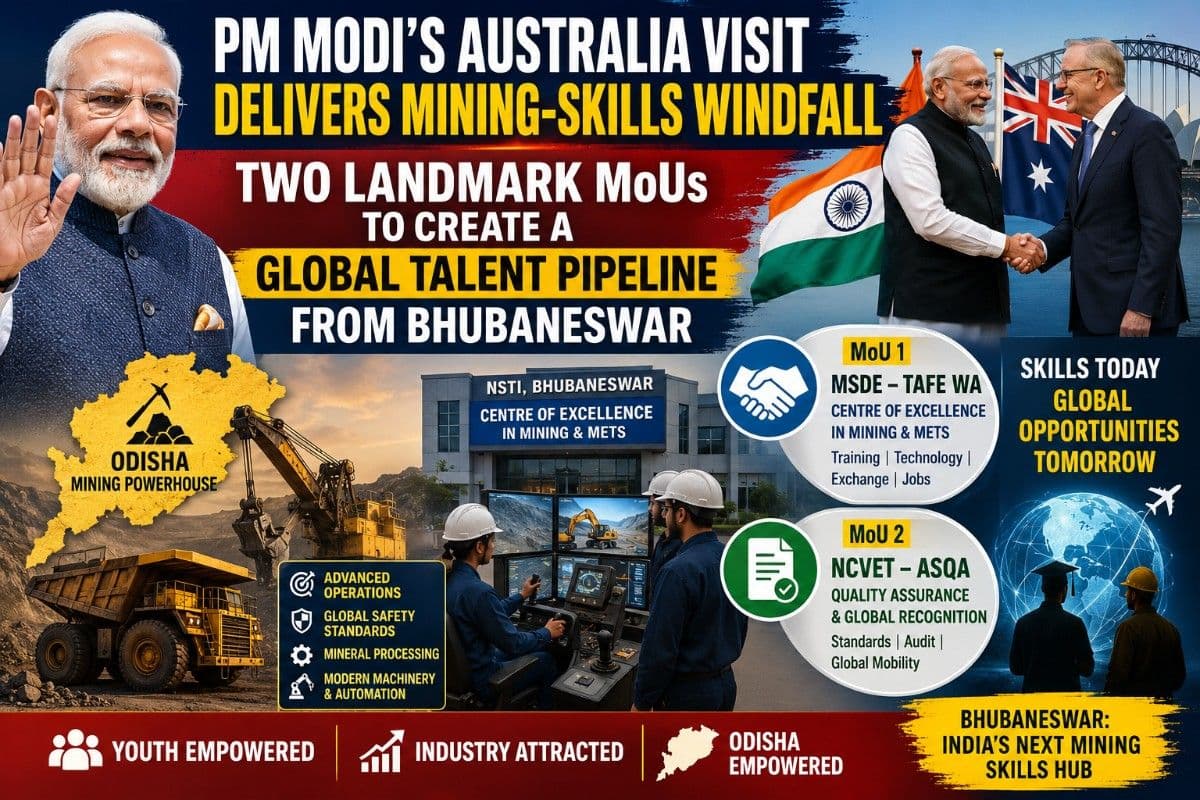
The biggest immediate gain comes through the Memorandum of Understanding between the Ministry of Skill Development and Entrepreneurship (MSDE) and Technical and Further Education (TAFE), Government of Western Australia, under which a Centre of Excellence (CoE) in Mining and Mining Equipment, Technology and Services (METS) will be established at the National Skill Training Institute (NSTI), Bhubaneswar.
The agreement creates a direct institutional bridge between Western Australia – the world's leading mining technology ecosystem – and Odisha, India's mineral powerhouse.
Unlike conventional vocational partnerships, the Centre of Excellence will deliver industry-tested Australian curricula instead of purely classroom-based instruction. Local trainees will receive specialised training in four critical domains: advanced mining operations, international mine safety standards, mineral processing technologies, and modern mining machinery and automation.
The programme introduces Odisha's youth to technologies increasingly defining global mining operations, including automated drilling systems, digital pit optimisation, autonomous haul trucks, fleet management technologies, telemetry-based maintenance, and advanced mineral beneficiation techniques.
Equal emphasis will be placed on globally accepted mine safety frameworks, disaster management, structural stability monitoring and zero-harm operational practices – areas that are becoming mandatory across modern mining jurisdictions.
How Youths, State Stand Benefitted
Perhaps the most tangible benefit lies in the bilateral mobility mechanism embedded in the agreement.
Selected trainees, instructors and engineering graduates from Odisha will undergo advanced training at TAFE institutions in Western Australia, while Australian experts will regularly conduct masterclasses and specialised training programmes at NSTI Bhubaneswar.
The arrangement not only upgrades technical competencies but also reduces the need for Odia youth to migrate to metropolitan centres to access internationally benchmarked mining certifications.
Over time, the availability of a globally trained workforce could also attract multinational Mining Equipment, Technology and Services (METS) companies to establish operations in Bhubaneswar.
The Top Up MoU
However, sophisticated infrastructure alone cannot produce globally employable talent without internationally credible quality assurance.
That is where the Letter of Intent between the National Council for Vocational Education and Training (NCVET) and the Australian Skills Quality Authority (ASQA) assumes strategic importance.
The agreement complements the Mining Centre of Excellence by introducing Australian regulatory and quality assurance mechanisms into India's vocational education system. Rather than relying on conventional paper-based approvals, the framework introduces risk-based monitoring, surprise compliance audits, assessment integrity protocols and competency-based evaluation systems.
For Odisha's ITIs and vocational institutions, this means students will receive the equipment, practical exposure and simulator hours prescribed in the curriculum instead of merely obtaining certificates with limited practical value.
The partnership also enables occupational standards in India to be systematically aligned with Australian vocational qualifications. As competency levels, practical training requirements and safety standards become increasingly harmonised, certifications earned by students in Odisha will carry greater international credibility, reducing barriers for those seeking employment in overseas infrastructure, mining and heavy engineering sectors.
Simultaneously, train-the-trainer programmes and faculty exchanges will modernise teaching methodologies across government and private institutions, shifting classroom instruction towards competency-based learning and globally accepted occupational safety practices.
In effect, the NCVET-ASQA partnership operationalises the Mining Centre of Excellence. While the Bhubaneswar facility provides world-class infrastructure and specialised equipment, the regulatory framework ensures that curriculum design, assessments, certification and quality control remain aligned with global industry requirements. Without such oversight, even advanced training infrastructure could struggle to deliver internationally competitive outcomes.
Synergy of PM, Union Edu Ministry, MSDE for Odisha
The broader significance of these agreements lies in the coordinated institutional approach underpinning them.
Prime Minister Narendra Modi's bilateral engagement created the diplomatic framework that enabled technology transfer and skill partnerships to become part of strategic cooperation rather than standalone education initiatives.
The Ministry of Skill Development and Entrepreneurship translated that vision into physical infrastructure by anchoring the Centre of Excellence at NSTI Bhubaneswar and institutionalising collaboration with Western Australia's TAFE system. Simultaneously, NCVET partnered with ASQA to embed internationally recognised regulatory standards into India's vocational ecosystem, ensuring quality and global portability of qualifications.
The Union Ministry of Education complements this architecture through the National Education Policy (NEP), which seeks to integrate vocational education with mainstream academic pathways.
As credit-transfer systems evolve, specialised mining modules undertaken at the Centre of Excellence can increasingly become part of broader academic progression, allowing students to move seamlessly between vocational training and higher technical education.
Together, the Prime Minister's diplomatic outreach, MSDE's institutional execution and the Education Ministry's policy integration create a complete ecosystem – from international agreement to classroom, from skill acquisition to global employability.
For Odisha, the outcome is far more consequential than two standalone MoUs. It marks the beginning of a structural transition in which the state's natural resource advantage is reinforced by globally benchmarked human capital.
If
implemented effectively, Bhubaneswar could emerge not merely as a mining
education hub for India but as one of South Asia's leading centres for
internationally recognised mining skills, advanced vocational training and
global workforce mobility.
Also Read: PM Modi’s Jakarta Pact Opens New Overseas Job Corridor for Odisha Nurses: Why World Skill Centre Must Launch ‘Bahasa for Healthcare’ Now | Exclusive
Related Topics
Explore more stories