



PM-JANMAN Hostels Hit a Wall in Odisha: 76 PVTG Student Hostels Sanctioned, None Completed as Funding Dries Up
Key Points
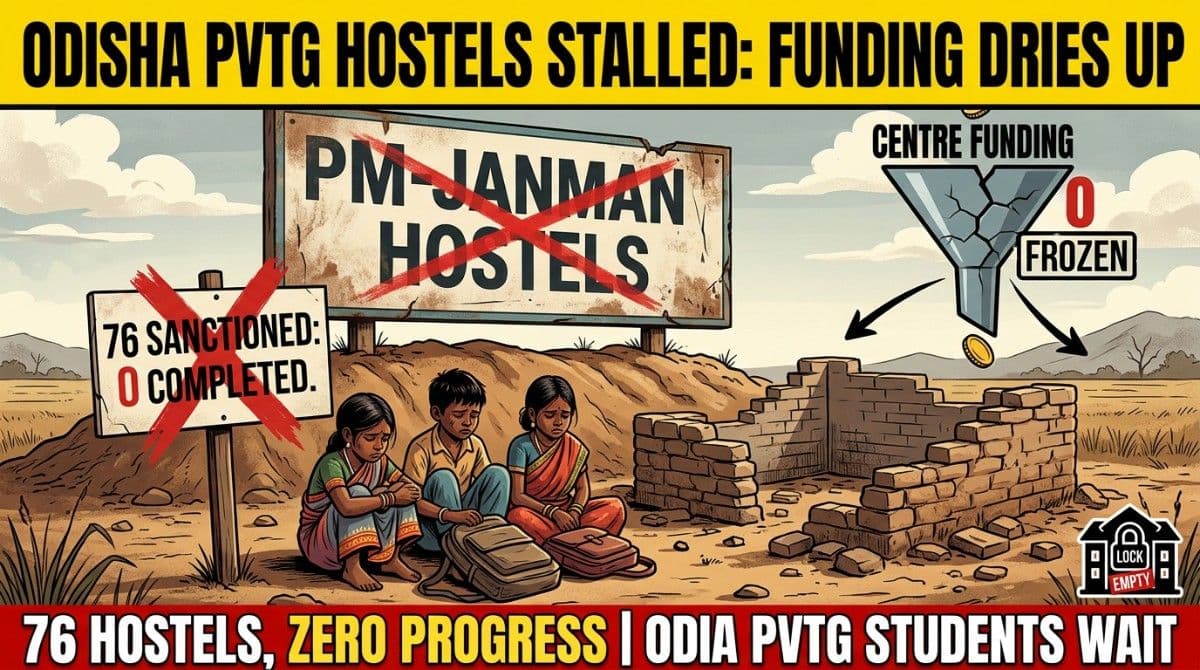
- 76 PM-JANMAN hostels worth ₹204.05 crore sanctioned for Odisha, but zero completed.
- No central funds released for the scheme during FY 2024-25 and FY 2025-26.
- Centre pivots to newer schemes, approving 132 additional tribal hostels through DAJGUA and the Ministry of Education.
Bhubaneswar: The Centre's flagship mission to bring Odisha's Particularly Vulnerable Tribal Groups (PVTGs) into the formal education system through residential hostels has virtually ground to a halt in the state.
Nearly three years after 76 hostels were sanctioned under the Pradhan Mantri Janjati Adivasi Nyaya Maha Abhiyan (PM-JANMAN) with a project cost of Rs204.05 crore, not a single hostel has been completed, according to the Union Ministry of Tribal Affairs reply to a question in Lok Sabha. The implementation deadlock has become even more glaring as no central funds were released during FY 2024-25 and FY 2025-26 for the hostel component.
The data, placed before the Lok Sabha on July 23, 2026 by Minister of State for Tribal Affairs Durgadas Uikey, exposes one of the biggest implementation bottlenecks in Odisha's tribal education infrastructure, particularly for the state's 13 PVTG communities.
Flagship Mission Stalled at Ground Zero

📱 Get Argus News App
✨The PM-JANMAN hostel initiative is among the most targeted interventions under the Centre's Rs24,104-crore tribal mission. It seeks to construct 500 specialised hostels across India exclusively for children belonging to Particularly Vulnerable Tribal Groups, who often live in remote forested habitations with poor access to schools.
Odisha received one of the largest allocations under the programme.
The state was sanctioned 76 hostels with a total approved cost of Rs204.05 crore, including a Central share of Rs122.43 crore. Yet parliamentary records show the physical progress remains at zero, making Odisha one of the clearest examples where sanction has failed to translate into infrastructure.
Funding Pipeline Frozen
The more striking revelation is that the Centre released no money for these hostels during the last two financial years.
The absence of fresh releases does not necessarily indicate a shortage of central funds. Instead, it points towards the operation of the Union government's financial safeguards governing Centrally Sponsored Schemes.
Under the Single Nodal Agency (SNA)-SPARSH framework, fresh instalments are automatically withheld if states fail to satisfy prescribed financial milestones. These include utilisation of earlier releases, submission of Utilisation Certificates (UCs), and depositing the mandatory state share in designated accounts.
Once these conditions remain unmet, subsequent releases are blocked, creating a funding freeze regardless of budget availability.
Why the Scheme Hit a Wall
Officials familiar with tribal infrastructure projects say the hostel programme encountered multiple structural hurdles before construction could gather momentum.
Unlike conventional infrastructure projects, PM-JANMAN hostels are planned in extremely remote PVTG habitations where obtaining suitable land, securing forest clearances, transporting construction material and attracting contractors are considerably more difficult.
Many proposed hostel locations fall inside isolated tribal pockets with poor connectivity, making execution slower and more expensive than ordinary public works.
As implementation lagged, the financial cycle tightened. Delayed physical progress affected utilisation, which in turn restricted fresh releases, further slowing construction.
The result was a self-reinforcing administrative bottleneck where slow execution and funding delays fed into each other.
The Worst Hit Are Odisha's Most Vulnerable Tribes
The stalled hostels were never intended as generic student accommodation.
They were designed specifically for Odisha's 13 Particularly Vulnerable Tribal Groups, communities with extremely low literacy levels, dispersed settlements and difficult geographical access.
The sanctioned hostels were planned across PVTG micro-project areas covering districts such as Kalahandi, Rayagada, Kandhamal, Keonjhar, Mayurbhanj, Malkangiri, Nuapada and Angul, among others.
The facilities were expected to benefit children from communities including the Bondo, Dongria Kondh, Kutia Kondh, Juang, Paudi Bhuyan, Chuktia Bhunjia, Hill Kharia and Lanjia Saura by enabling uninterrupted schooling near their habitations.
For these communities, residential hostels are often the only practical bridge between remote villages and formal education.
Execution Failure, Not Policy Abandonment
The parliamentary data does not suggest that either the Centre or the state has abandoned tribal education.
Instead, it reflects a significant implementation failure within one specific programme.
Interestingly, while PM-JANMAN hostels remain stalled, the Centre has simultaneously expanded tribal educational infrastructure through newer schemes.
A total of 132 additional hostels have now been approved for Odisha outside the PM-JANMAN pipeline.
Of these, 92 hostels have been sanctioned under the Dharti Aaba Janjatiya Gram Utkarsh Abhiyan (DAJGUA), while another 40 hostels have been approved through the Ministry of Education.
The approvals indicate that the policy objective of expanding tribal residential education remains intact even though one implementation channel has faltered.
A Shift Towards a New Delivery Model
The emergence of DAJGUA appears to represent more than just an expansion of hostel numbers.
It reflects a broader shift towards an integrated, multi-ministerial implementation framework designed to overcome some of the execution challenges encountered under earlier programmes.
Rather than depending solely on the stalled PM-JANMAN hostel pipeline, the Centre is increasingly routing tribal infrastructure through converged schemes that combine multiple departments and interventions.
Districts with large tribal populations are already seeing fresh infrastructure approvals under this newer framework.
Questions Over Future of PM-JANMAN Hostels
Despite the new approvals, uncertainty remains over the fate of the original 76 PM-JANMAN hostels.
Parliamentary records do not indicate whether these projects will be revived, relocated, merged with newer schemes or implemented independently after procedural hurdles are resolved.
Until construction begins, thousands of children from Odisha's most vulnerable tribal communities continue to wait for residential educational facilities that were promised under one of the country's most ambitious tribal welfare missions.
The latest
data therefore presents a paradox. While tribal education infrastructure is
expanding on paper through new programmes, the original flagship hostel scheme
meant exclusively for PVTGs has yet to deliver a single completed hostel in
Odisha.
Also Read: How PM Modi's Vaccination Drive Cut Odisha FMD to 6.5% But It Is No 'Cow Comforting' | Special Report
Related Topics
Explore more stories