



PLFS April-June 2026: Odisha Has More People in Workforce Than India, But Youth Jobs Remain the Big Concern | Exclusive
Key Points
Bhubaneswar: Odisha’s labour market presents a striking paradox in the latest Periodic Labour Force Survey (PLFS) Quarterly Bulletin for April-June 2026: more people are participating in the workforce than the national average, but a significant share of young people who want work are still unable to find it.
The latest Current Weekly Status (CWS) estimates show Odisha’s labour force participation rate (LFPR) for people aged 15 years and above at 55.7%, higher than the all-India figure of 54.6%. Its worker population ratio (WFPR) is also stronger at 52.8% against 51.7% nationally.
But the picture changes sharply when the focus shifts to the young.
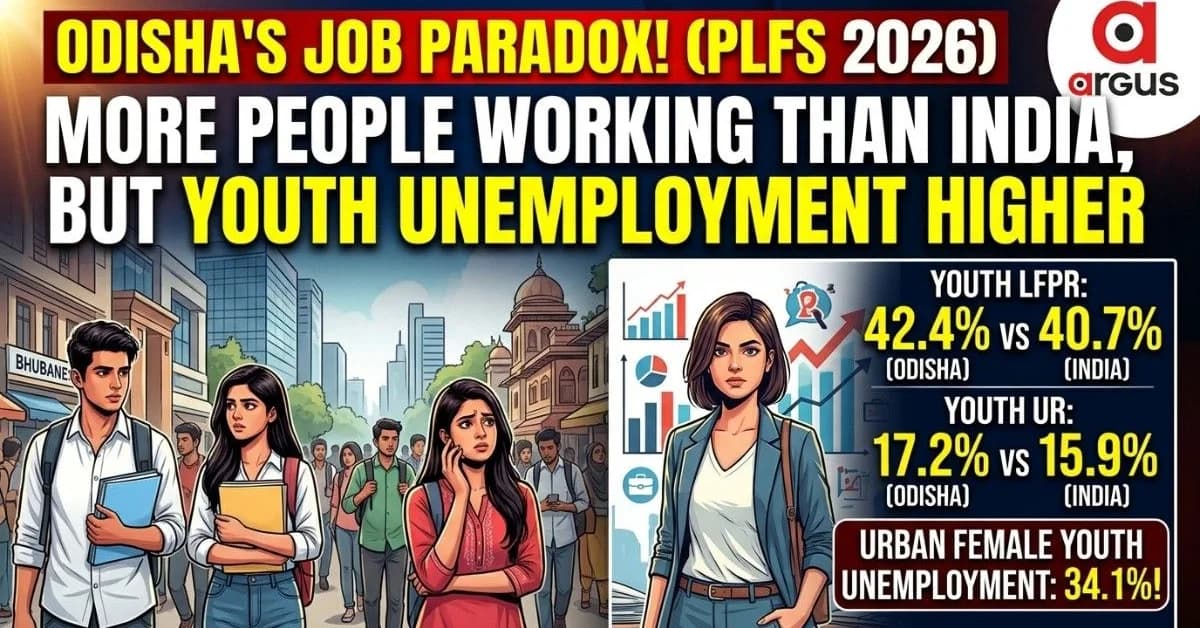
Odisha’s youth unemployment rate for the 15-29 age group is 17.2%, above the national rate of 15.9%. Among its immediate neighbours, only Chhattisgarh fares worse, with youth unemployment at 26.3%.

📱 Get Argus News App
✨That makes the latest PLFS numbers less a story of a weak labour market and more a story of a labour market struggling to convert participation into suitable jobs for its younger population.
Odisha beats India on workforce participation
The broad labour indicators initially paint a relatively positive picture.
Odisha’s 15+ LFPR of 55.7% is 1.1 percentage points above the national average. Its 15+ WFPR of 52.8% is also 1.1 percentage points higher than India’s 51.7%.
The state also performs better than the national benchmark among young people.
|
Indicator |
Odisha
India
Youth LFPR, 15-29 years
42.4%
40.7%
Youth WFPR, 15-29 years
35.1%
34.3%
15+ LFPR
55.7%
54.6%
15+ WFPR
52.8%
51.7%
Youth UR, 15-29 years
17.2%
15.9%
15+ UR
5.2%
5.4%
The combination is important.
Odisha has a larger proportion of its population participating in the labour market, and a slightly larger proportion actually working, compared with India as a whole.
Yet unemployment among those aged 15-29 remains higher.
In simple terms, Odisha’s problem is not that young people are staying completely outside the labour market. It is that many of those entering it are finding the transition from education or inactivity to employment difficult.
Odisha versus its neighbours: the middle ground
The regional comparison makes the picture sharper.
West Bengal records the highest youth LFPR among the five neighbouring states considered, at 43.0%, followed closely by Odisha at 42.4%. Chhattisgarh is at 42.0%, Jharkhand at 33.2% and Bihar at just 29.0%.
But youth unemployment tells a different story.
|
State |
Youth LFPR |
Youth WFPR |
Youth UR |
|
Chhattisgarh |
42.0% |
30.9% |
26.3% |
|
Odisha |
42.4% |
35.1% |
17.2% |
|
Jharkhand |
33.2% |
28.7% |
13.4% |
|
West Bengal |
43.0% |
37.9% |
12.0% |
|
Bihar |
29.0% |
24.8% |
14.4% |
|
India |
40.7% |
34.3% |
15.9% |
Odisha therefore sits in an unusual middle position.
Its youth participation is relatively strong and its youth WFPR is higher than the national average, but its youth unemployment rate is also above the national level.
The state has more young people entering the labour market than several neighbours, but the economy is not absorbing all of them fast enough.
The real fault line: young women in urban Odisha
The gender and location break-up reveals an even sharper problem.
For Odisha’s youth, male unemployment stands at 17.2%, compared with 17.5% among females.
But the rural-urban divide is stark.
Youth male unemployment is 16.1% in rural areas, rising to 23.2% in urban areas.
For young women, the gap is dramatically wider: unemployment is 14.4% in rural Odisha but 34.1% in urban areas.
That means roughly one in three young women in the urban youth labour force is unemployed, according to the CWS estimates.
This is arguably one of the most important signals emerging from the latest PLFS data.
The problem is therefore not simply “youth unemployment”. It is increasingly about how urban Odisha is creating jobs that match the skills, aspirations and mobility of its young population, particularly women.
The numbers suggest a potential mismatch between rising educational and labour-market aspirations and the availability of accessible, suitable employment.
Odisha's labour economy still runs on agriculture
The sectoral composition of employment provides another piece of the puzzle.
At the state level, agriculture remains Odisha’s single largest source of employment, accounting for 38.5% of employed persons aged 15 years and above.
The secondary sector accounts for 32.4%, while services account for 29.1%.
This is significant because Odisha has built a substantial industrial base around mining, metals, manufacturing, construction and allied activities. Yet agriculture continues to absorb the largest share of the state's workforce.
The rural-urban contrast is far more revealing.
Rural Odisha
In rural areas, agriculture employs 44.6% of workers.
The gender difference is striking:
- 62.7% of rural female workers are engaged in agriculture.
- Among rural males, agriculture accounts for 34.3%.
- The secondary sector is the largest employment category for rural men at 39.8%.
- Services account for only 15.3% of rural female employment.
The figures underline how heavily rural women remain dependent on agriculture for employment.
Urban Odisha
Urban Odisha is almost the mirror image.
Only 4.4% of urban workers are employed in agriculture.
The services sector dominates urban employment, accounting for a massive 68.7% of urban jobs.
It is even higher among women: 71.4% of urban female workers are in services, compared with 67.8% of urban males.
The secondary sector contributes 26.9% of urban employment.
This creates a clear structural divide:
Rural Odisha remains agriculture-led; urban Odisha is overwhelmingly services-led.
What the numbers say about Odisha's job challenge
Taken together, the PLFS indicators point to three different labour markets operating within Odisha.
First, there is the rural labour market, where agriculture remains the principal employer, particularly for women.
Second, there is the industrial and construction-linked labour market, which absorbs a substantial share of male workers, particularly in rural and semi-urban areas.
Third, there is the urban services economy, which dominates city employment but is simultaneously producing a significant unemployment challenge among young entrants, especially women.
This may explain why Odisha can record a 15+ unemployment rate of only 5.2%—slightly below India’s 5.4%—while youth unemployment remains elevated at 17.2%.
Once workers cross into the broader adult workforce, the unemployment problem eases considerably.
The sharper challenge is at the entry point into the labour market.
The bigger policy question: where will Odisha's next generation work?
The PLFS numbers come at a critical point for Odisha.
The state is pursuing an industrialisation strategy built around manufacturing, metals, mining, downstream industries, logistics, semiconductors, textiles and services. But the labour data suggests that economic growth alone may not automatically resolve the youth employment problem.
The crucial question is whether the new investment cycle can generate large volumes of jobs suitable for first-time workers, rather than predominantly capital-intensive output.
The urban female unemployment figure makes the question even more urgent.
If urban female youth unemployment is at 34.1%, then expanding the female workforce will require more than simply creating jobs. It will also require attention to skills, workplace accessibility, transport, safety, flexible employment, childcare and the location of jobs relative to residential areas.
At the same time, the continued dominance of agriculture in rural employment indicates that Odisha’s employment transition is incomplete.
The state is therefore facing a two-sided challenge: move workers from low-productivity agricultural employment towards better-paying non-farm jobs, while creating enough new urban and industrial employment to absorb young entrants.
Odisha's PLFS paradox in one line
The April-June 2026 PLFS does not portray Odisha as a state suffering from a broad-based employment collapse.
Instead, it reveals something more nuanced.
Odisha has a more active workforce than India overall, a slightly lower overall unemployment rate, and a stronger youth workforce participation rate but it still has a serious youth job-absorption problem.
And beneath that state-wide number lies an even sharper fault line:
urban young women face the greatest employment friction, while rural women remain disproportionately concentrated in agriculture.
That makes Odisha’s next employment challenge less about simply increasing the number of jobs and more about creating the right jobs, in the right places, for the right demographic.
The latest
PLFS data, therefore, offers both a positive signal and a warning: Odisha’s
workforce is ready to participate. The bigger question is whether the state
economy can create enough productive employment to meet that readiness.
Also Read: Odisha Employment / SBI Research Report: Odisha Emerges as High-Quality Employment Hub, but Wage Gaps Persist
Related Topics
Explore more stories