



Odisha Employment / SBI Research Report: Odisha Emerges as High-Quality Employment Hub, but Wage Gaps Persist

Key Points
Bhubaneswar:
A new comprehensive analysis of the Periodic Labour Force Survey (PLFS) 2025
unit-level data by SBI Research has positioned Odisha as a leading state in
employment quality, even as it continues to grapple with significant challenges
in minimum wage compliance for casual workers.
The SBI Research has documented this study result using PLFS 2025 Annual Report and developing a Work Quality Index to arrive at such inferences.
A Leader in Employment Quality
The report identifies Odisha as part of an elite group of states—including Karnataka and Tamil Nadu—that demonstrate a dual success: high Labour Force Participation Rates (LFPR) coupled with a high Work Quality Index (WQI). The WQI measures employment protection through three critical indicators:
· Presence of a written job contract.

📱 Get Argus News App
✨· Eligibility for paid leave.
· Provision of social security benefits.
While states like Uttar Pradesh, Bihar, and Punjab struggle with both low participation and low worker quality, Odisha’s labour market shows stronger "absorption capacity" and better job security for those in the workforce.
The Minimum Wage Challenge
Despite these gains in formal job quality, the story for Odisha's casual workforce remains starkly different. The state ranks among the bottom three in India regarding statutory minimum wage compliance.
Odisha’s Violation Rate: Approximately 66% of casual workers in the state earn below the statutory minimum wage.
Regional Comparison: This puts Odisha in the same bracket as Chhattisgarh (70%) and Jharkhand (65%), highlighting a persistent "poverty trap" for casual laborers in the eastern belt.
In contrast, the national average for minimum wage non-compliance stands at approximately 25%.
Informality and Regional Standing
While Odisha is a leader in quality for some, informality remains the dominant structure of its economy, a trait it shares with most Indian states.
Informality
Rate: In Odisha, the share of informal workers stands at 70%. 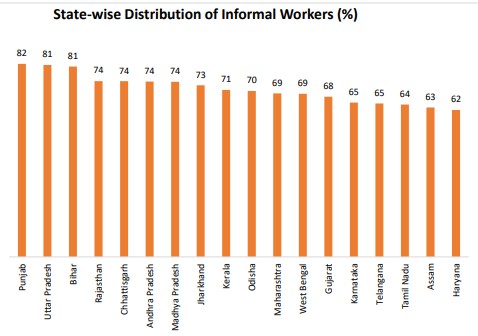
National Context: While high, this is notably better than northern states like Punjab (82%), Uttar Pradesh (81%), and Bihar (81%).
Sectoral Drivers: The report notes that agriculture remains the largest source of this informal employment (42% nationally), followed by trade and hotels.
Pathways Forward: The "Training" Effect
The research offers a clear policy roadmap for all states, includning Odisha to bridge its wage and quality gaps. The study using unit-level data proves that formal training is a powerful tool for economic mobility:
De-informalization: Any form of training is associated with a 4.8% reduction in the probability of being informally employed.
Women’s Empowerment: Specifically for women, government-funded training leads to a 5.8% rise in the probability of successful self-employment.
As Odisha
continues to outperform larger states in labour participation and job security
indices, the SBI Research findings suggest that the next frontier for the state
must be the strict implementation of the Minimum Wages Act to protect its most
vulnerable casual labourers.
Also Read: Projects worth Rs 1,04,041 cr in operation: Odisha 2nd After Gujarat in country in 2025
Related Topics
Explore more stories