



Paradip–Haridaspur Doubling: Modi CCEA Fast-Tracks Odisha’s ‘Steel Hub of India’ Ambition| Special Report
Key Points
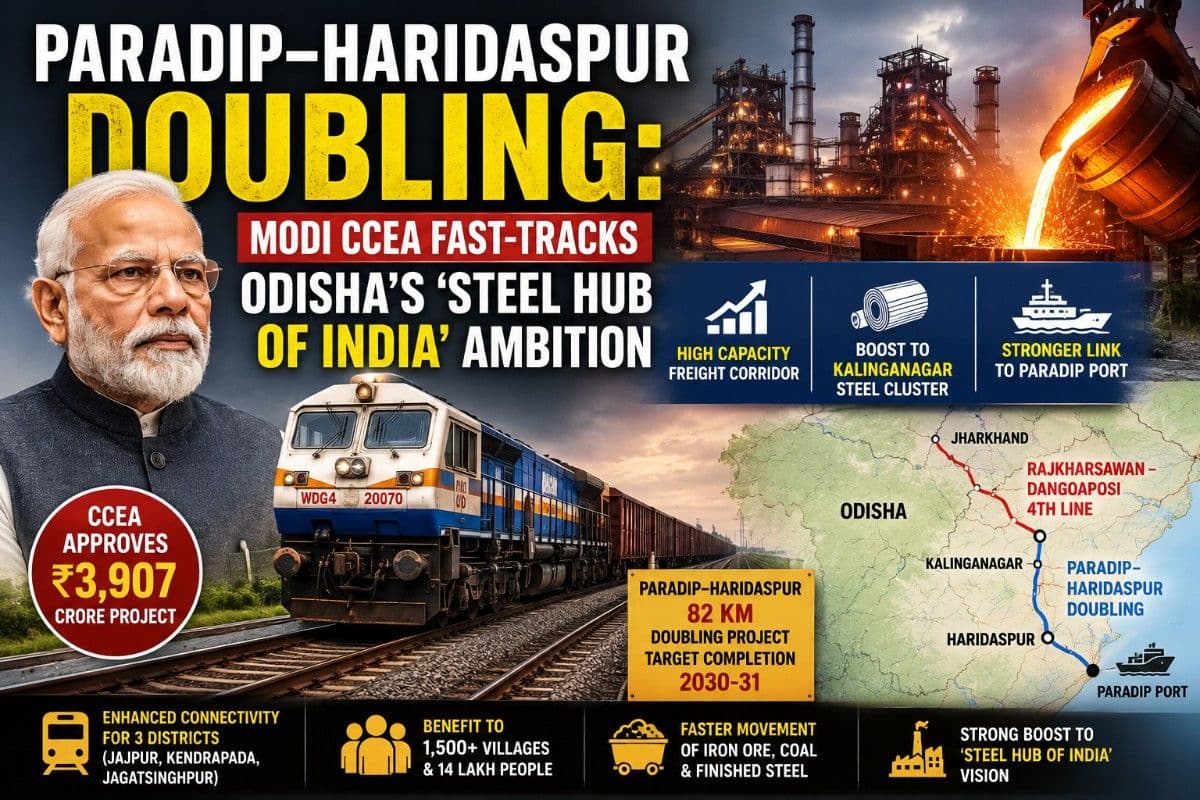
Capacity Surge: The Paradip–Haridaspur doubling will handle an additional 44 million tonnes of freight annually, eliminating bottlenecks for Kalinganagar’s steel clusters.
Strategic Sync: The project is timed for completion by 2030–31, directly supporting Odisha’s goal to contribute 100 MT to India’s National Steel Policy target.
Integrated Logistics: Combined with the Rajkharsawan–Dangoaposi 4th line, these projects create a seamless supply chain from mineral-rich mines to international ports.
Bhubaneswar: Odisha’s journey towards emerging as the ‘Steel Hub of India’ received a decisive infrastructure push on Wednesday after the Cabinet Committee on Economic Affairs (CCEA), chaired by Prime Minister Narendra Modi, approved the doubling of the 82-km Paradip–Haridaspur railway line, a project that industry experts describe as the missing logistics link in the state's steel expansion roadmap.
While the CCEA cleared two railway capacity augmentation projects worth around Rs3,907 crore – the Paradip–Haridaspur Doubling in Odisha and the Rajkharsawan–Dangoaposi Fourth Line spanning Odisha and Jharkhand –the strategic significance of the Paradip–Haridaspur project extends far beyond adding another railway track. It directly strengthens the logistics backbone required for Odisha to achieve its long-standing ambition of contributing 100 million tonnes (MT) of steel production towards India's 300 MT target under the National Steel Policy, 2017, by 2030-31.
The approval also marks another milestone in a project that had spent more than two decades battling delays before being revived under the Modi government.
A Rail Corridor at the Heart of Odisha's Steel Ambition

📱 Get Argus News App
✨At the centre of Odisha's steel strategy lies Kalinganagar, the state's largest steel manufacturing cluster.
Home to around 15 steel plants, the industrial region houses public sector units like NINL and private steel majors including Tata Steel, Jindal Stainless Limited, Visa Steel and MESCO. Together, these industries form the nucleus of Odisha's ambition to become India's steel capital.
Recognising Odisha's mineral wealth, the Union Government had, in 2018, projected that the state alone could produce 100 MT of steel by 2030-31, contributing one-third of India's National Steel Policy target.
However, industrial expansion required logistics to keep pace.
That is where the Paradip–Haridaspur railway corridor assumes strategic importance.
Originally sanctioned in 1996-97, the railway line remained trapped in land acquisition, funding and environmental hurdles for over two decades before gaining momentum after Prime Minister Narendra Modi reviewed the project under the PRAGATI monitoring mechanism in 2018.
The freight corridor was finally commissioned in 2020, connecting mineral-rich Jajpur district and the Kalinganagar industrial belt with Paradip Port, India's eastern gateway for steel exports and coking coal imports.
Barely five years later, the Centre concluded that the single-line corridor had begun facing capacity constraints because of rapidly expanding steel production and increasing freight movement.
Wednesday's CCEA approval for doubling the line seeks to remove that bottleneck.
The project has now been targeted for completion by 2030-31, synchronising with Odisha's steel production roadmap.
Why Paradip–Haridaspur Doubling Matters
The importance of the doubling project is not geographical – it is operational.
The existing single line already connects Jajpur, Kendrapada and Jagatsinghpur districts. But a single-track railway can handle only limited train movements because freight trains travelling in opposite directions must wait at crossing stations, creating delays across the network.
The second line transforms the corridor into a high-capacity freight artery capable of simultaneous two-way movement.
Railway planners estimate that the doubled corridor will handle an additional 44 million tonnes of freight annually, significantly improving evacuation of iron ore, finished steel, coal and imported coking coal between Kalinganagar and Paradip Port.
For steel manufacturers operating on tight production schedules, this means reduced wagon detention, faster turnaround time, lower logistics costs and greater supply-chain reliability.
Equally important, the project provides operational flexibility for Indian Railways to increase passenger services, as freight movement will no longer choke the single-track corridor.
The upgraded railway line, along with the Jharkhand 4th line, will continue serving over 1,500 villages across Jajpur, Kendrapada and Jagatsinghpur, benefiting nearly 14 lakh people through improved passenger connectivity while also strengthening access to tourism and religious destinations in the region.
In effect, the project shifts the corridor from merely providing connectivity to becoming a high-capacity industrial logistics network.
Rajkharsawan–Dangoaposi Fourth Line: Strengthening the Mineral Supply Chain
The second railway project approved by the CCEA – the Rajkharsawan–Dangoaposi Fourth Line – may lie largely in the mineral belt of Jharkhand, but its economic impact will spill over into Odisha's steel ecosystem.
The corridor passes through one of eastern India's richest iron ore producing regions and forms a critical railway route for transporting ore from mines in West Singhbhum towards steel plants in Odisha and beyond.
With the addition of a fourth railway line, freight congestion is expected to ease substantially, enabling faster movement of iron ore to major steel manufacturing centres, including Kalinganagar.
The project will also improve evacuation of raw materials from mining areas while facilitating smoother movement of finished steel towards ports and consumption centres.
Together with the Paradip–Haridaspur doubling, the fourth line creates an integrated logistics chain – from iron ore mines to steel plants and finally to export gateways – supporting Odisha's ambition of emerging as the country's premier steel manufacturing hub.
Bottomline
Since 2018, when the Modi government revived the long-delayed Paradip–Haridaspur railway project while simultaneously aligning infrastructure planning with the National Steel Policy and the PM Gati Shakti framework, Odisha's steel roadmap has steadily gathered momentum.
The commissioning of the freight corridor in 2020, the decision to double it in 2026, and the parallel expansion of the Rajkharsawan–Dangoaposi mineral corridor together demonstrate a coordinated strategy: remove logistics bottlenecks before production capacity peaks.
With rail
connectivity, port access and mineral transportation now being strengthened
simultaneously, the Centre has put in place some of the most critical
infrastructure boosters required for Odisha to translate its vast mineral
wealth into the long-envisioned goal of becoming the 'Steel Hub of India.'
Also Read: Odisha Bets Big on Agri-Entrepreneurship: Cabinet Extends MKUY Till 2031 with ₹2,496-Crore Outlay, Targets 8,500 New Rural Enterprises | Special Report
Related Topics
Explore more stories