



Odisha Bets Big on Agri-Entrepreneurship: Cabinet Extends MKUY Till 2031 with ₹2,496-Crore Outlay, Targets 8,500 New Rural Enterprises | Special Report
Key Points
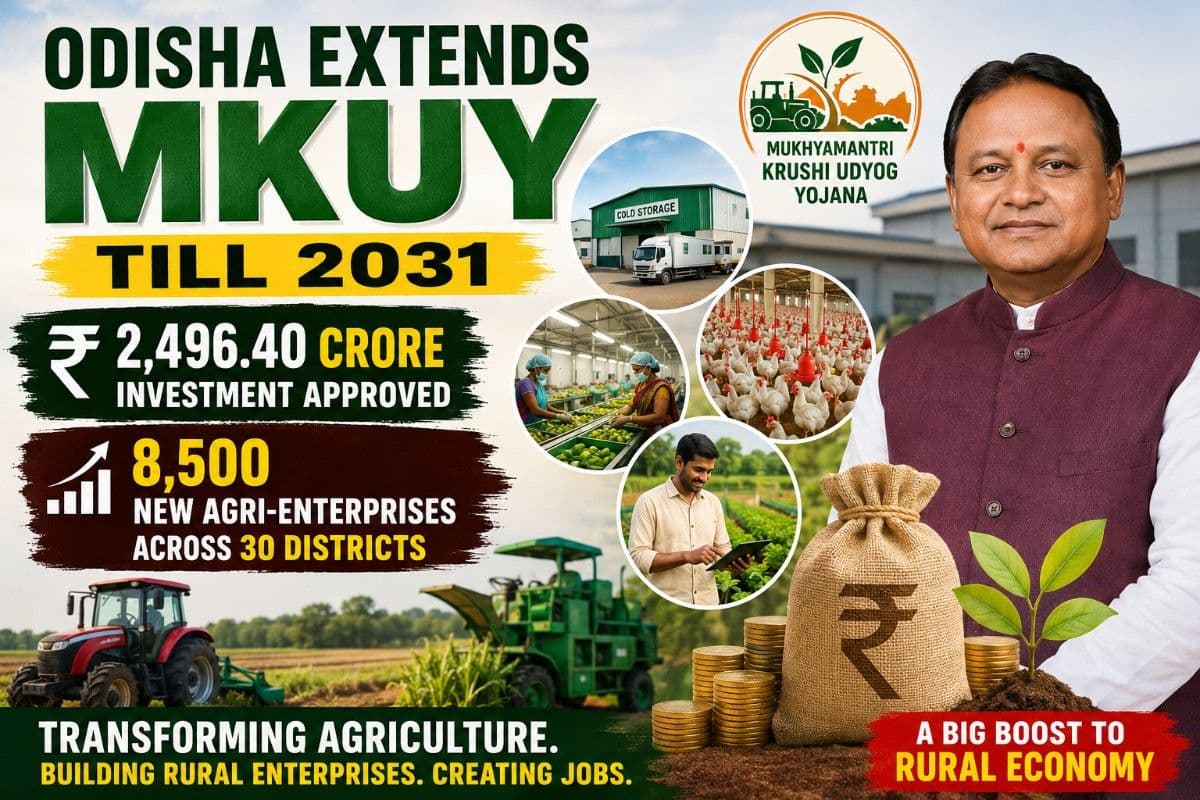
Bhubaneswar: In a significant policy decision aimed at accelerating the transformation of Odisha's farm economy, the State Cabinet on Tuesday approved the continuation of the Mukhyamantri Krushi Udyog Yojana (MKUY) for another five years, extending the flagship agri-entrepreneurship scheme from 2026-27 to 2030-31.
Backed by a financial outlay of Rs2,496.40 crore, the government plans to facilitate the establishment of around 8,500 new commercial agri-enterprise projects across all 30 districts during the extended period.
The decision signals the Mohan Charan Majhi government's intent to shift Odisha's agriculture from conventional cultivation towards value-added processing, commercial farming, rural enterprises and agri-industrialisation – a strategy expected to generate employment, increase farmers' incomes and reduce migration from rural areas.
A Shift from Farming to Farm Business

📱 Get Argus News App
✨Unlike traditional subsidy-driven agriculture schemes, MKUY is designed around a different philosophy – encouraging farmers and entrepreneurs to treat agriculture as a business rather than merely an occupation.
Launched in 2018, the scheme provides Capital Investment Subsidy (CIS) to individuals, Farmer Producer Organisations (FPOs), Self-Help Groups (SHGs), cooperatives and agri-graduates for establishing commercial ventures across agriculture and allied sectors.
The latest extension indicates that the government sees agri-entrepreneurship as a key pillar of Odisha's rural economic strategy over the next five years.
Rs2,496 Crore Investment: One of Odisha's Largest Agri-Enterprise Pushes
The approved allocation translates into an average annual investment of nearly Rs500 crore.
The objective is not merely increasing farm production but building an ecosystem comprising:
- Food processing units
- Seed processing centres
- Cold storages
- Dairy enterprises
- Fisheries projects
- Poultry farms
- Agro-service centres
- Farm mechanisation hubs
- Horticulture ventures
- Aquaculture infrastructure
Officials believe such investments will help retain value addition within Odisha instead of exporting raw agricultural produce.
Targeting 8,500 New Projects Across Odisha
The Cabinet has fixed an ambitious target of 8,500 new commercial agri-enterprises during the next five years.
This translates into roughly:
- Around 1,700 projects annually
- Nearly 57 projects per district every year, though actual distribution will depend on demand and local agricultural potential.
The expansion is expected to create a broad rural entrepreneurship ecosystem extending beyond traditional farming households.
Building on the Momentum of Recent Years
Although the government has not released a consolidated cumulative figure for projects approved between 2018 and 2023, available official data indicate that the scheme has gathered considerable momentum in recent years.
During 2024-25 alone, more than 3,400 projects received approvals across agriculture and allied sectors.
Additionally, the government has already disbursed nearly Rs188.34 crore as Capital Investment Subsidy for 1,431 completed projects, indicating that the scheme has moved beyond approvals to actual asset creation.
The programme now supports nearly 117 categories of agricultural enterprises, making it one of Odisha's most diversified rural investment schemes.
Why MKUY Has Become Popular
Several structural reforms have strengthened the scheme since its launch.
The government has progressively:
- Simplified applications through the Go-Sugam portal
- Introduced district-level nodal officers
- Expanded eligible sectors
- Increased subsidy ceilings
- Relaxed land-related documentation in several cases
- Extended benefits to women, SC/ST entrepreneurs, agri-graduates, Persons with Disabilities and transgender entrepreneurs.
Depending on beneficiary categories, subsidy support can range between 40% and 50%, with assistance extending up to Rs1 crore for eligible large projects.
For first-generation rural entrepreneurs, this substantially lowers the financial barrier to establishing commercial enterprises.
Ease of Doing Agri-Business
MKUY has gradually evolved into Odisha's flagship programme for promoting "Ease of Doing Agri-Business."
Unlike earlier subsidy models that often involved lengthy paperwork, the present framework emphasizes:
- Online application
- Time-bound approvals
- Digital tracking
- Departmental convergence
- District-level mentoring
This institutional support has become as important as financial assistance in encouraging rural entrepreneurship.
Employment Beyond Farming
The scheme is also expected to contribute to rural employment generation.
Every commercial agri-enterprise typically creates direct and indirect jobs in:
- Processing
- Packaging
- Transportation
- Cold-chain logistics
- Machinery operation
- Marketing
- Veterinary services
- Input supply
Economists believe that such enterprises create stronger rural multiplier effects than conventional farm subsidies because they generate year-round economic activity.
Connecting Agriculture with Industry
One of MKUY's biggest strengths lies in encouraging farmers to move up the agricultural value chain.
Instead of selling raw produce immediately after harvest, entrepreneurs are incentivised to process, store or package products locally.
This value addition can improve farm profitability while reducing post-harvest losses.
The policy also complements Odisha's growing investments in:
- Cold storage infrastructure
- Farmer Producer Organisations (FPOs)
- Food processing
- Integrated supply chains
As of March 2026, Odisha has nearly 1,791 active Farmer Producer Organisations with close to nine lakh farmer members, providing an institutional foundation for future agri-enterprises.
What Could Strengthen MKUY Further?
Agricultural experts suggest that the next phase of the scheme could become even more impactful by incorporating additional support beyond capital subsidies.
Priority areas include:
- Dedicated marketing platforms for rural enterprises
- Stronger cold-chain logistics
- Export linkages
- Industry mentorship programmes
- Business management training
- Financial literacy support
- Higher subsidy ceilings for capital-intensive projects
- Greater outreach in remote tribal districts
Such interventions could improve enterprise survival rates and ensure that investments translate into sustainable businesses.
Bigger Rural Transformation Strategy
The Cabinet's decision reflects a broader shift in Odisha's development strategy – from supporting agriculture as a livelihood to positioning it as a competitive economic sector.
With Rs2,496 crore committed over five years and a target of 8,500 new enterprises, the government is attempting to build an integrated rural economy where cultivation, processing, storage, logistics and marketing function as interconnected components.
If
implementation keeps pace with approvals and market linkages improve alongside
infrastructure creation, the extended MKUY could emerge as one of Odisha's most
consequential rural economic programmes of the decade, potentially reshaping
how agriculture contributes to the state's growth story.
Also Read: Roads to 2027? Ahead of Panchayat Polls, Mohan Majhi Cabinet Unveils ₹12,450-Crore Rural Connectivity Push Across Odisha
Related Topics
Explore more stories