



Odisha's Subhadra Yojana Emerges India's Most Progressive Rolling Women DBT Model; Nears 90% Saturation After 3.17 Lakh Fresh Applications | Exclusive
Key Points
* Continuous Expansion Model: Operates as a dynamic, rolling DBT framework that allows women to apply immediately upon turning 21 or after resolving bank-mismatch backlogs.
* Massive Fiscal Footprint: Spans a database of over 1.07 crore women, capturing up to 90% of the target demographic while utilizing nearly 5% of Odisha's total revenue expenditure.
Bhubaneswar: In 2019, Naveen Patnaik's BJD scripted another electoral triumph riding on the popularity of welfare programmes like KALIA and Balaram, proving that well-designed direct support schemes could decisively influence political outcomes.
Five years later, the BJP crafted its own political answer.
That answer was Subhadra Yojana.
Launched after the BJP formed the government in Odisha in 2024, the women-centric Direct Benefit Transfer (DBT) programme has now evolved far beyond an election promise. As the scheme entering its third year, fresh official data indicates that Subhadra has quietly transformed into one of India's most dynamic and flexible welfare architectures.

📱 Get Argus News App
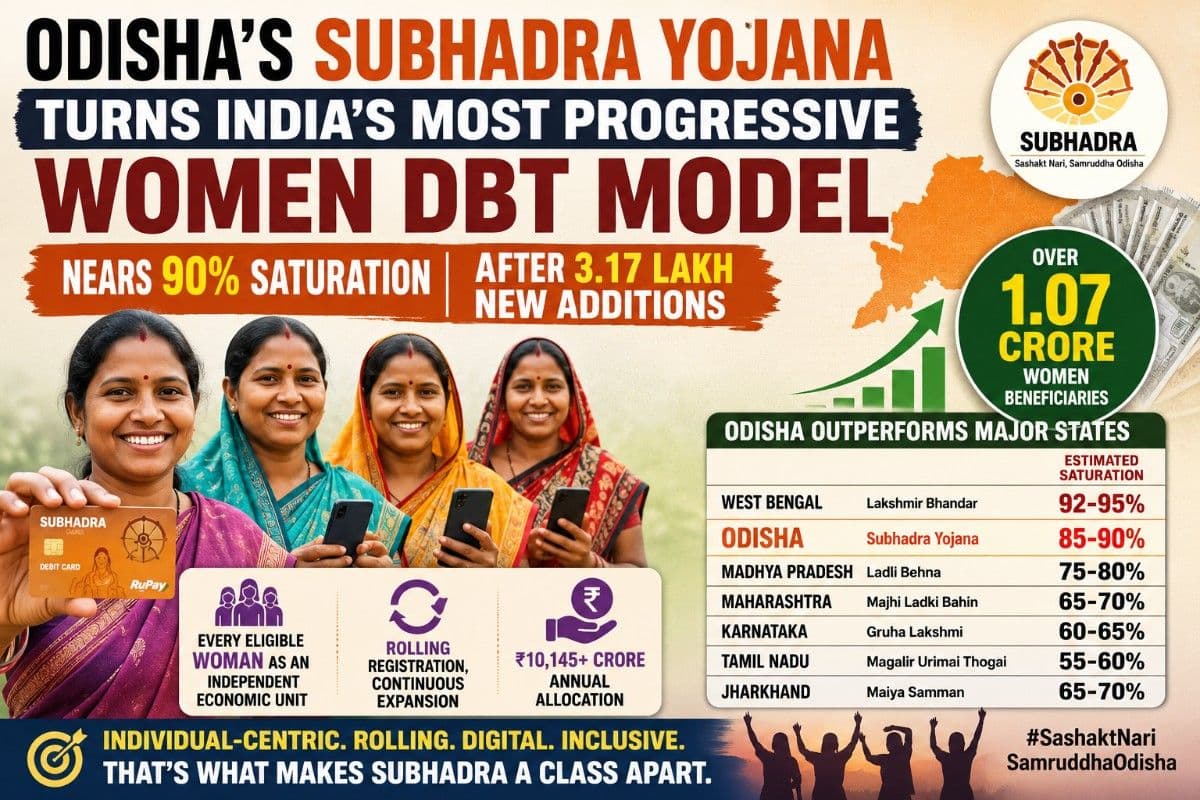
✨With 3,17,966 fresh applications now under verification, taking the beneficiary base well beyond 1.07 crore women, Odisha has achieved an estimated 85-90 per cent saturation of its intended beneficiary universe, making Subhadra one of the country's most successful targeted women-centric cash transfer programmes.
More importantly, policy analysts increasingly view it as the natural extension of Prime Minister Narendra Modi's vision of "Beti Bachao, Beti Padhao" – not merely protecting and educating girls, but providing them independent financial support throughout their productive years.
From Girl Child to Financial Independence
Most flagship women schemes across India focus on one stage of a woman's life – education, marriage assistance, maternity benefits or household welfare.
Subhadra breaks that template.
Instead of treating women as beneficiaries through the household, Odisha treats every eligible woman between 21 and 60 years as an independent economic unit.
This seemingly small policy decision has fundamentally altered the architecture of welfare delivery.
A mother, daughter-in-law, unmarried daughter and sister-in-law living under the same roof can all become beneficiaries simultaneously if they satisfy the eligibility norms.
Few major state schemes provide this level of individual financial recognition.
In many states, welfare stops at "one woman per household."
Odisha recognises every eligible woman.
That makes Subhadra not merely a welfare programme but a financial inclusion programme.
Why Subhadra Keeps Growing
Unlike most flagship welfare schemes that stop registrations after the initial launch, Subhadra functions as a rolling DBT framework.
Its architecture allows continuous expansion because:
- There is no permanent application closure.
- Every woman entering the 21-year eligibility bracket can apply.
- Previously rejected applications can be reconsidered after correcting Aadhaar, NPCI or bank-related issues.
- Continuous field verification keeps adding genuine beneficiaries.
Deputy Chief Minister Pravati Parida's announcement of 3,17,966 fresh applications illustrates this distinctive feature.
Rather than freezing its database, Odisha keeps refining and expanding it.
Few large-scale DBT programmes in India operate with such flexibility.
The Numbers Tell the Story
When launched in September 2024, nearly 25 lakh women received the first instalment.
Today:
- Beneficiaries have crossed 1.07 crore
- Annual allocation has increased to over Rs10,145 crore
- The scheme now accounts for nearly 5 per cent of Odisha's revenue expenditure
- Estimated saturation has reached 85-90 per cent of the intended economically eligible women aged 21-60.
This is among the highest coverage levels achieved by any economically filtered women welfare programme in India.
Odisha vs Other States
West Bengal — Lakshmir Bhandar
USP
- Near-universal coverage
- Monthly assistance
- Multiple women per family eligible
Estimated Saturation: 92-95%
Difference
West Bengal achieves higher overall saturation because eligibility is broader and screening is less restrictive. Odisha, despite imposing economic filters such as income, government employment and asset exclusions, still approaches 90 per cent coverage – making its targeting significantly sharper.
Madhya Pradesh — Ladli Behna
USP
- Rs1,250 monthly assistance
- Around 1.3 crore beneficiaries
Estimated Saturation: 75-80%
Difference
Madhya Pradesh largely operates on a fixed beneficiary database. Odisha keeps adding new beneficiaries through a rolling registration system, allowing women turning 21 or resolving documentation issues to enter continuously.
Maharashtra — Majhi Ladki Bahin
USP
- Rs1,500 monthly assistance
- One of India's largest fiscal commitments
Estimated Saturation: 65-70%
Difference
While Maharashtra transfers larger annual amounts, but the filter it used has been one unmarried woman per household will be eligible to avail benefit under the scheme. Recent, Maharashtra WCD notification shows that only two women per household will be eligible for the scheme benefits. But Odisha has no such bar.
More so, it complements cash transfers with the Subhadra Debit Card and digital transaction incentives, encouraging financial inclusion alongside welfare.
Karnataka — Gruha Lakshmi
USP
- Rs2,000 monthly assistance
Difference
Benefits are generally linked to the female head of household, whereas Odisha allows every eligible adult woman within a family to receive assistance independently.
Tamil Nadu — Kalaignar Magalir Urimai Thogai
USP
- Strict economic targeting
Difference
Tamil Nadu largely follows the one-beneficiary-per-family principle. Odisha rejects this approach by recognising individual women rather than households.
Jharkhand — Maiya Samman
USP
- Higher monthly support
- Younger beneficiary base
Estimated Saturation: 65-70%
Difference
Geographical and banking challenges have slowed expansion. Odisha's integration with NFSA and SFSS databases has enabled significantly faster enrolment.
What Makes Odisha a Class Apart
Subhadra stands apart because it combines features rarely found together in one programme.
It is:
- Individual-centric, not household-centric.
- Rolling, instead of operating through fixed registration windows.
- Digitally integrated with Aadhaar, NPCI and food security databases.
- Financially inclusive, encouraging digital banking through Subhadra Debit Cards.
- Expansion-oriented, continuously adding eligible women instead of freezing beneficiary lists.
The result is a scheme that has steadily moved towards near-total coverage of Odisha's intended beneficiary population without compromising on economic eligibility filters.
Bottom Line
Political welfare schemes often begin as electoral promises. Very few mature into enduring governance models.
Subhadra appears to be crossing that threshold.
The addition of 3.17 lakh fresh applicants demonstrates that Odisha has deliberately designed the programme as a living, continuously expanding welfare platform rather than a one-time cash transfer exercise.
As states across India increasingly compete through women-centric DBT programmes, Odisha's experience suggests that the future lies not merely in distributing cash, but in building a flexible, technology-enabled framework that recognises every eligible woman as an independent economic stakeholder.
In that
sense, Subhadra is no longer just Odisha's flagship welfare programme – it has
emerged as one of India's most sophisticated rolling women-centric DBT models.
Also Read: Women Rule Odisha's Colleges, But Men Take Over PhDs and Diplomas: AISHE Data Reveals a Surprising Higher Education Divide | Exclusive
Related Topics
Explore more stories