



Women Rule Odisha's Colleges, But Men Take Over PhDs and Diplomas: AISHE Data Reveals a Surprising Higher Education Divide | Exclusive
Key Points
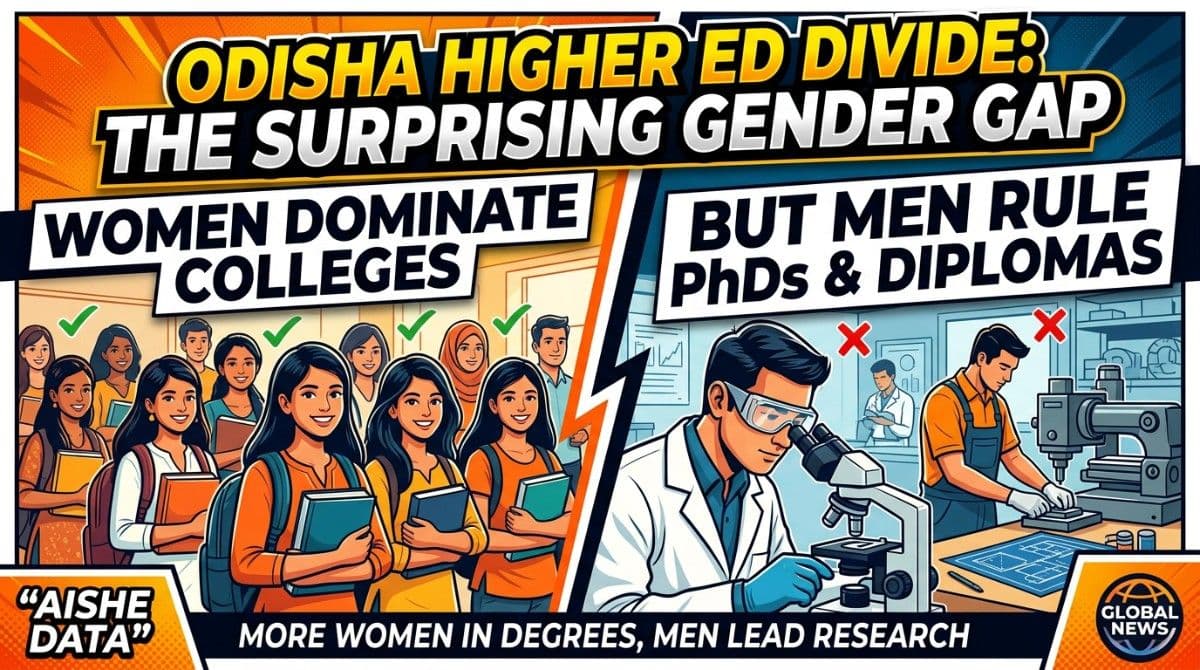
Bhubaneswar: Walk into most undergraduate or postgraduate classrooms in Odisha today and chances are you'll find more women than men. Yet, by the time higher education reaches research laboratories and technical diploma institutes, the gender equation undergoes a dramatic reversal.
The latest All India Survey on Higher Education (AISHE) data reveals a striking paradox that mirrors the national trend: women have overtaken men in conventional degree programmes, but men continue to dominate doctoral research and technical diploma education. The numbers suggest that while more women are entering and completing mainstream higher education, fewer are making the transition into research and technical career pathways.
Women Outnumber Men in General Classes
The data paints a fascinating picture of Odisha's higher education ecosystem. At the undergraduate level, women account for 4,32,275 enrolments, surpassing 4,19,619 men. The trend becomes even stronger in postgraduate education, where 68,580 women are enrolled against 60,588 men, indicating that female students are not only entering colleges in greater numbers but are also continuing their academic journey beyond graduation.

📱 Get Argus News App
✨However, the pattern changes sharply beyond the master's level.
Men Edge Out Women in Research/Techincal Courses
In doctoral programmes, 4,569 men are pursuing PhDs compared to 3,621 women. The gender gap widens further in technical education. Diploma courses have 1,21,143 male students, nearly twice the 56,328 female enrolments, while Postgraduate Diploma programmes also favour men with 1,690 enrolments against 1,204 women.
Only certificate courses buck this trend, where women hold an advantage with 1,402 enrolments compared to 886 men. Integrated programmes remain almost evenly balanced, with 7,024 men and 6,964 women.
Overall, Odisha records 11,85,931 students in higher education, comprising 6,15,536 men and 5,70,395 women. The overall male lead is largely driven by the overwhelming enrolment in diploma programmes rather than conventional degree courses.
Odisha in Sync with National Trend
Interestingly, Odisha's pattern closely reflects the national higher education landscape. Across India, women now outnumber men in undergraduate and postgraduate education, contributing to a Gender Parity Index above one. Yet, technical diploma institutions and doctoral programmes continue to remain male-dominated, highlighting a persistent divide between mainstream academic education and specialised professional or research streams.
Why The Contrast
Education experts attribute this "gender crossover" to a combination of social, economic and career-related factors.
One major reason is employability. Diploma programmes, particularly in engineering and polytechnic disciplines, offer quicker entry into the job market. Families often encourage young men to pursue these shorter, skill-oriented courses to achieve financial independence at an earlier age.
Women, on the other hand, continue to gravitate towards conventional Arts, Science and Commerce degrees, where participation has steadily improved over the past decade. However, the transition from postgraduate studies to doctoral research remains a challenge.
Researchers point to factors such as marriage, family responsibilities, limited research opportunities closer to home, safety concerns, and the long duration of PhD programmes, all of which disproportionately affect women's continuation into research.
Higher Edu in Private Mode
The AISHE data also underlines another structural reality of Odisha's higher education system – the overwhelming dominance of the private sector.
Of the state's 1,524 colleges, only 339 are government institutions, while 1,185 are privately managed, including 715 private unaided and 470 private aided colleges. In enrolment terms too, private institutions educate 5,58,367 students, accounting for nearly seven out of every ten students in the state, compared to 2,41,673 in government colleges.
The expansion story is even more telling. During 2023, Odisha added 104 new private colleges but only one government college, indicating that future growth in higher education capacity is being driven almost entirely by private investment rather than public institutions.
This mirrors the national trend, where nearly four out of every five colleges are privately managed, making private institutions the primary engine of higher education expansion across the country.
The Final Word
The latest AISHE figures therefore reveal two defining realities of Odisha's higher education landscape.
First, women have emerged as the dominant force in mainstream college education, signalling significant progress in access and retention.
Second, the pathways that lead to advanced research, technical expertise and specialised professional careers continue to be disproportionately occupied by men.
Bridging
this gap may well determine whether Odisha's higher education system can
convert educational parity into leadership parity in research, innovation and
high-skilled employment.
Also Read: Explained: Why Odisha Added 10,372 UG Seats Despite a 74,000-Seat Admission Gap
Related Topics
Explore more stories