



Odisha’s Elementary Education Paradox: GER Above 100%, Yet Govt School Footprint Keeps Shrinking| Exclusive
Key Points
Bhubaneswar: Even as Gross Enrolment Ratio (GER) in Odisha’s elementary school education stands at an overwhelming 103%, the devil lies in the details.
The latest UDISE+ data shows that the closure of government elementary schools in Odisha has slowed down to a great extent but has not stopped altogether.
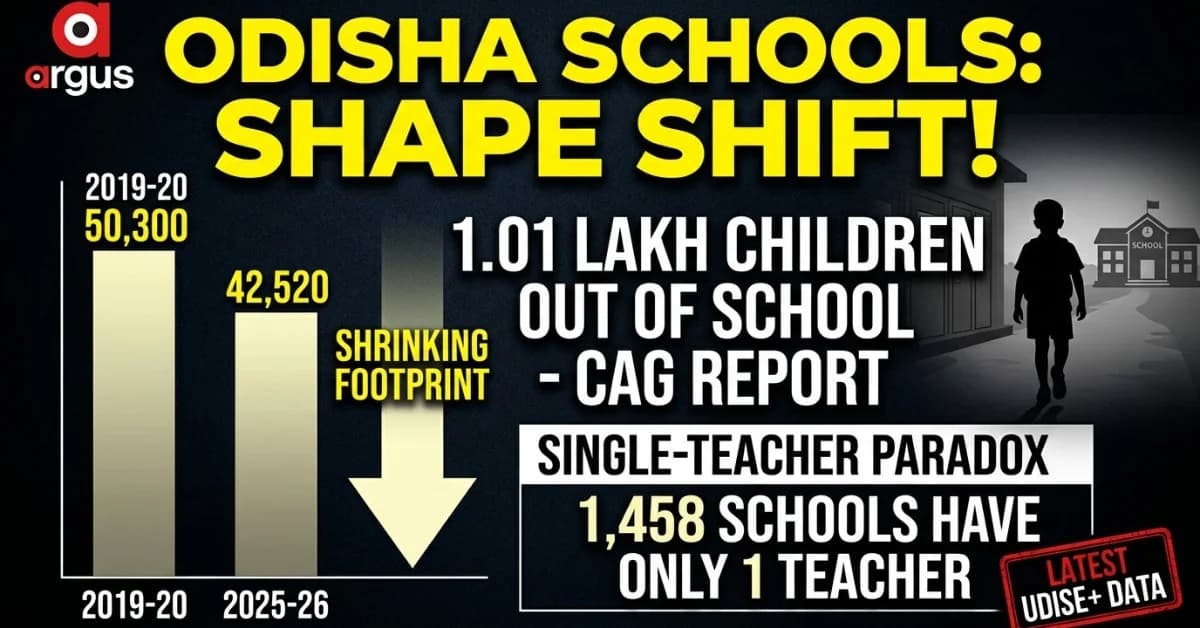
From a sprawling network of more than 50,000 government elementary schools a few years ago, the state’s footprint has now shrunk to 42,520 schools in 2025-26. The latest contraction may appear marginal, with 35 schools closing in a single year, but the longer trajectory reveals the scale of rationalisation that has already taken place.
Odisha’s elementary school footprint: From 50,000-plus to 42,520

📱 Get Argus News App
✨|
Academic Year |
Government Elementary Schools |
Annual Net Closures/Mergers |
|
2019-20 |
~50,300 |
— |
2020-21
~44,500
~5,800
2021-22
~43,200
~1,300
2022-23
~42,800
~400
2023-24
~42,600
~200
2024-25
42,555
~45
2025-26
42,520
35
The numbers tell a story of a dramatic policy shift.
Odisha witnessed its most aggressive phase of school consolidation between 2019-20 and 2020-21, when thousands of schools were merged or closed as part of the government’s school rationalisation exercise.
The pace subsequently moderated sharply – from thousands of closures to hundreds and eventually to double digits.
The latest fall from 42,555 schools in 2024-25 to 42,520 in 2025-26 represents a decline of just 0.08%. Yet, the fact that the number continues to fall is significant in a state where the government school remains the primary educational institution for children in rural, tribal and economically vulnerable communities.
Bihar and Chhattisgarh buck the contraction trend
Odisha’s shrinking government elementary-school network also stands out when compared with states such as Bihar and Chhattisgarh, which have added schools to their respective networks. While Odisha’s policy has moved towards consolidation of low-enrolment schools and pooling of resources, the expansion seen in these states points to a different approach towards maintaining or increasing the physical presence of schools.
The contrast is particularly relevant because the number of schools is not merely an administrative statistic.
A government school located within or close to a habitation can determine whether a child, particularly from a poor or tribal household, actually attends school. Thus, while consolidation can potentially improve teacher deployment and infrastructure utilisation, it can simultaneously increase the physical distance that children have to travel.
Odisha now among states witnessing school contraction
Odisha is now part of a group of states where the government-school network has continued to contract, although its current pace of decline is far lower than some states.
|
State |
Government Elementary Schools 2024-25 |
2025-26 |
Net Change |
Decline |
|
Odisha |
42,555 |
42,520 |
-35 |
0.08% |
|
Telangana |
22,983 |
21,022 |
-1,961 |
8.53% |
|
Meghalaya |
7,633 |
5,459 |
-2,174 |
28.48% |
The contraction is most dramatic in Meghalaya, which lost more than one-fourth of its government elementary schools in a single year, while Telangana saw a reduction of nearly 2,000 schools. Odisha’s 35-school decline, by comparison, is statistically negligible. This suggests that the state has largely completed the most aggressive phase of its school rationalisation and is now in a phase of minor, localised adjustments.
But the Odisha story cannot be assessed merely through the latest annual decline. The bigger question is whether the earlier consolidation has created an access deficit that may not be immediately visible in headline enrolment indicators.
The single-teacher school paradox
This is where another set of numbers becomes critical. Odisha had 42,520 government elementary schools and 60,916 teachers in 2025-26. On a simple arithmetic basis, that works out to just 1.43 teachers per school.
The state government’s official data also identifies 1,458 single-teacher schools. The average, therefore, masks a sharp disparity in teacher distribution: while larger schools in urban and semi-urban locations can have several teachers, a substantial number of small rural and remote schools continue to operate with only one teacher.
This brings the original rationale behind school rationalisation into focus. The large-scale closure and merger exercise was driven in part by the problem of low enrolment and inadequate teacher availability. But even after the consolidation of thousands of schools, the persistence of more than 1,400 single-teacher schools suggests that the teacher rationalisation challenge has not disappeared.
In other words, Odisha may have fewer schools to service, but the teacher-per-school arithmetic still remains extremely thin.
CAG raises the bigger red flag: 1.01 lakh children out of school
The most serious concern emerges from the Comptroller and Auditor General (CAG) of India’s performance audit of school education in Odisha, tabled in the Odisha Legislative Assembly on December 9, 2025.
The audit identified 101,607 Out-of-School Children (OoSC) in Odisha. Of these, only 40,120 children were successfully tracked and brought back into the school system, leaving more than 61,000 children outside the education network.
The finding assumes added significance in the context of school mergers. When a neighbourhood school disappears, children are often required to attend a school in another habitation. For older students or families with transport facilities, the additional distance may be manageable.
But for younger children, children from poor households and those living in geographically difficult areas, even a modest increase in distance can become a barrier.
The CAG audit also flagged a deeper data problem: Odisha’s habitation mapping used to assess school accessibility has remained outdated since 2014-15. This means official assessments of whether children have access to a school within the prescribed distance may not fully reflect the ground reality after years of school mergers and closures.
That creates a crucial distinction between enrolment and accessibility. A GER of 103% may suggest that Odisha has achieved near-universal access on paper, but it does not necessarily mean that every child has a functioning neighbourhood school within easy reach.
Distance, migration and the dropout trap
The consequences can be particularly severe in Odisha’s tribal and economically vulnerable districts. The CAG audit noted distance and difficult terrain among factors contributing to children dropping out. The physical removal of a village school can make regular attendance difficult for young children whose parents cannot accompany them to a school in another village.
The problem is compounded by seasonal migration. In parts of western and southern Odisha, families dependent on daily-wage employment migrate in search of work. When a school exists within the village, children can potentially remain connected to the education system even when their parents face economic hardship. But once that local institution is removed, ensuring that children travel to a neighbouring school becomes substantially harder.
The risk, therefore, is not simply that a school closes. It is that the institutional link between a habitation and the education system gets weakened.
The real question is no longer how many schools Odisha closes
For Odisha, therefore, the debate has moved beyond whether school rationalisation was necessary. The state had legitimate reasons to address thousands of low-enrolment schools, teacher shortages and inefficient deployment of resources. The dramatic slowdown in closures indicates that the bulk of that exercise is now over.
The more important question is whether the 42,520-school network is geographically adequate to retain every child in education.
A GER of 103%, therefore, tells only one part of Odisha’s elementary education story. The other part lies in the 42,520 schools, 60,916 teachers, 1,458 single-teacher schools and 101,607 children identified as out of school by the CAG.
The numbers
suggest that Odisha has largely won the battle of expanding enrolment and has
almost completed the phase of aggressive school consolidation. But the next
challenge is more fundamental: ensuring that the shrinking footprint of
government schools does not itself become a reason for children to fall off the
education map.
Also Read: Odisha’s Biggest Education Reform Yet: How Free KG-to-PG Scheme Drives NEP 2020 Goals for 4 Lakh Vulnerable Students in State| Special Story
Related Topics
Explore more stories