



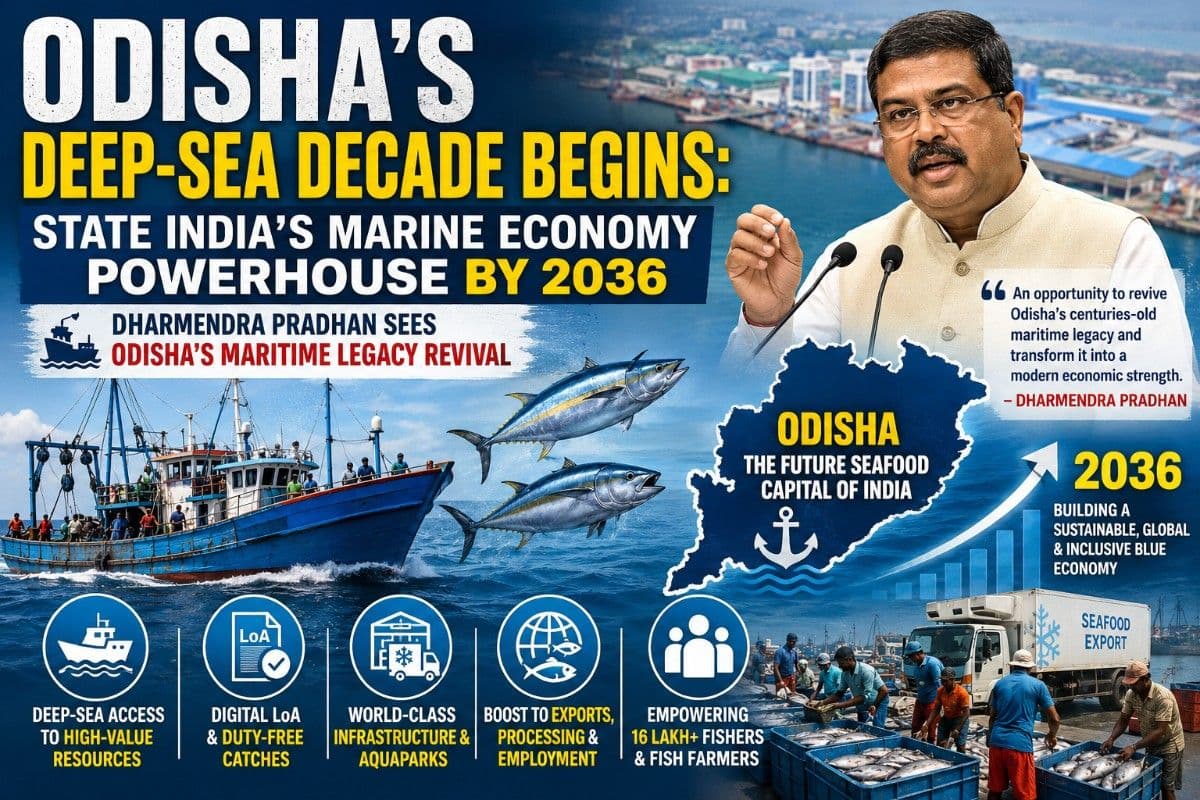
Odisha's Deep-Sea Decade Begins: State India's Marine Economy Powerhouse by 2036; Dharmendra Pradhan Sees Odisha's Maritime Legacy Revival| Special Report
Key Points
- Odisha's 10-year Deep Sea Fishing Mission aims to transform the state into Eastern India's premier seafood export hub by 2036.
- Union Minister Dharmendra Pradhan says the initiative revives Odisha's centuries-old maritime legacy while powering a modern Blue Economy.
- Duty-free deep-sea catches, digital fishing licences and world-class marine infrastructure promise higher incomes for over 16 lakh fishers and fish farmers
Bhubaneswar: Odisha has formally embarked on what could become the biggest transformation in its marine economy since Independence.
With the launch of the Odisha Deep Sea Fishing Mission (2026–2036) and the rollout of the digital Letter of Authorisation (LoA) framework, the state is no longer looking only at its 480-km coastline – it is looking deep into the Bay of Bengal and India's vast Exclusive Economic Zone (EEZ).
If the decade-long blueprint unfolds as planned, Odisha could evolve from a predominantly near-shore fishing state into Eastern India's premier seafood export and processing hub by 2036, creating a new growth engine for thousands of coastal families while significantly expanding the state's blue economy.
The transformation goes far beyond allowing fishermen to venture into deeper waters.

📱 Get Argus News App
✨It opens access to high-value pelagic species such as Yellowfin Tuna and Skipjack Tuna, introduces digital vessel tracking, scientific fisheries management, export-oriented infrastructure, duty-free deep-sea catches, and globally compliant traceability standards.
For Odisha, which already exported 1,00,897 metric tonnes of seafood worth Rs5,428.67 crore in 2025-26, the mission creates an opportunity to substantially raise export earnings by adding premium oceanic fish to its already strong shrimp-based export basket.
More importantly, it promises to generate employment across cold chains, seafood processing, logistics, aquaparks, vessel operations and marine entrepreneurship, benefiting over 16 lakh fishermen and fish farmers across the state.
A Late Starter, But One with a Strategic Advantage
Unlike Tamil Nadu, Gujarat or Andhra Pradesh, which began structured deep-sea fishing programmes several years ago, Odisha entered the sector relatively late.
Until now, the state's fisheries growth was largely driven by inland aquaculture and brackish-water shrimp farming, while marine fishing remained concentrated in near-shore waters with limited technological intervention.
Ironically, that delay may now work in Odisha's favour.
Instead of upgrading legacy systems, Odisha is entering the sector with a fully digital architecture built around the ReALCraft portal, the new LoA regime, 2025 EEZ regulations and the latest Union Budget incentives.
Local cooperatives, including the Paradip Marine Primary Fish Production & Marketing Cooperative Society, are among the early beneficiaries of high-seas authorisations, ensuring that traditional fishing communities – not just large commercial operators – become participants in the next phase of India's Blue Economy.
The state's central location along the eastern seaboard, combined with more than Rs1,301 crore invested under the Pradhan Mantri Matsya Sampada Yojana (PMMSY) since 2020, provides another strategic advantage.
Modern wholesale fish markets, cold-chain infrastructure and aquaparks planned at Paradip, Dhamra, Gopalpur, Chandipur and Astaranga position Odisha not merely as a fishing state but as a regional processing and export gateway for the Bay of Bengal.
2036: The Timeline That Could Redefine Odisha's Marine Economy
The Odisha Deep Sea Fishing Mission has been designed as a structured ten-year transition rather than a one-time policy announcement.
The immediate phase beginning in 2026 focuses on digital authorisations, operationalising the LoA framework, licensing eligible cooperatives and enabling Indian vessels to legally harvest deep-sea resources under the new duty-free regime.
Between 2027 and 2030, the emphasis will shift to deploying technologically advanced deep-sea vessels through Fisheries Cooperatives and Fish Farmer Producer Organisations (FFPOs), expanding aquaparks and wholesale hubs, strengthening cold-chain logistics and ensuring compliance with international seafood traceability norms.
The final phase, stretching from 2031 to 2036, aims to establish Odisha as the leading seafood export hub of Eastern India, supported by sustainable harvesting under Regional Fisheries Management Organisation (RFMO) guidelines, digitally monitored fishing operations and globally certified value chains.
If successfully executed, Odisha would move beyond being a supplier of marine resources to becoming a high-value seafood processing and export economy with stronger income generation for coastal communities.
Dharmendra Pradhan's Vision: From Maritime Heritage to a Modern Blue Economy
Union Education Minister Dharmendra Pradhan described the initiative as much more than a fisheries programme. He presented it as an opportunity to revive Odisha's centuries-old maritime legacy and transform it into a modern economic strength.
According to Pradhan, Odisha's coastline should no longer be viewed merely as a geographical boundary but as a gateway to international commerce. His vision places the state at the centre of Eastern India's seafood economy by integrating deep-sea fishing, brackish-water aquaculture, processing infrastructure, export-oriented logistics and institutional participation of fishing cooperatives.
A key element of his vision is ensuring that the gains of the Blue Economy reach grassroots fishing communities. By prioritising Fisheries Cooperatives and Fish Farmer Producer Organisations for deep-sea licences, the mission seeks to retain greater value within coastal villages instead of concentrating benefits among large commercial operators.
Vice President C. P. Radhakrishnan echoed the need to modernise India's fisheries sector, urging coastal youth to embrace technology-driven, science-based fishing practices. He stressed that digital vessel tracking, international quality standards and traceability would enable Indian seafood to access premium global markets while ensuring sustainable exploitation of marine resources.
Union Fisheries Minister Rajiv Ranjan Singh highlighted the policy architecture supporting the transition. He described the digital LoA system as a historic reform replacing cumbersome approvals with transparent online authorisation. He also underlined two major fiscal incentives that could significantly improve profitability – making all catches by Indian vessels in the EEZ and High Seas duty-free and treating catches landed at foreign ports as exports, thereby improving market access and global competitiveness. He further pointed to the Centre's unprecedented financial commitment to fisheries as evidence that the Blue Economy is emerging as a major national growth priority.
Bottom Line
For decades, Odisha's marine economy largely revolved around near-shore fishing and shrimp exports.
The Odisha Deep Sea Fishing Mission (2026–2036) signals the beginning of a different chapter – one where technology, deep-ocean resources, export infrastructure and institutional reforms converge to create a far larger economic opportunity.
While the state may have entered the deep-sea race later than several coastal competitors, its digital-first approach, expanding infrastructure, strong export ecosystem and policy backing provide a realistic pathway to becoming one of India's most influential marine economy hubs over the next decade.
If
implementation matches ambition, 2036 may well mark the year Odisha emerges
not only as Eastern India's seafood capital, but as one of the country's
defining Blue Economy success stories.
Also Read: PM Modi’s Australia Visit Delivers a Mining-Skills Windfall for Odisha: How 2 Landmark MoUs Create a Global Talent Pipeline from Bhubaneswar| Special Report
Related Topics
Explore more stories