



Odisha Voter List Revision: Why SEC Must Run a Parallel SIR Despite ECI Cleanup | Explainer
Key Points
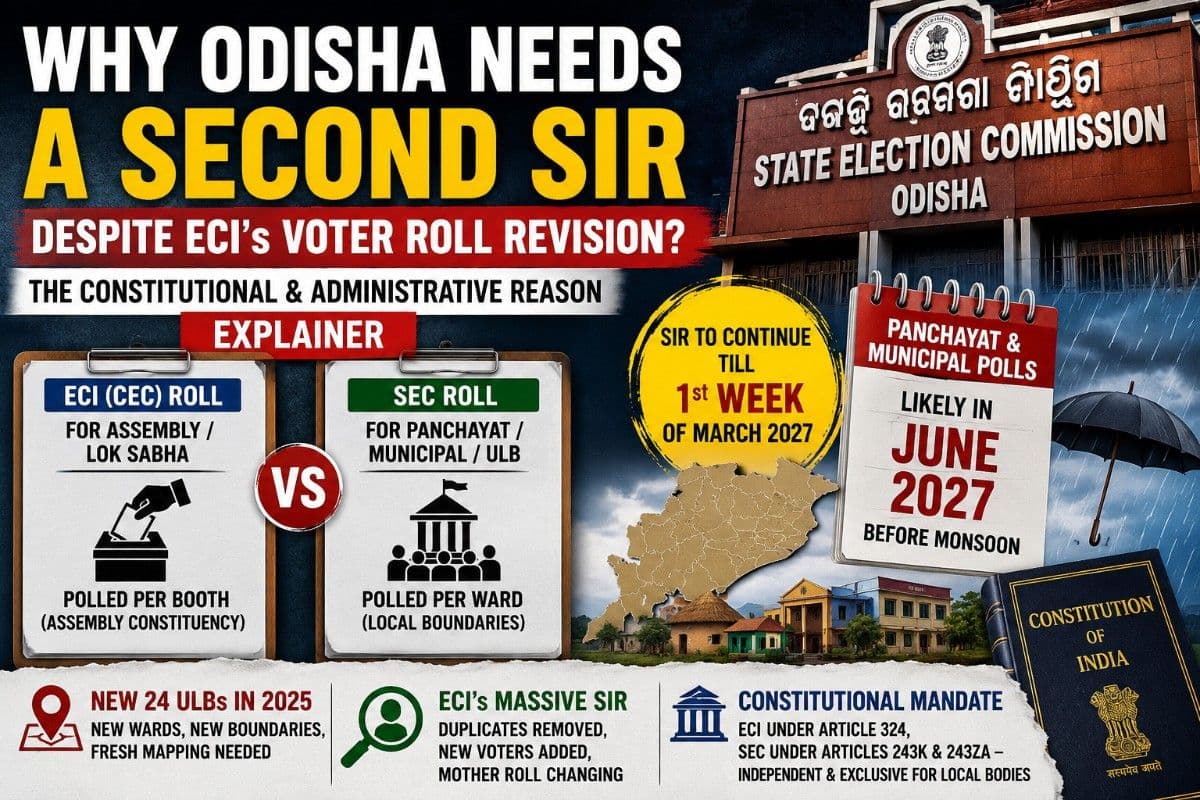
Constitutional Independence: The ECI operates under Article 324 for Assembly lines, while the SEC independently manages local body rolls under Articles 243K and 243ZA.
The Geometry Shift: The ECI creates rolls based on broad polling booths, whereas the SEC must manually map those voters into hyper-local Panchayat and municipal wards.
Structural Triggers: Unlike 2022, the 2027 delay is driven by the creation of 24 new ULBs and a massive foundational database cleanup by the ECI.
Bhubaneswar: When Odisha's political landscape has already been hit hard by the Special Intensive Revision (SIR) of electoral rolls undertaken by the Election Commission of India (ECI), the State Election Commission (SEC) announced on Friday that it will also conduct its own Summary Intensive Revision (SIR) before holding the Panchayati Raj Institution (PRI), Municipal and Urban Local Body (ULB) elections.
The announcement virtually pushes the Panchayat and Municipal elections to June 2027, before the onset of the monsoon, and has stirred the political tempest further.
Opposition parties have accused the ruling BJP of deliberately delaying the polls for political gain, arguing that the SEC did not undertake a separate SIR before the 2022 Panchayat and Municipal elections and had instead adopted the ECI's electoral rolls.
So, does the Opposition's charge hold ground?

📱 Get Argus News App
✨The answer lies in understanding the constitutional powers of the State Election Commission and the unique nature of local body electoral rolls.
What the SEC Said
State Election Commission Secretary Santosh Kumar Dash said the Summary Intensive Revision (SIR) will continue till the first week of March 2027, making it impossible to conduct Panchayat and Urban Local Body elections before the exercise is completed.
He said the Commission intends to conduct the elections before the arrival of the monsoon after the revised electoral rolls are published.
Dash also revealed that the SEC has already held review meetings with Revenue Divisional Commissioners (RDCs) and District Collectors to assess preparations for the PRI and ULB elections. Another comprehensive review meeting has been scheduled on July 21 to monitor the progress of the electoral roll revision and election preparedness.
Why Does the SEC Need Another SIR?
At first glance, the Opposition's argument appears logical. After all, if the ECI is already carrying out a Special Intensive Revision, why should the SEC repeat the exercise?
The answer is that the SEC is not actually duplicating the ECI's work.
The Election Commission of India prepares electoral rolls for Lok Sabha and Assembly constituencies under Article 324 of the Constitution.
In contrast, the State Election Commission conducts elections to Panchayats and Municipalities under Articles 243K and 243ZA, making it a constitutionally independent authority with exclusive responsibility over local body elections.
Although the SEC uses the ECI's Assembly electoral roll as its mother database, it cannot use that list in its existing form because Assembly electoral rolls are organised polling booth-wise, whereas local body elections are fought ward-wise.
An Assembly polling station often covers voters belonging to multiple Gram Panchayat wards or municipal wards. Therefore, every voter has to be geographically reassigned to the correct Panchayat ward, Municipality ward or Municipal Corporation ward before local body elections can legally be conducted.
This micro-level territorial mapping forms the core of the SEC's revision exercise.
Why Is This Exercise More Important This Time?
Unlike the 2022 local body elections, Odisha is currently witnessing two major structural changes that make a simple adoption of the ECI's electoral roll impractical.
First, the State has created 24 new Urban Local Bodies (ULBs) by upgrading several Gram Panchayats into municipalities and Notified Area Councils (NACs) in 2025. These new urban jurisdictions require fresh ward delimitation, reservation of seats and complete remapping of voters into newly created ward boundaries.
Second, the ECI itself is undertaking one of the biggest Special Intensive Revision exercises in recent years through house-to-house verification, deleting duplicate, shifted and ineligible voters while adding new eligible electors.
Since the mother electoral roll itself is undergoing substantial changes, the SEC cannot rely on the older ward-wise rolls prepared for previous local body elections. It must prepare fresh ward-specific electoral rolls based on the revised Assembly database.
The SEC's revision therefore is not a second verification of voter identity alone; it is also an exercise in spatial mapping, ensuring every voter is assigned to the correct local ward where he or she is legally entitled to vote.
Why Didn't This Happen in 2022?
The situation was significantly different before the 2022 Panchayat and Municipal elections.
At that time, there was no statewide restructuring of local bodies, no creation of dozens of new municipalities and no nationwide Special Intensive Revision altering the foundational electoral database.
The SEC could therefore adopt the ECI's Assembly electoral roll as its mother roll and carry out only the routine ward-wise mapping without launching an independent, intensive field verification.
The current exercise is fundamentally different because both the base electoral roll and the local administrative boundaries have undergone significant changes simultaneously.
The Bottom Line
The SEC's proposed Special Intensive Revision is not a duplication of the ECI's exercise but a constitutional and administrative necessity.
While the ECI prepares voter lists for Assembly and Parliamentary elections, the SEC must legally adapt, verify and publish electoral rolls specifically aligned to Panchayat and Municipal ward boundaries.
The ongoing restructuring of Odisha's urban landscape, coupled with the ECI's intensive revision of the mother electoral roll, has made this additional exercise unavoidable. That is why the SEC expects the revision to continue till early March 2027, with the Panchayat and Urban Local Body elections now likely to be held before the 2027 monsoon.
This
constitutional distinction, rather than merely political timing, explains why
Odisha is witnessing what appears to be a "second SIR" ahead of the
state's local body elections.
Also Read: 20 Lakh Names Deleted from Odisha SIR Voter List; 10 Lakh 'Shifted or Absent', Migrants Must Verify Before Aug 4 | Special Report
Related Topics
Explore more stories