



20 Lakh Names Deleted from Odisha SIR Voter List; 10 Lakh 'Shifted or Absent', Migrants Must Verify Before Aug 4 | Special Report
Key Points
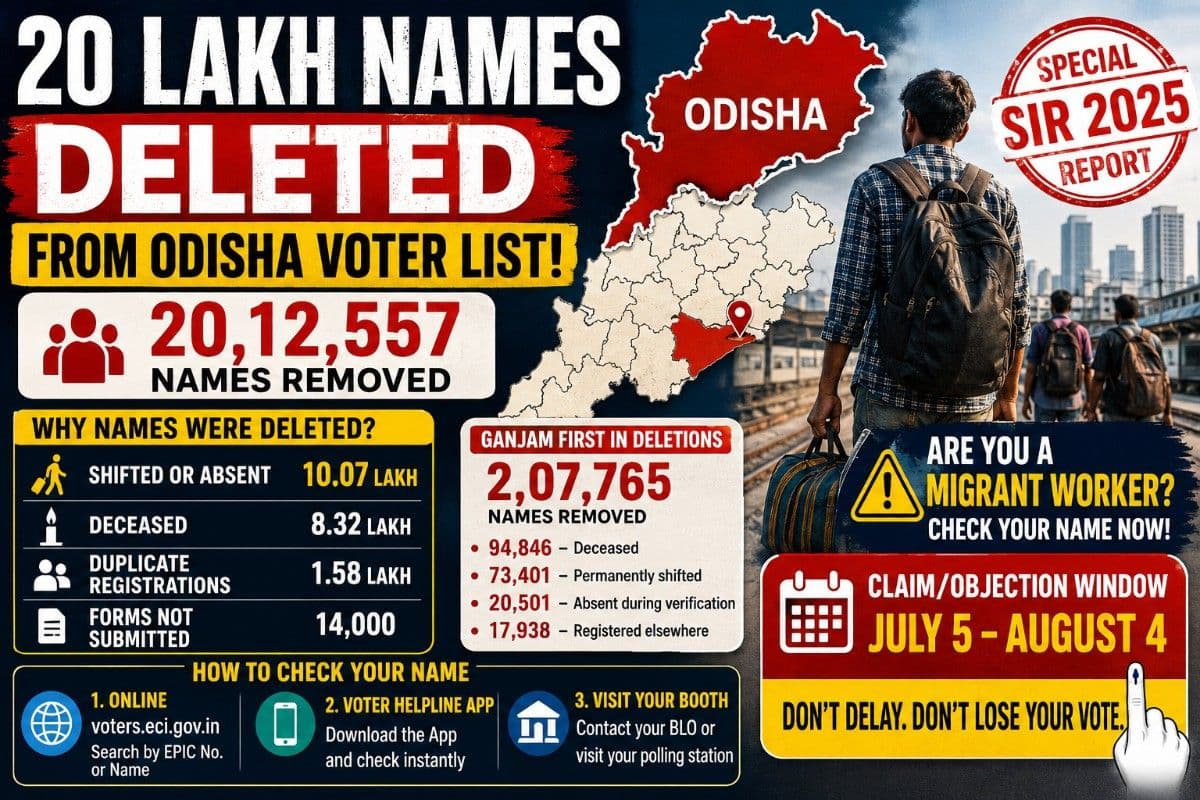
Massive Roll Pruning: A total of 20,12,557 names have been removed from the Odisha draft electoral roll under the Special Intensive Revision (SIR).
Migrants At Highest Risk: "Shifted or Absent" voters constitute the single largest deletion category, accounting for 10.07 lakh dropped individuals.
Strict Action Deadline: Affected citizens and migrant workers must file Form 6 online or via their BLO by August 4 to restore their voting rights.
Bhubaneswar: The publication of Odisha's draft electoral roll under the Special Intensive Revision (SIR) has thrown up a statistic that is likely to worry lakhs of families across the state, especially migrant workers.
While the headline figure is that 20,12,557 names have been removed from the electoral roll, the biggest category isn't deceased voters or duplicate registrations. Instead, it is "Shifted or Absent" voters – 10.07 lakh people, accounting for almost half of all deletions.
For a state like Odisha, where seasonal and long-term migration has become an economic reality, this category carries enormous implications.
Thousands of workers leave their villages every year for Surat, Bengaluru, Hyderabad, Chennai, Kerala, Delhi, other cities, and even to cities in Odisha other than their home city or district, in search of employment. Many are away for months when Booth Level Officers (BLOs) conduct door-to-door verification.

📱 Get Argus News App
✨The Election Commission has now opened a one-month claims and objections window from July 5 to August 4, giving every affected voter an opportunity to restore their voting rights before the final electoral roll is published.
Why the 10.07 Lakh Figure Matters
According to Chief Electoral Officer S. Gopalan, Odisha's registered electorate has reduced from 3.33 crore to 3.13 crore after completion of the Special Intensive Revision.
The deletion of over 20 lakh names was carried out following extensive field verification.
Why were names deleted?
|
Reason |
Number of Electors
Shifted or absent
10.07 lakh
Deceased
8.32 lakh
Duplicate registrations
1.58 lakh
Enumeration forms not submitted
14,000
The data shows that "Shifted or Absent" alone accounts for nearly 50% of all deletions, making it the single biggest category.
Unlike deceased or duplicate voters, many of these individuals could still be eligible voters who simply happened to be away from their registered addresses during physical verification.
That is why election officials are repeatedly urging citizens to immediately verify whether their names continue to exist in the draft electoral roll.
Ganjam Emerges as the Biggest Concern
The migration story becomes even more evident in Ganjam district, long regarded as Odisha's largest source of migrant labour.
The district has recorded the highest number of deletions in the state – 2,07,765 names.
The breakup illustrates why migration has become the centre of discussion:
- 94,846 — Deceased
- 73,401 — Permanently shifted
- 20,501 — Absent during verification
- 17,938 — Registered elsewhere
Taken together, nearly 94,000 deletions were linked directly to migration or absence, highlighting how movement of workers has influenced the revision exercise.
The highest deletions were reported from:
- Sanakhemundi – 24,628
- Chikiti – 20,430
- Digapahandi – 19,489
Election officials expect many genuine electors from these areas to file claims during the objection period.
Why So Many Migrant Workers Could Be Affected
Odisha has one of India's largest populations of migrant workers.
Workers from districts including:
- Ganjam
- Gajapati
- Kandhamal
- Balangir
- Kalahandi
- Nuapada
- Boudh
- Sundargarh
often spend several months outside the state.
If Booth Level Officers visited while they were away, their names could have been placed under the "Shifted or Absent" category following verification procedures.
However, election officials stress that deletion does not automatically mean permanent loss of voting rights.
Every eligible citizen has the opportunity to file a claim before the final electoral roll is published.
How Were the Names Deleted?
The Special Intensive Revision is not an automatic software exercise.
Instead, it involved a multi-layered physical verification process.
Step 1: Door-to-door verification
Between May 30 and June 28, Booth Level Officers conducted physical verification across polling stations.
Step 2: Digital matching
Election Commission software identified possible duplicate entries by comparing:
- Names
- Photographs
- Family details
- Demographic similarities
Step 3: Physical verification
Suspected duplicate or doubtful entries were physically verified.
Election Registration Officers and Assistant EROs were required to personally verify a substantial number of disputed cases.
Step 4: Legal safeguards
The CEO has clarified that:
- Notice must be served to the last known address.
- A reasoned ("speaking") order is required before deletion.
- Around 50 lakh minor mismatches have only been flagged for correction – not deletion.
- Ten senior IAS officers have been deployed as observers to monitor fairness.
First Step: Check Whether Your Name Still Exists
Before filing any application, citizens should first verify whether their names appear in the draft roll.
There are three easy ways.
Method 1: Online
Visit the Election Commission's voter portal.
Search using:
- EPIC (Voter ID) number, or
- Name and personal details.
If your record appears, your name remains in the draft roll.
Method 2: Voter Helpline App
Download the Voter Helpline App.
Enter your details to instantly check your voter status.
Method 3: Visit Your Booth
You can also:
- Visit your polling station,
- Contact your Booth Level Officer (BLO), or
- Check the draft electoral roll displayed locally.
Name Missing? Here's How to Get It Back Before August 4
If your name has been wrongly deleted, follow these steps immediately.
Step 1: Register
Create an account on the voter portal or log in through the Voter Helpline App using your mobile number.
Step 2: Select the Correct Form
This is the most important step.
Use Form 6 if:
- Your name has been wrongly deleted.
- You want re-enrolment.
- You need fresh registration.
Use Form 7 if:
- You want to object to someone else's duplicate entry.
- You want removal of a deceased family member's name.
Step 3: Upload Documents
Keep scanned copies ready.
Age Proof
- Aadhaar
- PAN
- Birth Certificate
Address Proof
- Aadhaar
- Electricity bill
- Water bill
- Bank passbook
- Other valid residence proof
Step 4: Submit the Application
Review all information carefully before submission.
The portal will generate a Reference ID.
Keep this safely.
You can use it later to track your application's status online.
Don't Want to Apply Online?
No problem.
Citizens may also:
- Collect Form 6 from their local BLO.
- Fill it manually.
- Attach self-attested copies of documents.
- Submit it to:
- Booth Level Officer, or
- Electoral Registration Officer (ERO).
Need Help? Find Your BLO Easily
If you're unsure whom to contact, there are several options.
Through Your EPIC Number
Search your voter details online.
Your digital voter slip will display:
- BLO name
- Mobile number
- ERO details
Through Your Polling Station
Visit the CEO Odisha portal.
Select:
- District
- Assembly Constituency
- Polling Booth
The system will generate the BLO details for that polling station.
Through the Voter Helpline App
Open the app and access your voter profile.
The "My Officials" section displays your assigned BLO.
Call 1950
Citizens without internet access can simply dial 1950.
Officials will provide BLO contact details after verifying the caller's location.
Remember These Important Dates
- Draft Electoral Roll Published: July 5
- Claims & Objections: July 5 – August 4
- Disposal of Claims: By September 2
- Final Electoral Roll: September 6
The Bottom Line
The deletion of 20.12 lakh names has naturally drawn attention, but the most significant figure is the 10.07 lakh electors marked as "Shifted or Absent." In a state where migration is a livelihood strategy for lakhs of families, this category could include many genuine voters who were away from home during verification rather than ineligible electors.
The Election
Commission's one-month claims window is therefore crucial. Anyone who has
migrated for work, studies or other reasons – or whose family members are
living outside their native village – should not assume their name remains on
the electoral roll. Checking the draft list and filing a claim, if required,
before August 4 is the safest way to ensure that the constitutional
right to vote remains intact when the final rolls are published in September.
Also Read: Bengal polls / West Bengal Elections 2026: Mamata Vs BJP: Who Will win?
Related Topics
Explore more stories