



Odisha Rolls Back Principals' Recruitment Powers After Litigation Surge, Vigilance Heat; RDEs Back as Appointing Authority| Special Report
Key Points
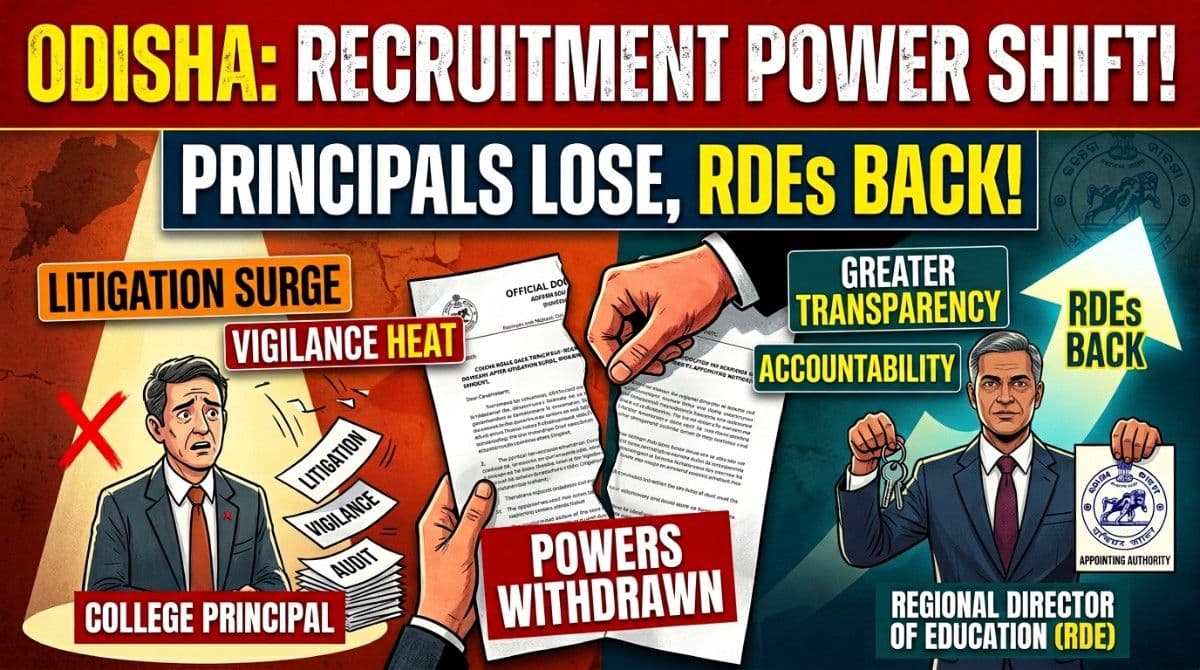
Bhubaneswar: Saddled with mounting litigation, repeated vigilance investigations and audit objections over recruitment of non-teaching employees in government colleges, the Odisha Higher Education Department has junked its decentralised recruitment model by withdrawing the appointing powers of college principals.
In a significant administrative overhaul, the department has restored the Regional Directors of Education (RDEs) as the appointing authority for non-teaching non-cadre Group-B, Group-C and Group-D employees, marking a return to a centralized system aimed at ensuring greater transparency, uniformity and accountability.
The decision, notified through a departmental order issued on July 20, 2026, comes after years of disputes over localized recruitment, allegations of irregular appointments, vigilance cases and a growing pile of court cases challenging selections made by individual colleges.
Back to the Earlier System

📱 Get Argus News App
✨The latest order effectively reverses the decentralised arrangement under which principals of government colleges functioned as the appointing authority for non-teaching staff.
For years, the system was justified on the ground that colleges needed quicker recruitment to fill vacancies in clerical, laboratory and support services without waiting for centralized approvals. However, the model gradually led to inconsistent recruitment practices across institutions.
With the latest decision, all appointments of non-cadre Group-B, Group-C and Group-D employees, along with key service matters, will now be handled by the respective Regional Director of Education instead of individual principals.
The move restores an administrative structure that places recruitment under a regional supervisory mechanism rather than institution-level discretion.
What the Government Order Says
The Higher Education Department has declared the Regional Director of Education as the sole appointing authority for all non-teaching non-cadre Group-B, Group-C and Group-D employees in government degree colleges and teacher education institutions.
The order simultaneously withdraws the powers earlier vested in principals for these categories of employees with immediate effect.
Apart from appointments, consequential administrative powers linked to service matters will also flow through the regional offices, ensuring uniform implementation of government service rules.
Litigation Triggered the Shift
Though the order does not cite individual instances, sources acknowledge that the decision follows years of administrative complications arising from localized recruitment.
The Higher Education Department has been burdened with hundreds of legal disputes filed by unsuccessful candidates questioning recruitment procedures adopted by different colleges.
Each institution followed its own recruitment process, resulting in varying interpretations of reservation policies, eligibility criteria, interview assessments and selection procedures. This created a flood of litigation before the Odisha High Court and departmental authorities.
By centralising appointments, the government expects recruitment to follow uniform procedures, thereby reducing future legal disputes.
Vigilance, Audit Objections Added Pressure
The administrative overhaul also follows years of vigilance scrutiny and audit observations relating to recruitment and management of non-teaching staff.
Complaints investigated over the years broadly revolved around:
- Alleged backdoor engagements through local fund appointments.
- Complaints regarding manipulation of interview marks during local selections.
- Audit objections relating to payroll management and financial irregularities.
- Administrative grievances involving disciplinary actions and allegations of favouritism.
Rather than addressing such issues institution by institution, the government has opted for a structural correction by shifting recruitment powers outside individual colleges.
Five RDEs to Handle Recruitment Across Odisha
The centralized system will function through Odisha's five Regional Directorates of Education, each catering to a cluster of districts.
They include:
- RDE Bhubaneswar – covering Khordha, Puri, Cuttack, Nayagarh, Jagatsinghpur, Kendrapara and adjoining coastal districts.
- RDE Berhampur – overseeing Ganjam, Gajapati, Kandhamal and neighbouring southern districts.
- RDE Sambalpur – administering western Odisha including Sambalpur, Bargarh, Jharsuguda, Sundargarh and nearby districts.
- RDE Balasore – supervising Balasore, Bhadrak, Mayurbhanj, Keonjhar and northern districts.
- RDE Jeypore – managing the KBK region including Koraput, Malkangiri, Nabarangpur and Rayagada.
The regional structure is expected to distribute administrative workload more evenly while ensuring standardized implementation of recruitment and service rules.
Principals Lose Disciplinary Control
The order also substantially changes disciplinary administration.
Since the appointing authority determines disciplinary jurisdiction under service rules, principals will no longer independently exercise powers relating to suspension or termination of these employees.
Instead, principals will report misconduct to the Regional Director of Education, who will examine the matter and initiate disciplinary proceedings wherever necessary under the Odisha Civil Services rules.
This is expected to reduce allegations of arbitrary disciplinary action arising out of local institutional disputes.
Administrative and Academic Gains
Officials believe the restructuring will produce benefits extending beyond recruitment.
Administratively, centralized appointments are expected to bring greater transparency, ensure uniform application of reservation policies, standardize service records, facilitate smoother promotions, pension processing and inter-college staff deployment, while significantly reducing litigation.
For principals, the decision removes a major non-academic responsibility that frequently consumed administrative time in recruitment disputes, disciplinary proceedings and court cases.
From an educational perspective, the move is expected to allow institutional heads to devote greater attention to teaching standards, academic planning, NAAC accreditation, student welfare, research activities and overall campus governance instead of prolonged personnel administration.
By
separating academic leadership from recruitment administration, the Higher
Education Department hopes to strengthen both governance and institutional
performance while insulating colleges from localized recruitment controversies
that have plagued the sector for years.
Also Read: CB Reaches SCERT Deputy Director's Office 72 Hours After Manoj Padhy’s Arrest; Crime Branch Tightening Documentary Trail in Textbook Scam | Special Report
Related Topics
Explore more stories