



CB Reaches SCERT Deputy Director's Office 72 Hours After Manoj Padhy’s Arrest; Crime Branch Tightening Documentary Trail in Textbook Scam | Special Report
Key Points
Operational Scrutiny: Crime Branch shifts focus to the SCERT Deputy Director to map the administrative workflow behind the flawed textbook approvals.
Evidence-Based Strategy: Investigators are prioritizing a documentary-led timeline over custodial interrogation to dismantle the "I only signed the files" defense.
Systemic Failure Probed: The SIT is investigating whether mandatory proofreading and quality protocols were bypassed during the hurried NEP curriculum rollout.
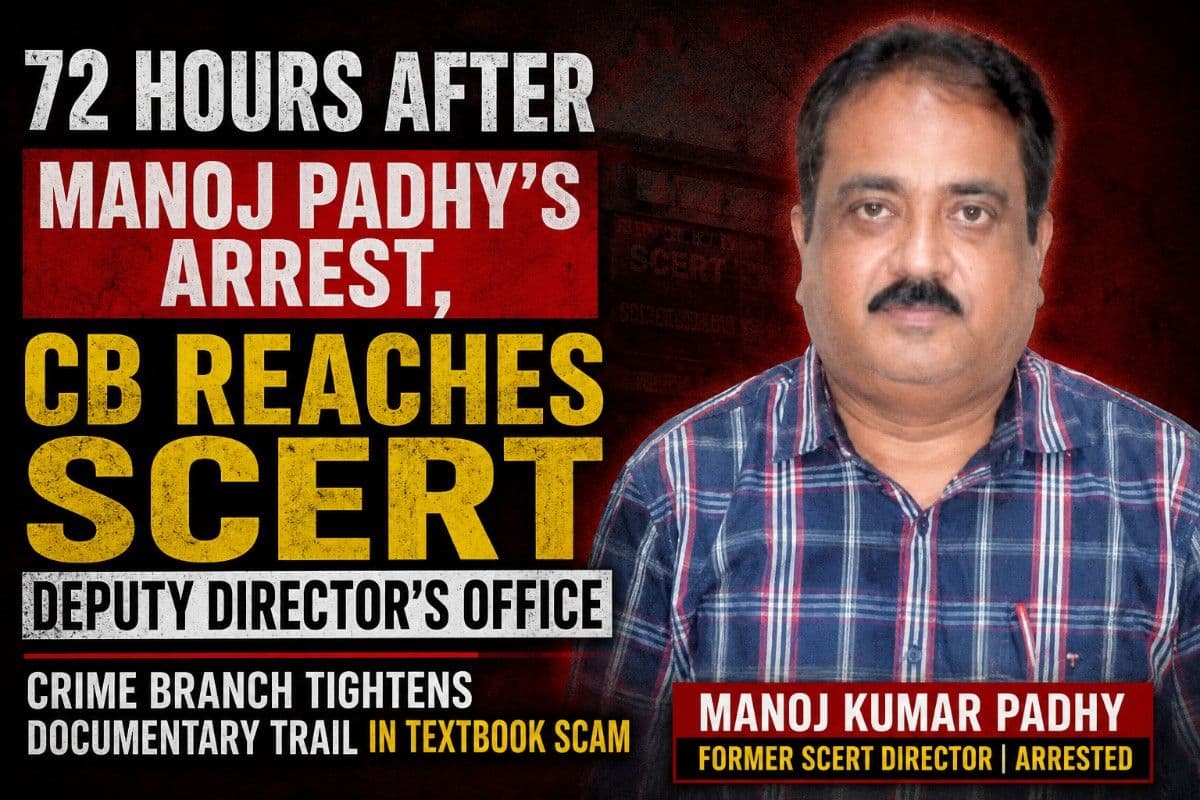
Bhubaneswar: Seventy-two hours after arresting former SCERT Director Manoj Kumar Padhy. Forty-eight hours after raiding the SCERT headquarters and seizing crucial files, digital records and note sheets, and twenty-four hours after grilling the owners of two private printing firms, on Friday, the Odisha Crime Branch (CB) walked into the office of SCERT Deputy Director Itishree Nayak, signalling that the investigation has now entered its most critical administrative phase.
The sequence is significant. Instead of rushing through interrogations, the Special Investigation Team (SIT) appears to be reconstructing the entire chain of decision-making layer by layer. Having isolated the former Director in judicial custody, secured documentary evidence from SCERT and confronted private printers, investigators have now turned to the officer who sat at the operational junction between subject experts and the Director's office.
Why the Deputy Director Became the Next Link
Crime Branch sources have not officially disclosed the questions put to Deputy Director Itishree Nayak.

📱 Get Argus News App
✨However, the timing suggests investigators were armed with leads generated over the previous 72 hours – from the four-hour interrogation of Manoj Padhy, the seizure of official files and digital layouts, and the questioning of the two private printing agencies.
As the administrative workflow manager, the Deputy Director supervised movement of files between Assistant Directors and the Director's office. Investigators are likely attempting to establish whether established textbook approval protocols were bypassed during the compressed National Education Policy (NEP) rollout.
Among the issues that investigators are verifying are:
- Whether manuscript files were fast-tracked without completion of mandatory multi-stage proofreading.
- Whether note sheets recorded objections or missing approvals before files reached the Director.
- Whether verbal or written instructions were issued to prioritise printing deadlines over quality verification.
- Whether draft corrections were communicated to the printers but ignored before mass printing.
- Whether pressure from the Director's office influenced the movement of files through the approval chain.
The questioning is also expected to help Crime Branch reconstruct the exact administrative chronology that culminated in 1,678 errors finding their way into 55 school textbooks.
Why Crime Branch Didn't Seek Manoj Padhy's Custody
One of the most notable developments in the investigation has been the Crime Branch's decision not to seek custodial remand of former Director Manoj Kumar Padhy after his arrest.
Investigators questioned him for nearly four hours before producing him before court, opposing his bail and allowing him to be remanded directly to judicial custody.
The move suggests the investigation has, at least for now, shifted away from extracting further verbal disclosures and towards testing his defence against documentary evidence.
During questioning, sources said, Padhy maintained that he merely signed files after they had travelled through various administrative levels, effectively projecting himself as the final approving authority relying on subordinate verification.
That "I only signed the files" defence now appears to be under scrutiny.
By questioning the Deputy Director and earlier examining Assistant Directors and private printers, the Crime Branch appears to be verifying whether procedural safeguards were knowingly bypassed before the files reached the Director's table.
Equally important, investigators had already inherited a substantial documentary foundation. The high-level inquiry headed by Development Commissioner D.K. Singh had collected file records, note sheets, digital documents and statements from officials before the Crime Branch formally registered the criminal case.
Following the subsequent SCERT raid, investigators also seized additional electronic records, textbook layouts and approval documents. With much of the evidence already secured, the agency seemingly found little immediate necessity for custodial interrogation.
Judicial custody also serves another investigative purpose – it effectively isolates the former Director from the SCERT administrative ecosystem, reducing the possibility of influencing witnesses or coordinating responses while investigators continue questioning serving officials.
Why Manoj Padhy Was Arrested So Swiftly
The speed with which the Crime Branch moved against the former Director reflects the document-centric nature of the case.
Within days of taking over the investigation, the SIT pieced together findings from the departmental inquiry, statements of suspended Assistant Directors, official approval records and the Director's statutory role in authorising mass printing.
The FIR invokes provisions relating to criminal conspiracy, criminal breach of trust by a public servant, framing incorrect records and other offences under the Bharatiya Nyaya Sanhita.
Investigators believe the Director's final approval was indispensable before the flawed textbooks could be released for printing and statewide distribution. That statutory responsibility, coupled with documentary approvals bearing his signatures, appears to have formed the prima facie basis for the arrest.
Instead of treating the case as one involving isolated proofreading mistakes, the Crime Branch is investigating whether the errors resulted from a systemic breakdown in institutional safeguards during the hurried implementation of the new curriculum.
The Bottom Line
The investigation is unfolding with calculated precision rather than dramatic raids alone.
First came the arrest of the former Director. Then the seizure of documentary evidence from SCERT. Next, the interrogation of the private printing firms accused of printing flawed textbooks. Now, the questioning of the Deputy Director responsible for administrative workflow.
Each step appears designed to corroborate the previous one before moving to the next link in the chain.
Rather than
relying on confessions, the Crime Branch seems to be constructing a
document-backed timeline that traces how a Rs175-crore textbook project
ultimately produced 1,678 errors. If that strategy continues, investigators are
expected to progressively tighten the evidentiary noose around every level of
the decision-making hierarchy before filing the final chargesheet.
Also Read: How Crime Branch Will Unravel the Odisha Textbook Errors ‘Conspiracy’ or ‘Sabotage’: The Forensic Trail Behind 1,678 Errors| Special Report
Related Topics
Explore more stories