



Odisha MBBS Seats Up 20%, PG seats Up 26% in Last 3 years: Why the State's PG Expansion Is the Real Story| Exclusive
Key Points
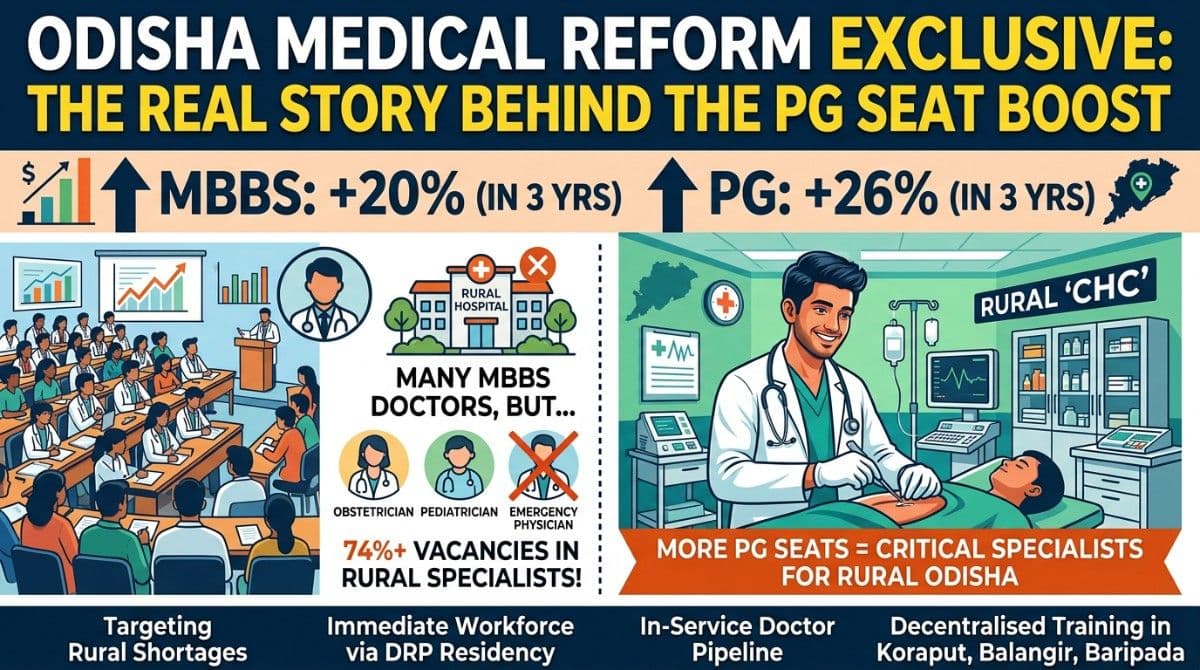
Bhubaneswar: In the last three-years, Odisha's had seen addition of over a thousand undergraduate MBBS seats as a major boost to medical education. It certainly strengthens the state's long-term doctor-population ratio.
But beneath the headline numbers lies a deeper healthcare reality: the state's biggest crisis is no longer a shortage of doctors – it is a shortage of specialists where they are needed the most.
The government, recently on the floor of the house, has even acknowledged that more than 74% of sanctioned specialist doctor posts at Community Health Centres (CHCs) remain vacant.
The vacancies are concentrated in three life-saving disciplines – Obstetrics & Gynaecology, Paediatrics and Medicine – the very specialties that determine maternal survival, newborn care and emergency treatment in rural Odisha.

📱 Get Argus News App
✨This is precisely where the simultaneous expansion of postgraduate (PG) medical seats becomes strategically far more significant than merely increasing MBBS admissions.
An MBBS graduate can function as a general physician, but a CHC cannot conduct complicated deliveries, treat critically ill newborns or manage medical emergencies without trained specialists. Odisha's expanding PG ecosystem, therefore, is not merely an academic exercise; it is gradually becoming the state's most important rural healthcare reform.
Odisha's MBBS-PG Balance Is Emerging as a National Strength
According to the available data with Union Health Ministry, tabled recently in Parliament, the seat matrix of the State gives the clue why PG seats increase has been higher than MBBS seats.
|
|
|
|
|
|
|
|
|
|
|
|
|
|
|
|
Odisha's emerging undergraduate-to-postgraduate ratio of roughly 2:1 places it among the better-balanced states in specialist training.
Rather than producing an oversupply of general doctors, Odisha is gradually building a proportionate specialist pipeline. The moot question is WHY and HOW
The Ground Reality: Rural Odisha's Specialist Desert
Although Odisha has steadily improved its overall medical education capacity, nearly three out of every four specialist positions at CHCs remain vacant.
The impact is visible across rural healthcare:
- Pregnant women continue to be referred to district hospitals because no obstetrician is available.
- Sick newborns are shifted long distances due to the absence of pediatricians.
- Emergency medical cases are delayed because physicians and specialists are unavailable.
This specialist vacuum – not the shortage of MBBS doctors – is what weakens Odisha's grassroots healthcare system.
MBBS Expansion Improves Doctor Ratio, Not Specialist Availability
The expansion of undergraduate MBBS seats undoubtedly addresses one longstanding challenge.
More MBBS seats mean:
- More medical graduates every year.
- Better doctor-population ratio over time.
- Greater availability of primary care physicians.
For Odisha, whose doctor-population ratio has remained below the WHO benchmark, this is an essential step.
However, MBBS graduates alone cannot legally or clinically replace specialists in labour rooms, neonatal units or complicated medical emergencies.
Simply put, increasing MBBS seats helps the quantity of doctors – but not the quality of specialist care available in rural hospitals.
PG Expansion Directly Targets Odisha's Biggest Healthcare Deficit
Unlike MBBS seats, postgraduate seats are speciality-specific.
Every additional PG seat produces:
- Obstetricians
- Pediatricians
- Physicians
- Anaesthesiologists
- Surgeons
These are precisely the specialists missing from Odisha's CHCs.
The state's strategy of proportionately expanding PG seats therefore aligns specialist production with actual vacancies instead of merely increasing the number of general practitioners.
It transforms medical education planning from numerical expansion into workforce planning.
How District Residency Programme Augments Immediate Rural Workforce
Perhaps the biggest advantage of PG expansion is that Odisha does not have to wait three years for specialists to graduate before rural hospitals benefit.
Under the National Medical Commission's (NMC) mandatory District Residency Programme (DRP), second and third-year postgraduate students are compulsorily posted to district and peripheral hospitals for rotational training.
This creates an immediate pipeline of skilled manpower.
As PG admissions increase, hundreds of senior residents rotate through district hospitals every year, strengthening:
- Labour rooms
- Pediatric wards
- Emergency services
- Surgical units
The residency programme therefore converts educational expansion into immediate service delivery, partially buffering specialist shortages even before graduation.
In-Service Doctor Quota Builds a Permanent Specialist Pipeline
Odisha's strategy extends beyond training new specialists.
The state reserves a significant share of PG seats for in-service government doctors already serving as Medical Officers in rural areas.
The model works in three stages:
- Rural Medical Officers receive incentives and weightage for PG admission.
- They undergo specialist training within Odisha.
- Mandatory service bonds require them to return to government service after completing PG.
This creates a closed-loop system where rural doctors upgrade their qualifications without permanently exiting the public health system.
Instead of losing experienced Medical Officers to private practice, Odisha converts them into government specialists.
Decentralised Medical Colleges Reduce Urban Concentration
Historically, specialist training in Odisha remained concentrated in major institutions such as SCB Medical College, MKCG and VIMSAR.
The new PG expansion changes that geography.
Medical colleges at:
- Koraput
- Balangir
- Baripada
- Balasore
- Other peripheral institutions
are increasingly receiving postgraduate seats.
Training specialists in backward and tribal regions has an important behavioural advantage.
Doctors trained in these districts become familiar with local disease patterns, infrastructure limitations and patient demographics, making them more likely to continue serving in those regions.
This decentralisation helps reduce Odisha's longstanding urban-rural specialist divide.
Nationally, many states continue to expand MBBS seats much faster than postgraduate capacity.
The consequence is predictable:
Thousands of MBBS graduates compete for limited PG seats, migrate to other states for specialisation or delay joining government service while repeatedly preparing for entrance examinations.
This balanced expansion distinguishes the state from regions where undergraduate growth has significantly outpaced postgraduate infrastructure.
Bottom Line
Odisha's expansion of nearly a thousand MBBS seats is undoubtedly a milestone in medical education.
But the real story of transformative reform lies in the simultaneous scaling up of postgraduate seats.
MBBS expansion strengthens the state's overall doctor base.
PG expansion strengthens the healthcare system itself.
By aligning specialist production with rural vacancies, deploying postgraduate residents through the District Residency Programme and creating a long-term pipeline of bonded government specialists, Odisha is attempting to solve a structural problem that has persisted for decades.
If backed by
timely recruitment and stronger rural infrastructure, this dual strategy could
finally convert Odisha's medical education growth into something far more
meaningful – a functioning specialist healthcare network reaching every block
of the state.
Also Read: Odisha's 755 New Medical Posts Mark What Historic Shift: How Modi's Medical College Push Help State Reach National Doctor Population Ratio by 2036| Exclusive
Related Topics
Explore more stories