



Odisha's 755 New Medical Posts Mark What Historic Shift: How Modi's Medical College Push Help State Reach National Doctor Population Ratio by 2036| Exclusive
Key Points
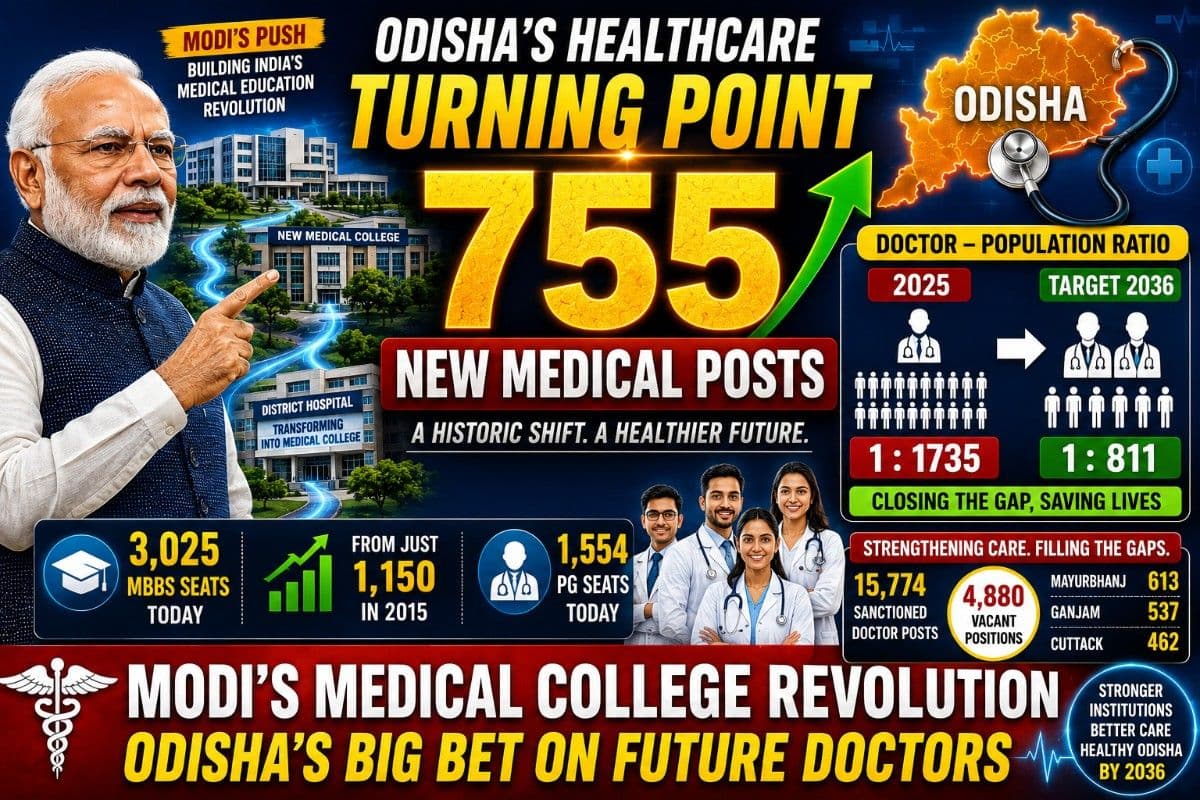
* MBBS seat capacity has surged from 1,150 in 2015 to 3,025 today, driven by the Centre's medical college expansion programme.
* Health Policy watchers believe Odisha could approach the national doctor-population ratio of 1:811 only by 2034-36 if recruitment and retention keep pace.
Bhubaneswar: In a significant shift, Odisha govt’s decision to create 755 new faculty and clinical posts is not just a routine administrative exercise. In reality, it could become one of the most consequential healthcare reforms in the state's history.
Signalling a policy shift, the State is not merely trying to fill existing vacancies, it is expanding its institutional capacity to train, retain and produce doctors at a scale to address the low doctor to population ratio.
The paradigm move by Odisha govt seems apparently to address the decade-long transformation triggered by the Narendra Modi government's nationwide medical education expansion programme.
While the first phase focused on creating medical colleges and increasing MBBS seats, it seems decision of the newly sanctioned 755 posts represent the next stage of that revolution – building the human infrastructure required to sustain the rapid growth.

📱 Get Argus News App
✨According to Healthcare policy watchers, since medical colleges create future healthcare systems. Odisha's latest decision is significant because it strengthens the foundation of that future system.
From Three Government Colleges to a Statewide Network
The scale of Odisha's transformation becomes evident when viewed against its historical trajectory.
Between 1959 and 2015, Odisha managed to establish only three government medical colleges. During the same period, the private sector gradually expanded and eventually overtook the public sector in seat capacity.
In the 2015-16 academic session, Odisha had:
- Only three government medical colleges.
- Around 550 government MBBS seats.
- Five private medical colleges offering nearly 600 seats.
- A total of about 1,150 MBBS seats.
And then more than 23,000 aspirants competed for these limited opportunities.
The picture began changing dramatically after the Centre launched the Centrally Sponsored Scheme (CSS) for establishing new medical colleges attached to district hospitals.
By 2021-22:
- Government medical colleges had increased to nine.
- Government MBBS seats rose to about 1,350.
- Total state capacity crossed 2,100 seats.
Today, according to the available data, Odisha has reached an unprecedented milestone:
- 21 undergraduate medical colleges.
- 3,025 MBBS seats.
- 1,554 postgraduate seats.
In little over a decade, MBBS seat capacity has expanded by more than 160 percent, while government-sector growth has decisively outpaced private expansion.
The transformation mirrors a larger national shift. In 2015, private medical colleges collectively offered more MBBS seats than government institutions across India. By 2026, the country has nearly 1.29 lakh undergraduate seats and over 85,800 postgraduate seats, supported by the Centre's aggressive medical education expansion strategy.
Why the 755 Posts Matter?
Until now, Odisha's medical expansion story has largely been about buildings, campuses and seat numbers.
The newly approved 755 posts signal a transition from infrastructure expansion to institutional strengthening.
Medical colleges cannot increase admissions indefinitely without adequate faculty, specialists, clinical departments and teaching staff. The new positions therefore create the academic backbone required for sustaining existing colleges and future seat enhancement.
This makes the latest decision fundamentally different from conventional recruitment drives.
How the Decision Aid Doctor – Population Ratio?
The answer remains complicated.
Odisha's doctor-to-population ratio currently stands at roughly 1 doctor for every 1,735 people – far behind the WHO benchmark of 1:1,000 and much below the effective national average of 1: 811.
Therefore, the challenge is not only producing doctors but ensuring they remain in the state and serve beyond urban centres. as a consequence, vacancies galore across the State.
The present scenario:
- 15,774 doctor posts are sanctioned.
- 4,880 positions remain vacant.
- Mayurbhanj alone accounts for 613 vacancies.
- Ganjam has 537 vacancies.
- Cuttack has 462 vacancies.
These numbers explain why rural healthcare continues to struggle despite a rapid rise in medical colleges.
However, demographic projections and current seat growth trends suggest that Odisha could begin narrowing the gap significantly over the next decade.
With more than 3,000 MBBS seats now available annually and increasing postgraduate opportunities within the state, Odisha could potentially add tens of thousands of locally trained doctors between 2026 and 2035.
Even after accounting for migration, specialization and attrition, healthcare planners believe the state could approach national doctor-population parity by around 2035-36 if current expansion rates are maintained and recruitment keeps pace.
The 755 new posts are therefore best viewed as the first step toward that long-term objective.
The Rural Challenge – Quake Therapy – Still Looms Large
Yet the biggest test of Odisha's medical revolution lies outside medical colleges.
Despite the surge in seats, large parts of rural Odisha continue to face chronic doctor shortages. Community Health Centres and referral hospitals remain heavily understaffed, particularly in specialist disciplines.
This vacuum has allowed quakes (unqualified and informal medical practitioners) to flourish in many remote pockets.
These practitioners often become the first point of contact because they are available round the clock and located close to villages. But dependence on such providers carries serious risks, including delayed diagnosis, irrational drug use and unsafe treatment practices.
The real measure of success for Odisha's medical expansion will not be the number of colleges built or seats added. It will be whether graduates emerging from these institutions eventually replace unsafe informal healthcare networks in underserved regions.
The Final Word: With Modi push to seat matrix, Majhi govt has to start targeting attaining the national doctor : population average of 1:811 in 2025 versus Odisha’s 1:1,735, atleast by 2036 to eliminate the biggest rural challenge.
Related Topics
Explore more stories