



Odisha May Soon Get Pothole-Free Roads Like Ahmedabad, Surat, Hyderabad, Chennai: Orissa HC Builds New Road Accountability Protocol| Special Report
Key Points
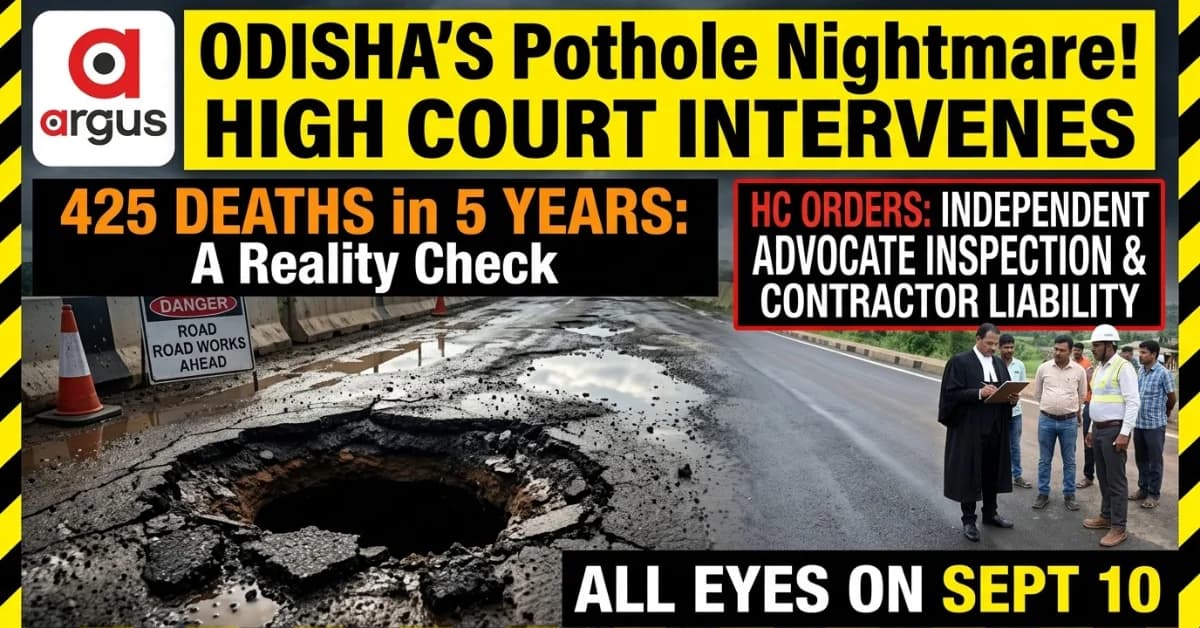
Bhubaneswar: Odisha may finally be on the road to pothole-free roads. The grim fact here has been that 425 people being killed in pothole-related road accidents in Odisha over a five-year period. But how soon? All eyes on September 10 now.
The poor status of roads in Odisha has been acknowledged by the Majhi led govt in State Assembly. For which, the State has initiated the following measures to perk up the status of roads in the State.
Status of Roads In Odisha: A Reality Check
|
Time Period |
|---|

📱 Get Argus News App
✨Action Entity
Policy / Funding Announcement
Operational Focus & Gaps
May–June 2026
Chief Minister / State Cabinet
₹150 crore Bhubaneswar Capital Allocation
Sanctioned specifically to overhaul failing road surfaces and internal commercial lanes, along with underground sewerage and drainage restructuring across major capital wards.
July 2026
Chief Minister / State Cabinet
₹30,000+ crore Mega Infrastructure Package
Expanded long-term rural and urban connectivity networks; proposed upgrading existing state roads, construction of 3,837 new bridges, and a framework for a comprehensive 50-year road sector policy.
On the above backdrop, Orissa High Court taking suo moto the poor roads in State's silver city (Cutack) has introduced a stringent ground-verification and accountability mechanism that could fundamentally change how roads are repaired, certified and maintained across the State.
The HC Intervention
The
intervention comes against the grim backdrop, where the Court has now
elevated a motorable road from a mere civic facility to a
constitutional
lifeline protected under Articles 19(1)(d) and 21.
What
makes the latest judicial intervention different is not another
direction to “repair roads”.
The Court has moved several steps ahead – towards creating a system in which road conditions are independently verified on the ground, officials who certify works can be identified, contractors can be made financially accountable and repeated promises can no longer substitute for motorable roads.
And that could be the beginning of Odisha's answer to cities such as Ahmedabad, Surat, Hyderabad and Chennai, where stronger road-management systems, concrete/white-topping solutions, drainage interventions and faster restoration mechanisms have helped reduce the recurring monsoon-pothole problem.
The big change: The Court no longer wants to believe the files
For years, the familiar sequence in Odisha's urban roads has been simple: roads deteriorate, authorities promise repairs, repairs are shown as completed, the monsoon arrives – and the potholes return.
The Orissa High Court has now called out precisely this cycle.
In its latest order, the Bench of Justice K.R. Mohapatra and Justice V. Narasingh recorded that repeated compliance affidavits had “not translated themselves to motorable roads”, describing the situation as an agonising cycle of potholes, repairs, monsoon and again potholes.
That observation is critical.
Because the Court's latest architecture is designed to ensure that what is reported on paper must match what exists on the street.
The new watchdog: Advocates will physically inspect roads
The most significant innovation is the use of an independent Advocates' Committee as an on-ground verification mechanism.
Instead of relying exclusively on municipal reports, engineering certificates or compliance affidavits, members of the committee are required to physically visit wards and inspect roads.
Their mandate goes beyond simply counting potholes. They are expected to examine arterial and sub-arterial roads and report the actual condition of the road network.
The latest Court order specifically asks the Advocates' Committees to visit their respective wards and submit a comprehensive report on arterial roads.
This effectively creates a second layer of scrutiny outside the executive machinery.
Why this matters
Until now, an authority could say that a road had been repaired.
Under the emerging judicial protocol, the more important question becomes:
Does the road actually remain repaired?
If an official compliance report says “completed” but an independent field inspection finds a crater-filled road, the discrepancy itself becomes evidence before the Court.
That is a fundamental shift from paper compliance to ground compliance.
The second breakthrough: Every road must have an accountable engineer
The Court has also targeted one of the biggest weaknesses in public-works accountability – the absence of identifiable responsibility when a newly repaired road deteriorates quickly.
Its earlier directions required ward-wise details of roads repaired, the funds sanctioned and, crucially, the names of the Junior Engineers who certified the works.
This changes the accountability equation.
A road will no longer simply be a project executed by an anonymous chain of departments and contractors. The certification trail can lead back to the official who declared the work satisfactory.
That creates a powerful deterrent: certification itself can carry consequences.
Third pillar: Contractors may have to pay when roads fail
The Court has repeatedly expressed concern over roads deteriorating soon after repairs and has called for defect-liability clauses that allow the government to recover repair costs from contractors responsible for sub-standard work.
The Court subsequently sought clarity on incorporating such a clause into contracts so that contractors are held accountable for the quality and durability of their work.
This could eventually change the economics of road construction.
At present, the worst possible incentive is:
Bad road → repair contract → road fails → another repair contract.
The judicial approach seeks to turn it into:
Bad road → contractor liability → recovery of repair cost.
If implemented consistently, that would make poor-quality construction financially painful rather than merely administratively inconvenient.
Fourth: No more “whose road is it?”
Another chronic problem exposed by the Court is jurisdictional confusion.
In Cuttack, officials of the Municipal Corporation and Roads & Buildings Department had differed over which agency was responsible for particular roads. The Court termed this a “patent lack of coordination”, observing that one department was trying to shift the onus to another.
The Court has consequently required the agencies to identify jurisdiction and coordinate where CMC, R&B and NHAI responsibilities overlap. It has also directed that roads be evaluated irrespective of which of these agencies owns them.
That is important because a pothole does not care which department owns the road.
For the commuter, the road is simply a road.
The Court is now attempting to make the administration think the same way.
Fifth: Potholes are no longer being treated as an isolated road problem
Perhaps the most important engineering shift is that the Court's framework looks beyond the visible pothole.
The supporting judicial framework requires examination of waterlogging, drainage failures, road and drain obstructions, encroachments, traffic pressure and utility-related damage.
This strikes at the root of Odisha's recurring monsoon problem.
A pothole is often merely the final symptom.
Water
remains on the carriageway.
The asphalt weakens.
Utility
agencies dig up the road.
The sub-base gets damaged.
Heavy
traffic loads the weakened surface.
The monsoon arrives.
The
pothole returns.
The Court is effectively demanding that the administration break this chain rather than repeatedly patch its final symptom.
The drainage connection could be the game changer
The latest order records the Housing & Urban Development Department's assurance that a Detailed Project Report is being prepared for proper storm-water discharge in Cuttack, specifically to tackle waterlogging during the rainy season.
That matters because Odisha cannot realistically aspire to durable pothole-free roads while allowing water to remain trapped beneath or over road surfaces.
The emerging judicial approach therefore connects three issues that are normally handled separately:
Road engineering + drainage + maintenance accountability.
That is potentially far more consequential than another round of resurfacing.
The Court has also changed the priority list
The latest directions require road repairs to be prioritised around markets, hospitals, educational institutions, accident-prone locations and densely populated wards. Urgent repairs can be undertaken on an emergent basis rather than waiting for the entire tender process.
In other words, the protocol is not simply about repairing more roads.
It is about repairing the right roads first.
And the Court wants a road-by-road, ward-by-ward database
Engineers in charge of each ward have been directed to prepare statements showing:
total road length;
roads requiring repair;
the nature/extent of damage;
the repair requirement; and
the timeline for completion.
The Court has further directed that the extent of damage may be measured in the presence of members of the Advocates' Committee.
That creates the possibility of something Odisha has historically lacked in a unified form:
a verifiable road-condition trail from identification to repair to certification to subsequent inspection.
And that is where the “pothole-free” possibility becomes real.
Why the 425 deaths make this more than a civic issue
The stakes are not cosmetic.
According to the inputs based on Ministry of Road Transport and Highways data, 425 people were killed in pothole-related accidents in Odisha over five years, placing the State fourth nationally in the cited dataset.
The danger is particularly acute for two-wheelers, who can lose balance suddenly after hitting potholes, especially at night or when potholes are concealed by rainwater.
So when the High Court says a road is a “lifeline” under Article 19(1)(d) read with Article 21, it is effectively reframing bad roads as a question of citizens' fundamental rights, not merely municipal inconvenience.
That constitutional framing could prove to be the most powerful element of the entire intervention.
Why Ahmedabad-Surat model now matters to Odisha
The objective is not merely to make roads look smooth for a few months.
Cities such as Ahmedabad and Surat have developed reputations for relatively consistent urban road maintenance, while Hyderabad has increasingly used white-topping/concrete overlays on important corridors to reduce recurring asphalt deterioration. Chennai and other Tamil Nadu cities have also experimented with mechanised pothole repair and smart-road interventions.
The lesson for Odisha is therefore not that it must copy one city.
It is that pothole management requires an entire system:
better construction → drainage → utility coordination → defect liability → inspection → certification → rapid repair → independent verification.
The High Court has now begun putting several of those pieces into one accountability chain.
But will this really make Odisha pothole-free?
There is one important caveat.
The immediate judicial proceedings concern the condition of roads in Cuttack/Katak, and the Court's latest order has not magically declared every road in all 30 districts of Odisha pothole-free.
What it has created, however, is potentially much bigger: a judicially enforced model of road accountability that can become a precedent for urban local bodies and road agencies across Odisha.
The supporting framework specifically envisages statewide implications through defect-liability provisions, constitutional accountability and greater responsibility for field engineers.
That means Cuttack could become the testing ground.
If the model works there, the question will inevitably be:
Why not Bhubaneswar? Why not Sambalpur? Why not Rourkela? Why not Berhampur? Why not every municipality?
The final test is now on the road, not in the affidavit
The Court itself appears conscious that another set of assurances will not be enough.
The latest order records its hope that the executive's assurances will result in visible changes actually being seen and felt on the streets, rather than remaining confined to affidavits and compliance reports.
The matter has been posted for September 10, 2026, when the Court intends to consider whether that change has actually begun.
That date could therefore become an important checkpoint.
Because Odisha's road story is no longer simply about how many potholes exist.
It is becoming a question of who inspected the road, who certified it, who repaired it, who is liable when it fails, and whether the government can prove that the road is actually motorable.
After 425 pothole-linked deaths, the High Court has put the road itself at the centre of constitutional accountability.
If
that protocol survives beyond Cuttack and becomes the template for
the State, Odisha could be witnessing the beginning of a fundamental
shift – from a culture of repairing potholes to a system designed
to prevent them from returning.
Also Read: Odisha Food Safety Blitz: Raids Hit Paneer & Lassi Shops But Is It Just a Showpiece?| Special Report
Related Topics
Explore more stories