



Odisha Food Safety Blitz: Raids Hit Paneer & Lassi Shops But Is It Just a Showpiece?| Special Report
Key Points
Bhubaneswar: With the festive season looming ahead in Odisha, the State Food Safety Department and the food safety wings of urban local bodies appear to have suddenly switched into an overdrive.
From Balasore to Berhampur and Bhubaneswar to Cuttack, news of food safety raids and detection of suspected adulterated food products is now pouring in at a rapid pace. What started with raids over alleged fake or adulterated paneer has now widened further, with lassi shops also coming under the scanner.
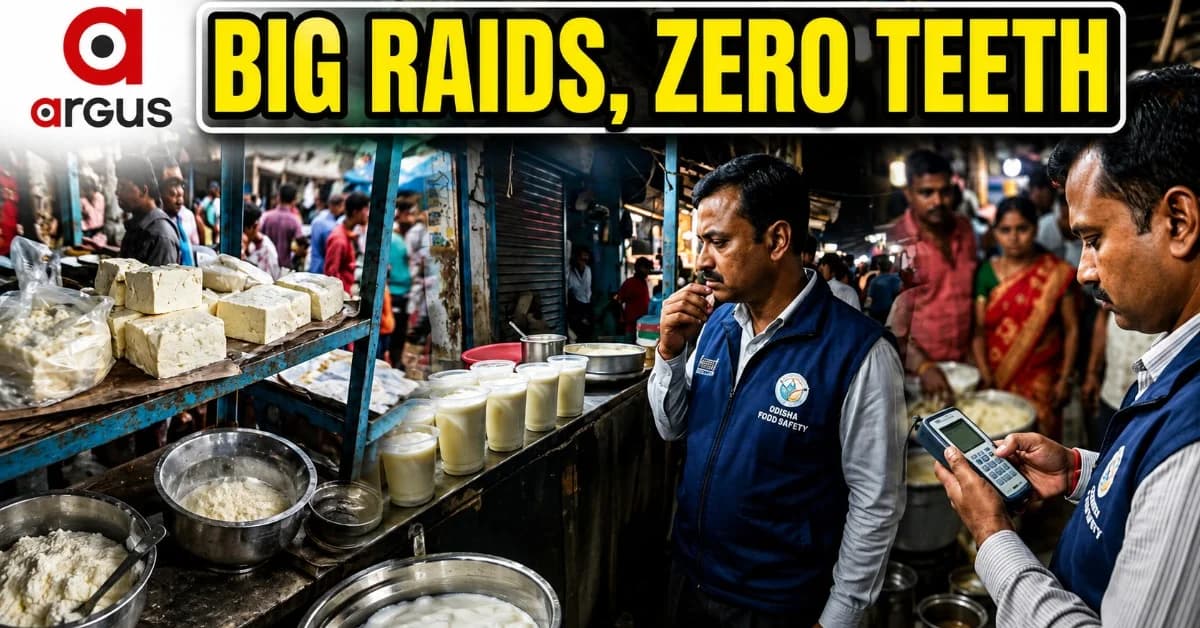
In Berhampur, multiple lassi shops in the busy Sana Bazar area came under the scanner on Friday, with Food Safety Department officials conducting inspections at various outlets as part of the continuing crackdown against suspected counterfeit and adulterated food products.
The Berhampur raids come close on the heels of a series of food safety actions reported from other parts of the State.

📱 Get Argus News App
✨In Balasore, officials inspected several shops and hotels in the Cinema Bazar area. In Bhubaneswar, a six-member Food Safety team raided restaurants at The World Mall over allegations of adulterated paneer being sold. In Cuttack too, the food safety wing has intensified inspections amid concerns over adulterated and unsafe food products.
The common thread running through these raids is striking: dairy and milk-based products.
Paneer first came under the spotlight. Now lassi shops are being checked.
And that is precisely where the timing of the sudden enforcement surge becomes significant.
FSSAI Had Sounded the Alarm Before the Festival Season
The Food Safety and Standards Authority of India (FSSAI) had already alerted all States and Union Territories to the heightened risk of food adulteration during the festival period.
In a directive earlier this year, FSSAI asked Commissioners of Food Safety across the country to launch a special “Anti-Adulteration Drive–2026”.
The reason cited by the food regulator was clear.
During the festival season, demand for sweets, savouries, edible oil and milk and milk products—including ghee, khoa and paneer – rises sharply. Such a seasonal demand spike, FSSAI warned, often creates economic incentives for adulteration, posing risks to public health and consumer confidence.
The national food regulator therefore directed State food safety authorities to intensify surveillance, inspections and sampling, particularly at identified hotspots and sensitive locations. It also asked States to strategically deploy available Food Safety on Wheels mobile testing laboratories for on-the-spot testing and surveillance.
A glance at the FSSAI directive now appears to explain the sudden burst of enforcement activity visible across Odisha.
The target commodities mentioned in the national regulator's advisory are almost the same categories that are now repeatedly appearing in Odisha's raid reports.
Milk products. Paneer. Sweets. Dairy-based products.
And now, even lassi.
Sample This: From Fake Paneer to Lassi
The latest raids show how quickly the enforcement net is spreading across Odisha.
Bhubaneswar: A six-member Food Safety Department team conducted inspections at restaurants in The World Mall following allegations that adulterated paneer was being sold.
Balasore: Food Safety officials inspected shops and hotels in the Cinema Bazar area as part of the crackdown against suspected counterfeit and adulterated food products.
Cuttack: Food safety enforcement has intensified, with suspected adulterated paneer and other food safety violations coming under the scanner during inspections.
Berhampur: The latest action has shifted the spotlight to lassi. Multiple shops in Sana Bazar are being inspected as the Food Safety Department widens its surveillance beyond paneer.
The pattern is important.
The enforcement agencies are no longer appearing to focus on one product or one district. The raid map is stretching from north Odisha to south Odisha and from the twin cities to major commercial centres.
But as the number of raids rises, a more fundamental question from Odisha's food safety data becomes impossible to ignore.
Where Do All These Raids Boil Down To?
The answer, going by the latest available official data, is sample testing.
And this is where Odisha's food safety machinery presents a troubling contradiction.
Food adulteration has been officially detected across 29 districts of the State. Everyday food items – lfrom ghee and paneer to chilli powder, sauce and other products – have figured in official records of adulteration.
Yet the number of food samples actually sent for testing has remained startlingly low for a State with a population of over 4.6 crore.
|
Financial Year |
Food Samples Tested |
Non-Conforming Samples |
Non-Conforming Rate |
|
2023-24 |
2,003 |
252 |
12.58% |
|
2024-25 |
2,282 |
273 |
11.96% |
|
2025-26* |
1,110 |
61 |
5.49% |
*2025-26 data provisional.
The most striking number is the latest one.
In 2025-26, Odisha tested just 1,110 food samples – less than half the 2,282 samples tested in the previous year.
This sharp fall makes the recent statewide burst of raids particularly significant.
Because raids by themselves do not establish the scale of adulteration.
Samples do.
A food inspector may enter dozens of shops, hotels and restaurants. But unless samples are systematically lifted and sent for laboratory examination, the actual extent of adulteration remains largely unknown.
Odisha's population-adjusted testing record is even more revealing.
During 2025-26, the State tested only about 24 food samples per million population, placing Odisha 20th among 21 major States, ahead of only Bihar.
For a State where adulteration has been officially detected across 29 districts, the surveillance intensity remains exceptionally thin.
The paradox is obvious.
The State has nine Food Safety on Wheels mobile testing laboratories, yet the total number of food samples tested in 2025-26 was only 1,110.
That works out to barely around 123 samples per mobile laboratory for the entire year, or roughly one sample every three days.
This is the real significance of the sudden flood of raid reports now emerging from across Odisha.
The raids may show that the enforcement machinery has become active ahead of the festive season.
But the next question will be: how many samples are actually being collected and sent for laboratory testing?
Raids Can Spread Fast, But Can Sampling Keep Pace?
The FSSAI's own festive-season strategy is based not merely on inspection but on inspection plus sampling plus testing.
The February directive specifically called upon enforcement officials to conduct inspections and sampling at hotspots and sensitive locations. It also stressed strategic deployment of mobile testing laboratories and mandatory recording of inspection, sampling and outcome data.
That makes the current Odisha crackdown a critical test.
With the festive season approaching, the food safety machinery is visibly more active. Raids are now spanning multiple cities and multiple categories of food products.
Fake paneer is under scrutiny.
Lassi has now entered the enforcement radar.
More products could follow as demand rises during the festival season.
But the real measure of this overdrive will not be the number of raids reported in the coming days.
It will be the number of food samples collected.
The number actually tested.
And the number found non-conforming.
Because Odisha's previous record shows that detection depends on the size of the testing net.
With only 1,110 samples tested in the latest year despite adulteration being reported across 29 districts, the State may not have been testing enough food to capture the true scale of the problem.
The raids have now begun to spread.
The question is what is going to be the logical conclusion of these highly publicised raids.
Related Topics
Explore more stories