



Odisha IPS Transfer Decoder: Why Guv’s First Woman Police ADC Got a 2-Month Tenure? | Exclusive
Key Points
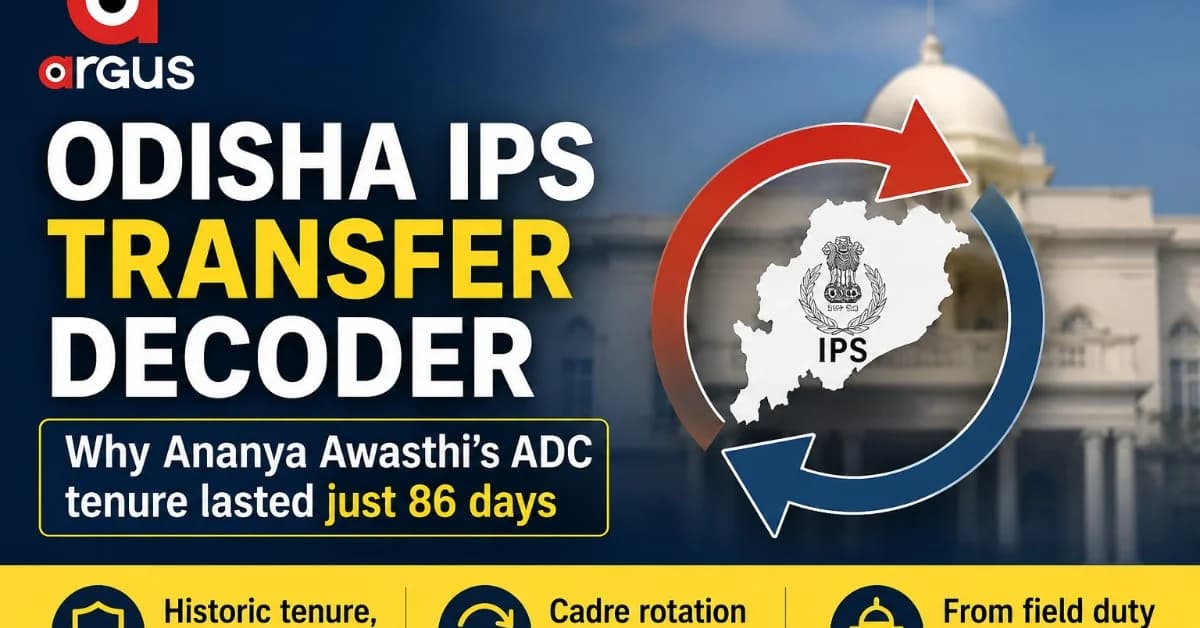
Bhubaneswar: By moving Ananya Awasthi from Raj Bhavan to the Bhubaneswar-Cuttack Commissionerate in just 86 days and bringing in 2023-batch IPS officer Anugu Shiva Maruthi Reddy from Kandhamal, the Odisha Home Department has executed a compact reshuffle that reveals the changing career choreography of young IPS officers.
For Ananya Awasthi, IPS, the journey to Raj Bhavan was historic. But the journey out of Raj Bhavan has come unusually fast.
On May 31, 2026, Awasthi became the first woman Police Aide-de-Camp (ADC) to the Governor of Odisha, marking a historic moment in the state's policing and administrative history. On August 24, the Odisha Home Department moved her out of that prestigious assignment and posted her back to the Bhubaneswar-Cuttack Police Commissionerate.
That gives her a tenure of just 2 months and 24 days.

📱 Get Argus News App
✨For the Raj Bhavan, where a Police ADC appointment often lasts around one to two years, the duration stands out.
But the transfer order becomes more interesting when decoded alongside the officer chosen to replace her: 2023-batch IPS officer Anugu Shiva Maruthi Reddy, who is moving from frontline policing as SDPO of G. Udayagiri in Kandhamal to the Governor's House.
This is not merely an ADC replacement. The transfer order appears to be a carefully balanced reshuffle of two young officers at different stages of their IPS career trajectories.
The 86-Day Question
The first question raised by the reshuffle is obvious: Why was Odisha's first woman Police ADC moved out so quickly?
A Police ADC to the Governor is among the most prestigious early-career assignments available to a young IPS officer. The role places the officer at the intersection of constitutional protocol, high-level security, VVIP movements and state ceremonial functions.
Yet it is fundamentally different from executive policing.
An officer posted as an ACP or SDPO directly deals with crime, law and order, investigations, police station supervision and field operations. An ADC, in contrast, performs a highly specialised security and protocol role.
For a young IPS officer, therefore, the Raj Bhavan assignment offers prestige and exposure – but it cannot become a substitute for sustained executive policing.
This may explain why the Home Department has moved Awasthi back into the Bhubaneswar-Cuttack Police Commissionerate. At her stage of service, field and executive exposure remains crucial for the next phases of her career progression.
The move, therefore, can be decoded as a return from constitutional protocol to operational policing.
Why Bhubaneswar-Cuttack May Need Her More
The second layer of the transfer lies in the destination.
Awasthi has not been moved to a quiet district or another ceremonial assignment. She is being brought into the state's most demanding urban policing environment – the Bhubaneswar-Cuttack Police Commissionerate.
The twin-city police system handles an exceptionally wide range of challenges: capital security, VIP and VVIP movement, political protests, cybercrime, organised crime, economic offences, traffic management and major public events.
It also requires a continuous supply of young executive officers at the ACP level.
For the Home Department, the calculation may have been simple: a young officer who had already gained exposure in Sundargarh, worked in Cuttack's urban policing system and then spent nearly three months at Raj Bhavan could now be more immediately useful in a frontline commissionerate role.
In that sense, Awasthi's short ADC tenure may not represent an interruption in her career. It may instead represent a rapid career rotation designed to keep her firmly anchored in executive policing.
From G. Udayagiri to Raj Bhavan: The Reddy Shift
If Awasthi's move is a return to the field, the appointment of Anugu Shiva Maruthi Reddy represents the reverse transition.
The 2023-batch IPS officer has been serving as SDPO of G. Udayagiri in Kandhamal – a frontline post that offers an entirely different kind of policing exposure.
His career track has been moving quickly through the foundational stages of an IPS officer's early years:
UPSC Civil Services Examination 2022 → IPS 2023 batch → Odisha cadre → BPSPA training in Bhubaneswar → SDPO, G. Udayagiri → Police ADC to the Governor
Reddy reported to the Biju Patnaik State Police Academy in October 2024 for his state-level police training. He subsequently moved into active field duty at G. Udayagiri, where the job required direct supervision of policing at the sub-divisional level.
Now, the Home Department is giving him a dramatically different exposure: Raj Bhavan.
The move will take him from rural field policing to a role requiring high-level protocol coordination, constitutional security management and close interaction with the Governor's office and the state's senior administrative structure.
The Kandhamal Factor
Reddy's previous posting also gives the transfer an additional dimension.
G. Udayagiri is located in Kandhamal, a district with a complex policing history involving communal sensitivity, difficult terrain and the wider security challenges associated with its historical Left-wing extremism footprint.
For a young IPS officer, an SDPO posting in such a region provides intense field exposure early in service.
Moving him after this frontline stint to Raj Bhavan fits a familiar pattern in the career development of young direct-recruit officers: field baptism first, institutional exposure next, followed by further executive assignments.
The Raj Bhavan posting will give Reddy a different understanding of how constitutional institutions, protocol systems and high-level security arrangements function.
The Career Swap Behind the Transfer
Seen together, the reshuffle almost resembles a carefully timed exchange of experiences.
Ananya Awasthi is moving:
Field policing → Urban ACP exposure → Raj Bhavan → Back to executive policing
Anugu Shiva Maruthi Reddy is moving:
Training → Rural SDPO field policing → Raj Bhavan
The Home Department appears to be ensuring that neither officer remains confined to one kind of policing environment during the crucial early years of service.
That is the larger significance of the August 24 order.
The reshuffle is less about a simple change of faces at Raj Bhavan and more about cadre choreography – moving young officers between field policing, urban policing and constitutional assignments to broaden their professional exposure.
A Historic Appointment, But a Brief One
Awasthi's tenure will nevertheless remain significant because of what her appointment represented.
She broke a gender barrier by becoming the first woman Police ADC to the Odisha Governor. The post had traditionally been held by male police officers, making her May 31 appointment a milestone in the history of Odisha policing.
Her successor now takes over the role at the beginning of his own career.
The contrast is striking. One officer is leaving Raj Bhavan after making history; another young officer is entering the same office after completing his first major frontline policing assignment.
The Transfer Decoder
The August 24 reshuffle can be read through three layers:
First: Field policing remains central to an IPS career. A prestigious constitutional assignment may add valuable exposure, but young officers still need sustained executive and operational experience.
Second: Bhubaneswar-Cuttack requires young executive manpower. Moving Awasthi back into the Commissionerate indicates the continuing demand for trained direct-recruit officers in the state's most complex urban policing zone.
Third: Raj Bhavan is being used as a career-building exposure posting. After frontline duty at G. Udayagiri, Reddy now gets experience in constitutional protocol and high-level security coordination.
The most unusual feature of the transfer remains the number: 86 days.
For Odisha's first woman Police ADC, the Raj Bhavan chapter lasted just 2 months and 24 days – far shorter than the more familiar one-to-two-year tenure often associated with the assignment.
But the transfer order suggests that the Home Department's priority was not to preserve a fixed tenure. It was to keep two young IPS officers moving through different professional environments.
And
that is the real decoder behind the reshuffle: one
young officer is being pulled back into the pressure zone of urban
policing, while another is being moved from Kandhamal's frontline
into the constitutional corridors of Raj Bhavan
Also Read: Odisha Big IPS Reshuffle: Heavy-Hitting IGs Himanshu Lal, Satyabrat Bhoi Pulled Out from Field-Range Desks to State Command| Exclusive
Related Topics
Explore more stories