



Odisha Flood Relief 2026: Centre Approves ₹500 Crore Advance SDRF Funds, Odisha Among Top Beneficiaries| Special Report
Key Points
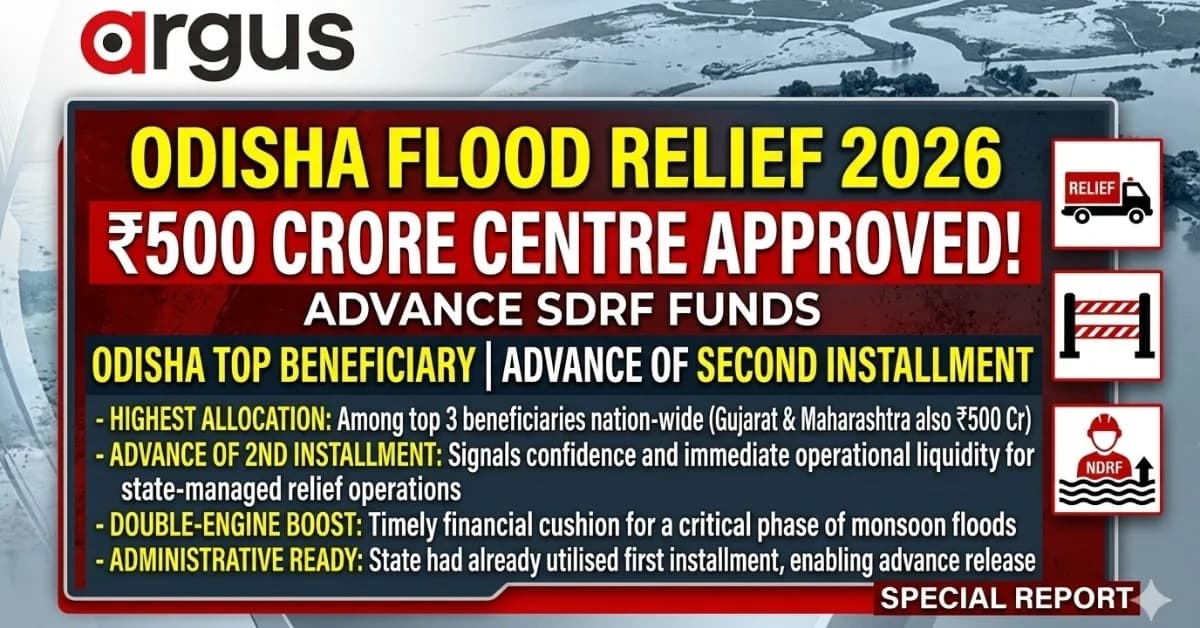
Centre clears maximum SDRF allocation to Odisha even before fresh damage assessment, signalling confidence in the state's disaster response machinery amid the ongoing flood battle.
Bhubaneswar: As Odisha grapples with the first major flood spell of the 2026 southwest monsoon, the "double-engine government" narrative has received a fresh boost. The Centre has sanctioned ₹500 crore to Odisha under the State Disaster Response Fund (SDRF)—placing the state among the highest beneficiaries in the country at a time when floodwaters continue to threaten large parts of the Mahanadi delta and northern river basins.
The financial assistance assumes significance because Odisha is the only state among the top beneficiaries to receive the advance release of the second SDRF installment, indicating that it had already exhausted or substantially utilised the first installment during the current financial year. Gujarat and Maharashtra also received ₹500 crore each, but those were advance releases of their first installment.
The latest central release forms part of the ₹2,117.85 crore sanctioned for seven flood-affected states.
Odisha's ₹500 Crore Tells a Bigger Story

📱 Get Argus News App
✨Unlike several other states that received advance funds with relaxed documentation owing to the evolving flood situation, Odisha's allocation reflects a different assessment by the Union Home Ministry.
The state had already drawn its first SDRF installment for FY 2026-27 and demonstrated utilisation of those funds. That enabled the Centre to clear the second installment in advance, effectively providing Odisha with immediate financial liquidity when flood relief operations are intensifying.
In disaster management terms, this is significant because SDRF is the first line of funding available to state governments for emergency response.
The fund finances relief camps, food, drinking water, temporary shelters, compensation for deaths and injuries, crop input subsidies, assistance for damaged houses and temporary restoration of essential public infrastructure such as embankments, drinking water systems and electricity supply.
Why Odisha Figures Among the Top Beneficiaries
The Centre's decision also reflects Odisha's unique disaster vulnerability.
With a coastline stretching nearly 480 km and river systems such as the Mahanadi, Baitarani, Brahmani and Subarnarekha, the state routinely faces compound disasters during the monsoon—river floods, intense localised rainfall and tidal influences in coastal districts.
This year's floods again underline that vulnerability, with large inflows into Hirakud Reservoir, rising river levels and inundation warnings issued across several districts.
Another factor appears to be Odisha's institutional capacity.
Over the years, the state has built one of India's most structured disaster management systems, enabling rapid utilisation of emergency funds and timely accounting. Such administrative readiness often influences the Centre's decision to release higher advance allocations, as funds can be deployed immediately instead of remaining unutilised.
How the Centre Assesses Flood Damage
When flood losses exceed the state's immediate response capacity, the Union Government deputes an Inter-Ministerial Central Team (IMCT) to physically assess damages.
The assessment covers multiple parameters, including:
- Human casualties and livestock losses.
- Crop damage, particularly where losses exceed one-third of the cultivated area.
- Damage to roads, bridges, schools, health centres and power infrastructure.
- Duration and spread of flooding, including villages cut off from communication.
- The extent to which the state has already utilised its SDRF resources.
The IMCT findings eventually form the basis for additional assistance from the National Disaster Response Fund (NDRF), if required.
NDRF Deployment Begins Before Floods Peak
Parallel to financial assistance, the Centre also supports states through the National Disaster Response Force (NDRF).
The deployment is largely proactive.
Based on forecasts issued by the India Meteorological Department (IMD) and the Central Water Commission (CWC), NDRF teams are pre-positioned in vulnerable districts before floodwaters reach critical levels.
Once deployed, the specialised teams coordinate with district administrations and state disaster response forces while carrying advanced rescue equipment such as inflatable boats, life jackets, medical response kits and deep-water rescue gear.
How Other Flood-Hit States Fared
Among the seven states covered in the latest release:
|
State |
Amount Released |
Nature of Assistance |
|
Odisha |
₹500 crore |
Advance release of second SDRF installment |
|
Gujarat |
₹500 crore |
Advance first installment |
|
Maharashtra |
₹500 crore |
Advance first installment |
|
Assam |
₹379.35 crore |
Advance first installment |
|
Himachal Pradesh |
₹193.95 crore |
Advance second installment |
|
Arunachal Pradesh |
₹44.55 crore |
Advance first installment |
|
Nagaland |
No fresh allocation in this order |
IMCT being constituted |
A Timely Financial Cushion
For Odisha, the fresh ₹500-crore assistance arrives when flood management has entered a critical phase. Relief camps, evacuation operations, crop protection, restoration of damaged infrastructure and emergency services require continuous funding.
With another substantial tranche now available, the state government is expected to have greater operational flexibility in sustaining relief measures while preparing for any further spell of heavy rainfall during the monsoon season.
The
allocation also reinforces Odisha's position as one of the country's most
disaster-prone yet administratively prepared states—where vulnerability is
matched by an established capacity to absorb and deploy emergency funds quickly
when nature strikes.
Alos Read: Mahanadi Flood: Odisha Braces for 5-Foot Inundation in Bhubaneswar, Jagatsinghpur & Puri Pockets Sunday-Monday| Exclusive
Related Topics
Explore more stories