



Odisha Eyes Electrical Equipment Manufacturing Boom; Joins Gujarat in Race to Woo High-Employment Sector at August Investor Meet| Special Report
Key Points
Bhubaneswar: The Odisha government is preparing to make one of its strongest sector-specific investment pitches at the upcoming investors' meet this month, with electrical equipment manufacturing emerging as the new focus area.
Banking on a sector capable of generating around 1.2 lakh to 1.5 lakh jobs for every Rs1 lakh crore invested, the state is set to join frontrunner Gujarat in aggressively courting manufacturers of transformers, switchgears, cables, smart meters, power equipment, industrial motors and grid infrastructure.
The move signals a strategic shift in Odisha's industrial policy – from being primarily a supplier of metals to becoming a manufacturing destination for value-added electrical equipment.
Electrical Equipment: Odisha's Next Big Employment Engine

📱 Get Argus News App
✨The timing of Odisha's push could not be more significant.
India's energy transition, rapid renewable energy expansion, power distribution reforms and transmission infrastructure projects are driving unprecedented demand for electrical equipment. Massive investments in green energy, battery storage systems, smart grids, electric mobility and industrial electrification are expected to keep demand buoyant for the next decade.
Recognising this opportunity, the Odisha government intends to position the state as a preferred destination for manufacturers looking to establish integrated facilities for power transmission equipment, electrical machinery, cables, conductors, transformers and renewable energy components.
Unlike traditional heavy industries that are capital intensive with relatively lower employment generation, electrical equipment manufacturing offers significantly higher direct and indirect job creation while nurturing a strong MSME vendor ecosystem.
Why Odisha is Taking on Gujarat
For years, Gujarat has dominated India's heavy electrical equipment manufacturing ecosystem, while Tamil Nadu has emerged as the country's electronics manufacturing powerhouse. Gujarat enjoys a dense network of original equipment manufacturers (OEMs), component suppliers and export-oriented industrial clusters.
Odisha, however, believes it possesses structural advantages that can help it narrow the gap.
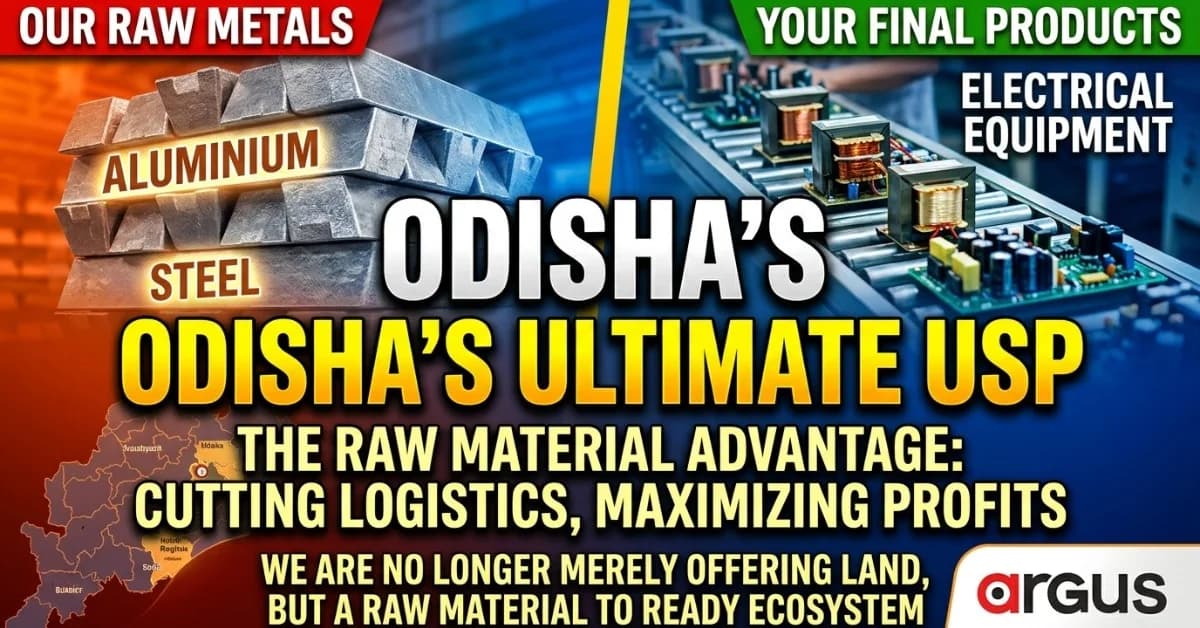
Unlike Gujarat, which largely sources key industrial metals from other states, Odisha sits at the very source of the raw materials that power the electrical equipment industry.
The state produces over half of India's aluminium, remains the country's largest steel producer and possesses significant reserves of nickel, cobalt and manganese – all critical inputs for power equipment, transmission infrastructure, battery energy storage systems and renewable energy components.
This upstream dominance enables manufacturers to cut logistics costs, improve supply chain efficiency and reduce production expenses.
The state also offers a strategic logistics advantage through Paradip Port, providing direct access to eastern India, the North-East and fast-growing ASEAN markets.
Odisha's Biggest USP: Raw Materials to Ready Ecosystem
Odisha's biggest selling point is that it is no longer merely offering land to investors; it is offering an integrated manufacturing ecosystem.
The state's Info Valley Electronics Manufacturing Cluster near Bhubaneswar provides plug-and-play infrastructure for electronics and electrical component manufacturers, complete with ready factory spaces, reliable utilities and common testing facilities.
Downstream metal parks at Angul and Kalinganagar allow industries to source aluminium and steel virtually at the production point, reducing transportation costs and improving competitiveness.
The emerging electrical and capital goods cluster in Khordha is further strengthening the local supplier base for switchgears, circuit breakers, control panels and industrial equipment.
Supporting this ecosystem are more than 1,000 MSMEs supplying components, state-backed testing facilities, dedicated industrial power infrastructure and the "Skilled in Odisha" programme, which is producing technicians trained in electronics assembly, CNC machining and high-voltage systems.
Perhaps the strongest argument in Odisha's favour is the demand that already exists within the state itself.
With an ambitious industrial expansion programme worth nearly Rs10 lakh crore and a target of developing 11 GW of renewable energy capacity by 2030, Odisha will require enormous quantities of transformers, smart meters, substations, switchgears and transmission equipment over the coming years.
Instead of merely exporting raw materials, the state is now seeking to manufacture these products locally, creating jobs, building ancillary industries and moving up the industrial value chain.
If the
upcoming investors' meet succeeds in attracting major electrical equipment
manufacturers, Odisha's industrial story could undergo a significant
transformation – from India's mineral storehouse to one of the country's
fastest-growing destinations for high-value electrical equipment manufacturing.
Also Read: Textiles, HCL Lead Odisha's Labour-Intensive Industrial Evolution as SLWC Clears ₹4,573-Crore Investments | Special Report