



Odisha Cotton Yield Beats Gujarat, Maharashtra: How Double Engine Push Made State India’s No.1| Exclusive
Key Points
Odisha records India’s highest cotton yield at 620 kg/ha, surpassing Gujarat and Maharashtra.
Cotton procurement value in Odisha jumps from ₹344 crore to ₹1,080 crore in just two years.
The productivity surge strengthens CM Mohan Majhi’s vision of making Odisha Eastern India’s next textile manufacturing hub.
Bhubaneswar: Here comes a striking agricultural story for Odisha: the state has emerged as India’s highest cotton-yielding major state in 2025-26, overtaking traditional cotton giants Gujarat and Maharashtra.
The timing looks significant, when the Mohan Charan Majhi led BJP government is aggressively pushing Odisha as a textile manufacturing destination, with a stated ambition to build a farm-to-fabric ecosystem and attract large downstream investments.
The Parliament data suggests that Odisha’s cotton story is no longer merely about acreage – it is increasingly about productivity, raw-material security and the ability to feed a future textile industry from within the state.
The numbers underline the scale of the turnaround.

📱 Get Argus News App
✨Odisha’s cotton productivity has climbed steadily from 551 kg/ha in 2021-22 to 620 kg/ha in 2025-26, even as its cotton acreage expanded from 193.11 thousand hectares to 239.42 thousand hectares.
At 620
kg/ha, Odisha is now ahead of Gujarat’s 551 kg/ha, Telangana’s 460 kg/ha and
Maharashtra’s 342 kg/ha.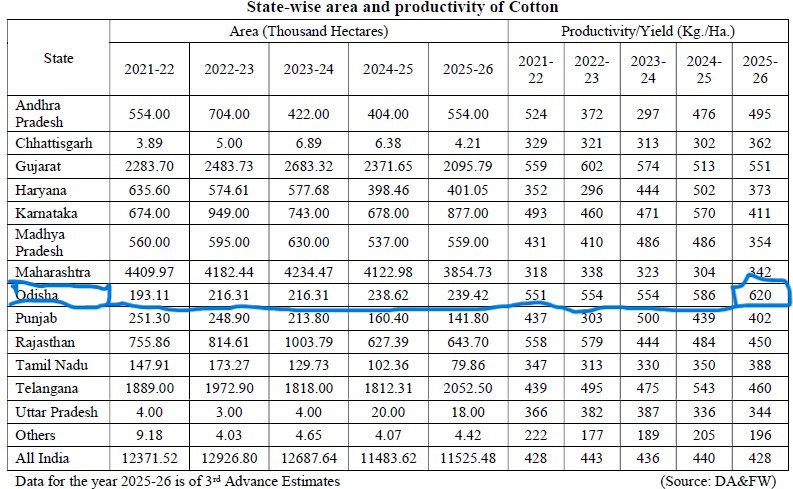
What makes the achievement particularly notable is the contrast in scale: Maharashtra cultivated 3.85 million hectares and Gujarat 2.09 million hectares, compared with Odisha’s 2.39 lakh hectares. Yet Odisha extracted substantially more yield from every hectare.
In tandem, the state’s procurement has also surged – from 0.95 lakh bales worth Rs344 crore in 2023-24 to 2.70 lakh bales worth Rs1,080 crore in 2025-26.
The Double Engine Gallop
The cotton numbers point to what can be described as a Double Engine effect – the Centre providing the price and procurement architecture, while the Odisha government focuses on local execution and creating the ecosystem around the crop.
The raw economic force driving the numbers comes entirely from New Delhi:
The Ultimate Price Shield: The central government sets the national Minimum Support Price (MSP). When global markets crashed, the center absorbed the risk, pumping a massive Rs1,718 crore subsidy nationally into the Cotton Corporation of India (CCI) to buy cotton from farmers when private traders wouldn't.
Massive Infrastructure Scale-up: The Union Ministry of Textiles expanded the physical procurement footprint. The number of active CCI procurement centers across India was aggressively pushed from 508 in 2024-25 up to 571 centers in 2025-26, bringing official central buying directly into remote hinterlands like Odisha's Central Zone.
The Odisha BJP Govt Role
The specific ground-level actions that Odisha took during these last two years to convert central funding into direct local success include:
Eliminating Border Leakage and "Distress Sales": Historically, because Odisha lacked local processing, private middlemen from neighbouring Andhra Pradesh and Telangana would cross the border during harvest. They routinely bought Odisha’s premium cotton at dirt-cheap, predatory rates and smuggled it out.
The Dr Fixit: Over the last two years, the Odisha state administration, in coordination with regulated Market Committee (RMC) yards, set up strict border check-posts and dedicated local Mandis (market yards) specifically in the Kalahandi-Bolangir-Koraput (KBK) region. By physically bringing the Cotton Corporation of India (CCI) procurement counters directly to the farmers' doorsteps, the state blocked out-of-state middleman networks, forcing the cotton to be registered and paid for locally.
Achieving Near-Zero Pest Outbreaks: As the table below proves, northern states like Haryana were economically crippled by severe pest attacks, requiring hundreds of crores in insurance payouts. If a massive pest outbreak had hit Odisha, even a high central MSP wouldn't have saved the yield.
Odisha’s state agriculture department executed highly disciplined Integrated Pest Management (IPM) block-level monitoring. By training smallholder farmers to spot early signs of Pink Bollworm and enforcing strict seed quality controls at the borders, they kept crop damage virtually nonexistent. This allowed the central government's High-Density Planting System (HDPS) subsidies to work flawlessly, creating the swift yield spike to 620 Kg/Ha.
Micro-Irrigation and the "Krushak Odisha" Database: Central subsidies are only useful if the government knows exactly who the genuine farmers are and where they are located.
Odisha utilized its robust Krushak Odisha digital database to seamlessly verify cotton farmers and fast-track them into the central procurement system.
Simultaneously, the state focused on shifting cotton from purely rain-fed fields to areas backed by farm ponds and subsidized micro-irrigation kits under state schemes. This micro-level water management insulated the crop from erratic monsoon patches over the last two seasons.
Textiles Manufacturing Ambition ‘In High Cotton’?
With the double engine gallop yielding results on ground, will it prove the State govt’s mega push for making Odisha a textile hub or ‘Tirupur/Surat of East’?
Check the following indicators.
- Steady Acreage Expansion
- The Yield Leader
- Financial Realization: The Most Profitable Market Prices: For textile manufacturers looking to source locally, Odisha’s farmers are already heavily incentivized because they realize excellent market traction.
- Premium Market Pricing: In 2025-26, the average modal market price realized by farmers in Odisha was Rs. 7,403 per quintal. This safely clears the national Minimum Support Price (MSP) of Rs. 7,710 for Medium Staple when accounting for standard market fluctuations, keeping farming highly viable.
- Massive Procurement Boom: This indicates a highly secure, formal, and organized supply chain ready for industrial off-take.
- Unmatched Crop Security & Climate Resilience: The most striking insight for textile investors is Odisha’s near-zero reliance on central insurance payouts, proving it is one of the safest agricultural zones for raw material sourcing. (see the table below)
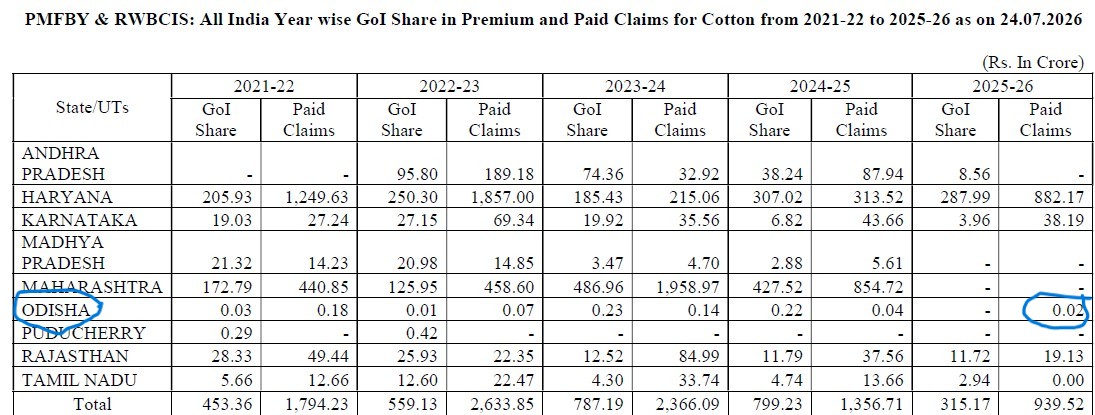
The
Bottomline
This agricultural surge now dovetails neatly with CM Majhi’s textile manufacturing push.
Odisha has historically produced cotton in its western and southern belts but lacked sufficient downstream processing, forcing a substantial portion of the raw material to move outside the state for ginning and spinning.
The government is now seeking to reverse that pattern by pushing textile and spinning capacity closer to cotton-producing districts such as Balangir, Sonepur and Kalahandi, alongside projects such as the proposed Rs124-crore cotton-to-yarn unit and larger apparel and technical-textile investments.
The significance is straightforward: if Odisha can combine the country’s highest cotton productivity with local ginning, spinning, yarn, apparel and technical-textile manufacturing, the state can capture far more value from the same farm output.
The cotton
miracle, therefore, may prove to be not the end of the story but the
raw-material foundation of Odisha Govt’s larger textile ambition.
Also Read: Odisha Eyes Electrical Equipment Manufacturing Boom; Joins Gujarat in Race to Woo High-Employment Sector at August Investor Meet| Special Report