



YB Khurania: The System Man Who Leaves Odisha Police With an Institutional Blueprint
Key Points
Bhubaneswar: Y.B. Khurania, who today walks down the shades of retirement, had never been a flamboyant cop.
Through a 36-year police career, the 1990-batch IPS officer largely stayed away from personality-driven policing and media theatrics.
In the annals of Odisha policing, Khurania will perhaps be remembered more as a system man and an institutional policing officer – someone who preferred to repair the machinery rather than seek the spotlight for individual operations.
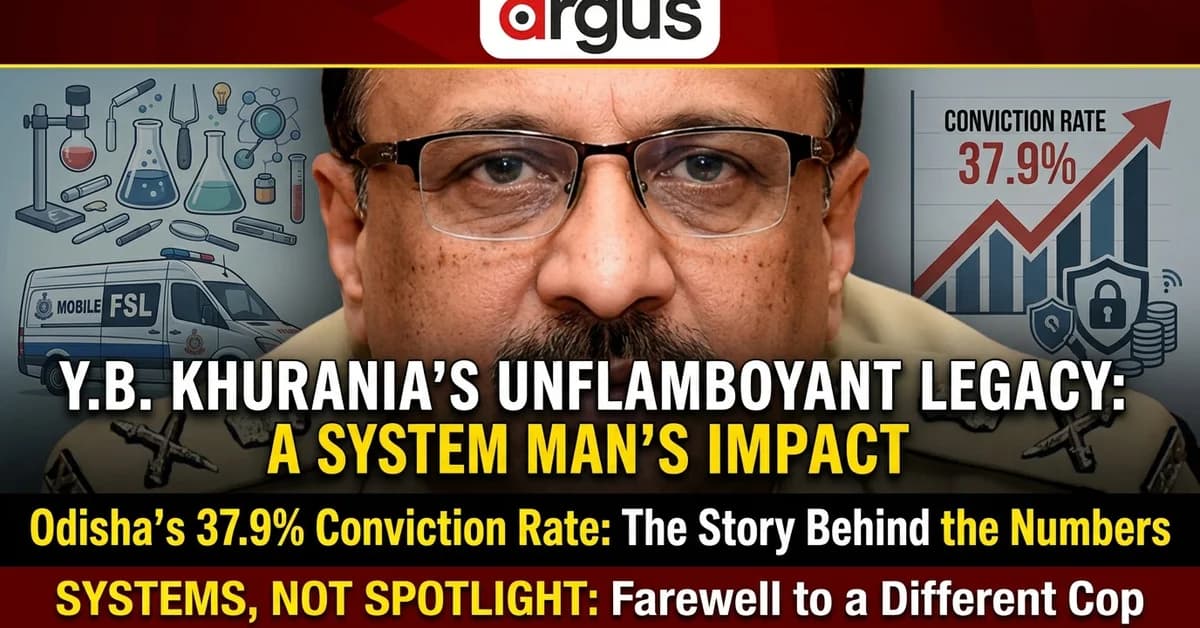
Those defining shades of Khurania were particularly visible during his two-year tenure at the helm of Odisha Police. And perhaps the biggest evidence of that institutional approach lies not in a single sensational operation, but in a number: Odisha recorded a historic conviction rate of 37.9% in 2025.

📱 Get Argus News App
✨The system behind the 37.9% conviction rate
For Khurania, improving policing was as much about changing the architecture of investigation as it was about increasing arrests or seizures.
One of his most consequential interventions was the decentralisation of forensic investigation. Odisha Police deployed 36 Mobile Forensic Science Laboratory vans, taking scientific evidence collection closer to crime scenes instead of keeping the process dependent on centralised forensic infrastructure. The change brought down the reported response time for crime-scene evidence collection from around 4–8 hours to 1–2 hours.
That mattered because the quality of a criminal case is often determined at the crime scene, not in the courtroom. Faster forensic intervention meant better preservation of evidence, more standardised collection and greater reliance on scientific evidence.
Khurania also pushed policing deeper into the digital age. Under his tenure, Odisha expanded to 34 dedicated cyber police stations, created 1,067 IT-centric posts and worked towards placing cyber experts in police stations across the state. Nearly 40,000 mule accounts were blocked, with the system claiming to have saved Rs328 crore from digital fraud.
His approach was therefore clear: make investigation less dependent on individual policing skills and more dependent on systems, technology and evidence.
The same philosophy was visible in the decision to treat all missing-person reports as active crimes, forcing faster institutional response, particularly in cases involving missing women.
Building the police institution: Men, mobility and infrastructure
Khurania inherited a force carrying a significant manpower burden. Before 2024, around 16,000 police posts were vacant. His tenure saw a fast-tracked effort to fill those vacancies, addressing one of the most basic requirements of policing: having enough personnel on the ground.
The institutional push went beyond recruitment.
He sought to strengthen the physical and technological capacity of the force – from vehicles and mobile forensic units to cyber infrastructure and coastal surveillance. Odisha's 18 Marine Police Stations were brought under a more technology-enabled coastal security architecture, including long-range surveillance drones and high-speed trawlers.
He also left behind permanent institutional structures rather than temporary operational arrangements. The creation of a dedicated 1,083-person Jagannath Temple Security Battalion was one such example, designed to institutionalise crowd management and pilgrim security in Puri.
The same institutional thinking shaped his anti-narcotics strategy. Rather than treating drug seizures as isolated successes, his tenure produced a March 2029 Drug-Free Odisha blueprint, with cannabis cultivation targeted across eight districts and a multi-agency approach to dismantling the narcotics network.
In internal security, too, the Khurania tenure ended with perhaps the most significant structural milestone: Odisha was officially declared Naxal-free on March 31, 2026, after years of counter-insurgency operations. Yet, tellingly, Khurania's farewell message did not treat that achievement as the end of the problem.
Khurania's two years: The good, the bad and the unfinished
|
Area |
The Khurania gain |
The other side of the tenure |
|
Internal security |
Odisha achieved the historic milestone of becoming Naxal-free; three new OSSF battalions were raised. |
The outgoing DGP himself warned that dormant Maoist elements could potentially attempt a comeback if vigilance drops. |
|
Investigation |
36 Mobile FSL vans decentralised forensic investigation and reduced response time from 4–8 hours to 1–2 hours. |
The system still requires trained personnel and sustained investment to make scientific investigation routine across every police station. |
|
Conviction |
State conviction rate reached a historic 37.9%, reflecting a stronger evidence-led investigation architecture. |
Institutionalising that rate under successive leadership remains the bigger challenge. |
|
Manpower |
Around 16,000 vacant posts were fast-tracked for recruitment, strengthening the force's human-resource base. |
Absorbing such a large intake created pressure on training and administrative capacity. |
|
Cyber policing |
34 dedicated cyber police stations and 1,067 IT-focused posts pushed Odisha towards specialised digital policing. |
Cyber expertise remains unevenly distributed, particularly at smaller and rural police stations. |
|
Narcotics |
Large-scale cannabis destruction and seizures were backed by a structured Drug-Free Odisha blueprint till March 2029. |
Inter-state trafficking routes and evolving drug networks remain a continuing challenge. |
|
Coastal security |
Drone-based surveillance and stronger marine policing infrastructure expanded the state's technological reach along the coast. |
Maintaining surveillance across a long coastline will require sustained resources and technology upgrades. |
|
Public order |
Stronger punitive and structural responses were introduced against organised mob violence and habitual rioters. |
The tenure also witnessed a difficult public-order environment, including communal riots and major mob-violence incidents. |
|
Citizen policing |
Missing-person cases were brought into an active-crime framework, with greater emphasis on women and citizen safety. |
The challenge is to ensure that these institutional reforms translate consistently into police-station-level behaviour. |
The three challenges Khurania leaves for the next DGP
At his customary retirement-day press conference, Khurania's message to his successor was less about his own legacy and more about what Odisha Police must confront next.
First is cybercrime. With 34 cyber police stations already in place, the next challenge is to take cyber expertise right down to every police station and make the force more proactive against increasingly sophisticated digital crime.
Second is narcotics. Khurania pointed towards the March 2029 target for a drug-free Odisha, with cannabis cultivation and trafficking remaining a major challenge. The blueprint exists; the test for the next leadership will be implementation.
Third is coastal security. With 18 marine police stations and drone surveillance already in place, the next phase will require newer technologies and continuous vigilance along Odisha's coastline.
But there was another, more personal message in Khurania's farewell.
After retirement, he said, he would no longer wear the uniform and would become an ordinary citizen. And that, perhaps, explains the essence of his two-year tenure better than any operational statistic.
The system man who spent his final years strengthening the police machinery was preparing to become one of the people that machinery is meant to serve.
His real
legacy, therefore, may not be a particular raid, encounter or headline. It
could be whether the systems he leaves behind – forensics, digital policing,
manpower, institutional investigation, citizen response and specialised
security forces – continue to work when the man who built them is no longer in
uniform.
Also Read: Vinaytosh Mishra: The Calm, Analytical Officer Now Stepping Into Odisha’s Top Police Chair as Interim DGP
Related Topics
Explore more stories