



Ocean Winner Rescue Mission Enters Its Most Crucial 72 Hours: Inside the High-Tech Hunt for 22 Missing Mariners in Paradip Sea| Special Report
Key Points
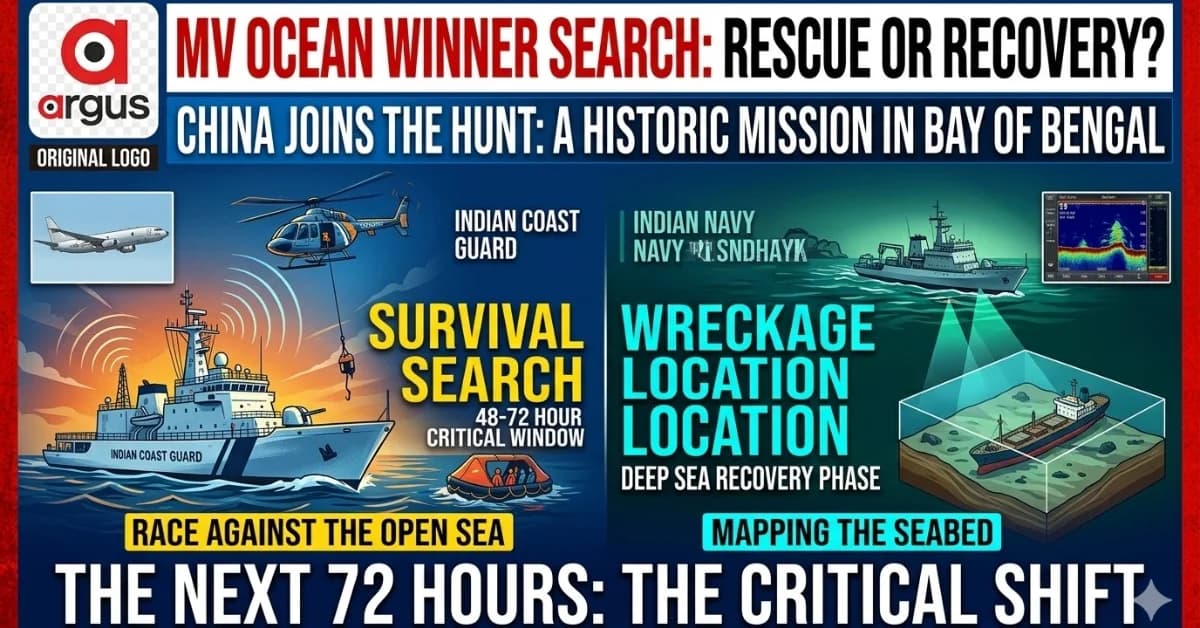
Bhubaneswar: The next 48 to 72 hours may decide what the massive international search operation in the Bay of Bengal will ultimately be remembered as: a rescue mission or a deep-sea recovery operation.
Four days after the 225-metre bulk carrier MV Ocean Winner went down far out in the Bay of Bengal, the hunt for its 22 missing crew members is entering the most critical phase.
The expanding search now involves Indian Coast Guard ships, Indian Navy long-range maritime surveillance aircraft and specialised Chinese rescue vessels. But the most important story unfolding in the waters off Paradip is not simply about more ships joining the search.
It is about how modern technology is attempting to beat time in one of the most difficult environments for a maritime rescue operation –the open sea.

📱 Get Argus News App
✨The search is being fought simultaneously in three worlds.
Above the sea, long-range aircraft are scanning vast stretches of water.
On the surface, Coast Guard vessels are chasing drifting clues –life jackets, debris, oil slicks and possibly life rafts.
And far below, sonar systems are preparing to turn the invisible seabed into a digital map that could eventually reveal where the massive vessel now lies.
The mission has now entered its fifth day, and the next 48-72 hours are widely seen as the critical remaining window for an intensive search for possible survivors in the open sea. The operation involves surface, aerial and sub-surface assets from India and China, with the search area expanding under the influence of monsoon winds and currents.
The Rescue Is Now a Race Against the Bay of Bengal
The mathematics of an open-sea search changes dramatically with every passing hour.
A survivor does not remain at the point where the ship sank.
Wind pushes the surface. Currents pull objects in another direction. Waves alter drift. A floating person, a life jacket, a raft, an oil slick and pieces of debris may all travel differently.
That is why the search operation cannot simply keep circling the sinking location.
It must constantly predict where a survivor could have moved.
This is where the gigantic search machines come in.
Indian
Coast Guard ships, including offshore patrol vessels such as ICGS
Varad
and ICGS
Vishwast,
are capable of undertaking prolonged searches in heavy weather. Their
surveillance radars, electro-optical systems, night-vision equipment
and rescue boats allow the search to continue beyond daylight hours
and across large stretches of sea.
Their task is not merely to
search randomly.
Every floating clue matters.
An oil slick can reveal the movement of surface waters. Debris can help establish a drift corridor. Repeated sightings of floating objects can gradually improve the prediction of where a survivor or life raft may have travelled.
The search teams are therefore trying to build a moving map of the disaster.
MV Ocean Winner Search: A Peep Into High-Tech Hunt
The multi-agency search and rescue operation for the 22 missing crew members of the MV Ocean Winner is an intense, coordinated effort involving specialized surface, sub-surface, and aerial assets from India and China.
|
Force / Country |
Ship Name / Asset Type |
Specialized Onboard Equipment |
Primary Operational Capability |
|---|---|---|---|
|
Indian Coast Guard |
ICGS Varad (Offshore Patrol Vessel) |
• Infrared Search & Track (IRST)• Rigid Hull Inflatable Boats (RHIBs)• Surveillance & Navigation Radars |
Heavy-weather endurance patrols, high-speed surface rescue interception, and deployment of specialised boarding/rescue teams. |
|
Indian Coast Guard |
ICGS Vishwast (Offshore Patrol Vessel) |
• Pollution Control Equipment• Advanced Communication Suite• Night-Vision Electro-Optics |
Long-range deep-sea sweeps, multi-vessel tactical communication command, and tracking the ship's oil slick. |
|
Indian Navy |
P-8I Neptune (Long-Range Aircraft) |
• Active/Passive Sonobuoys• APY-10 Maritime Search Radar• High-Definition Electro-Optical Sensors |
High-altitude, rapid search grids spanning thousands of square kilometres to detect emergency radio transmissions and life rafts. |
|
Indian Navy |
INS Sandhayak-class (Large Hydrographic Survey Vessel) |
• Multi-Beam Echo Sounders• Towed Side-Scan Sonars• Autonomous Underwater Drones |
Deep-sea bottom mapping, sub-surface wreckage localisation, and high-resolution acoustic imaging of the seabed. |
|
Chinese Rescue Fleet |
Specialised Rescue Ships (e.g., Nanhaijiu Series Type) |
• Dynamic Positioning Systems• High-Frequency Side-Scan Sonar• Heavy-Duty Marine Rescue Radars |
High-stability search grids, processing underwater acoustic tracking data, and deep-water search operations. |
|
Commercial Sector |
MT Isopos & Nearby Ships |
• Standard Commercial AIS• Marine Visual Lookouts |
Opportunistic rescue sweeps along designated international shipping routes near the sinking zone. |
Why the Search Still Split Between Surface and Seabed
This is the defining feature of the Ocean Winner operation.
There are essentially two completely different missions being carried out at the same time.
The first is the human survival search.
It is based on the possibility that one or more crew members escaped the sinking vessel and remained afloat, perhaps with a life jacket or on some form of survival craft.
The second is the wreck localisation search.
It is based on the possibility that the vessel and those who did not escape must be located on the seabed.
These two missions use different technology.
The first needs aircraft, radar, visual surveillance, infrared and surface vessels.
The second needs multi-beam sonar, side-scan sonar, underwater vehicles and precise seabed mapping.
The next 48 to 72 hours could be the period when the balance between these two missions begins to change.
The current operational assessment places the intensive surface search window for survivors at roughly the first week after the August 22 sinking, with the search expected to continue intensely through August 28-29 before the probability of survival in open water deteriorates sharply.
That does not mean the search simply stops.
It means the search may gradually change its objective.
What Happens If the Search Window Closes?
If the intensive survivor search does not produce results, the mission will not disappear from the sea.
It will transform.
The focus will increasingly shift towards locating the exact wreckage site and mapping the debris field.
That sub-surface phase could continue for days or weeks because deep-sea sonar operations involve repeated sweeps and detailed examination of potential targets. The source assessment envisages a longer underwater mapping and recovery phase after the active survival window has passed.
The final outcome of that phase could be a precise digital map of where the Ocean Winner lies beneath the Bay of Bengal.
How It Become A Historic Rescue Mission
The Ocean Winner operation is unusual not because a ship has sunk in Odisha-linked waters before.
The Odisha coast has seen major maritime accidents, including the Black Rose sinking in 2009.
In order to understand the historic scale of this mission, here is a compariosn with other major maritime disasters and rescue operations executed by Indian maritime authorities:
|
Incident Name & Year |
Location / Waters |
Scale of Incident & Crew |
Scale of the Rescue Operation |
Key Differentiating Factor |
|---|---|---|---|---|
|
MV
Ocean Winner |
Deep
Bay of Bengal |
• 225m
Bulk Carrier |
Massive
& International |
First time in history China has openly deployed specialized government rescue ships to collaborate directly inside an active Indian-led maritime SAR grid. |
|
Barge
P305 |
Arabian
Sea |
• Accommodation
Barge |
Largest
Domestic SAR Fleet |
Largest human-scale operation in terms of lives saved at sea, but conducted entirely by India close to the coast in shallow waters. |
|
MV
Emerald Star |
Philippine
Sea |
• Indian-crewed
Bulk Carrier |
Long-Range
International Joint Grid |
Similar technical cause (liquefaction) and aircraft deployment, but India acted as the assisting partner rather than the host authority. |
|
MSC
Elsa 3 |
Arabian
Sea |
•
Container
Vessel |
Shallow-Water
Tactical Sweep |
High-intensity local operation where the ship sank in shallow waters, allowing 100% of the crew to be safely evacuated before capsizing. |
For the next 48 to 72 hours, however, the mission's priority remains painfully simple.
Somewhere
in that enormous search grid, if even one survivor is still alive,
the rescue teams must find him before the Bay of Bengal's survival
clock runs out.
Also Read: Odisha Flood Threat: Fresh Low Pressure on August 29 to Trigger Severe Multi-Basin Crisis, Know the Critical Districts| Exclusive
Related Topics
Explore more stories