



Science And Technology / NIT Rourkela Scientists Develop Lead-Free Light-Emitting Material for Safer Technologies
Key Points
Rourkela, Oct 28: Researchers at the National Institute of Technology (NIT) Rourkela, in collaboration with scientists from IIT Guwahati, IIT Bombay and NISER Bhubaneswar, have developed a new class of lead-free light-emitting materials that could find applications in security systems, sensors and next-generation lighting technologies.
The research focuses on bismuth-based compounds as environmentally safer alternatives to conventional lead-based photoluminescent materials, which are widely used for their light-emitting properties but pose significant health and environmental concerns due to lead toxicity.
Safer Alternative
The interdisciplinary team investigated bismuth-based organic-inorganic hybrid compounds capable of emitting different colours of light under ultraviolet (UV) exposure. The developed material exhibits a unique response to heat and moisture, making it suitable for multiple practical applications.

📱 Get Argus News App
✨According to the researchers, heating the material causes it to lose water trapped within its structure, enabling it to emit blue light under UV illumination. When exposed to moisture again, the material reabsorbs water and the blue emission disappears. The process can be repeatedly reversed by altering environmental conditions.
The findings have been published in the Journal of Materials Chemistry C. The study was co-authored by Prof. Saroj L. Samal and research scholar Subhasish Sahoo from NIT Rourkela, along with researchers from IIT Guwahati, IIT Bombay and NISER Bhubaneswar.
Security and Sensing Uses
Prof. Saroj L. Samal, Associate Professor in the Department of Chemistry, said the compound was synthesised using low-cost and environmentally friendly constituents through a simple process.
Researchers believe the material could be used in anti-counterfeiting technologies. Special inks incorporating the compound may be applied to certificates, signatures and security labels, with authenticity verified through controlled UV-light inspection.
The material also shows promise for humidity-sensing
applications, as its luminescence changes in response to moisture. This feature
could assist in monitoring humidity levels in food packaging, storage
facilities and other environments where moisture control is critical.
Also Read: NIT Rourkela Develops Jackfruit Peel-Based Material to Remove Fluoride from Water
White LED Development
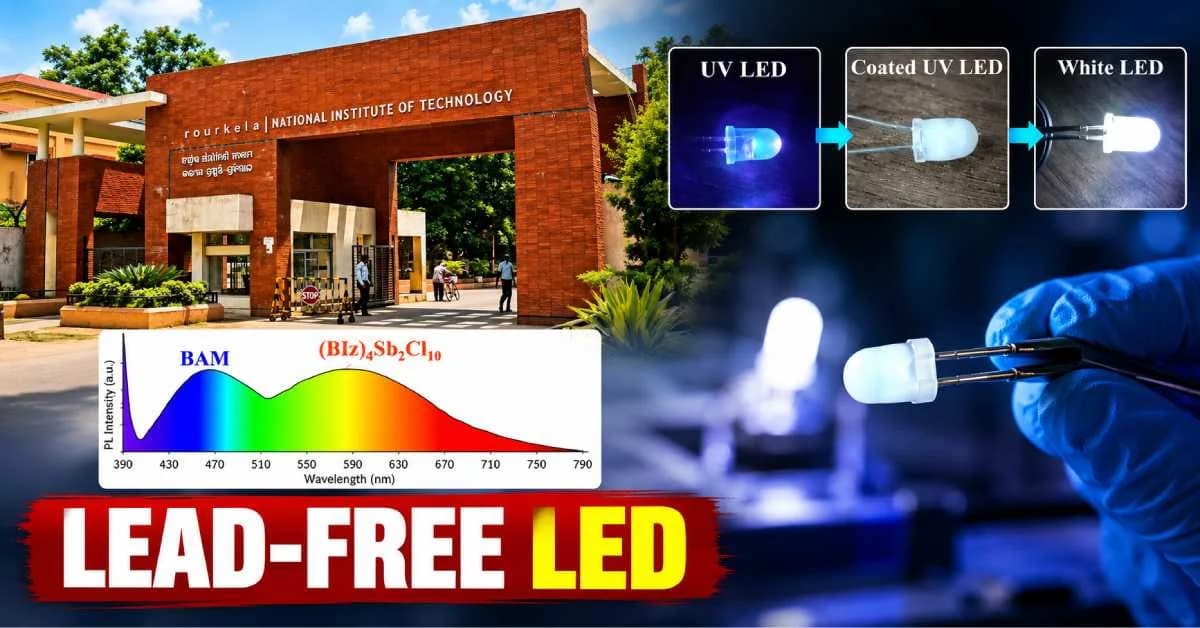
The research team has also developed related lead-free LEDs capable of producing yellow light under UV exposure. By combining the material with a commercially available blue-light-emitting compound, the scientists produced a stable white LED with a cool daylight-like appearance.
Prof. Samal noted that the material demonstrates potential for reversible luminescence switching, moisture sensing, solid-state lighting and anti-counterfeiting applications. The team now plans to improve light-emission efficiency, long-term stability and device integration to support future applications in optical security, environmental monitoring and energy-efficient lighting systems.
Related Topics
Explore more stories