



Technology / NIT Rourkela Develops Jackfruit Peel-Based Material to Remove Fluoride from Water
Key Points
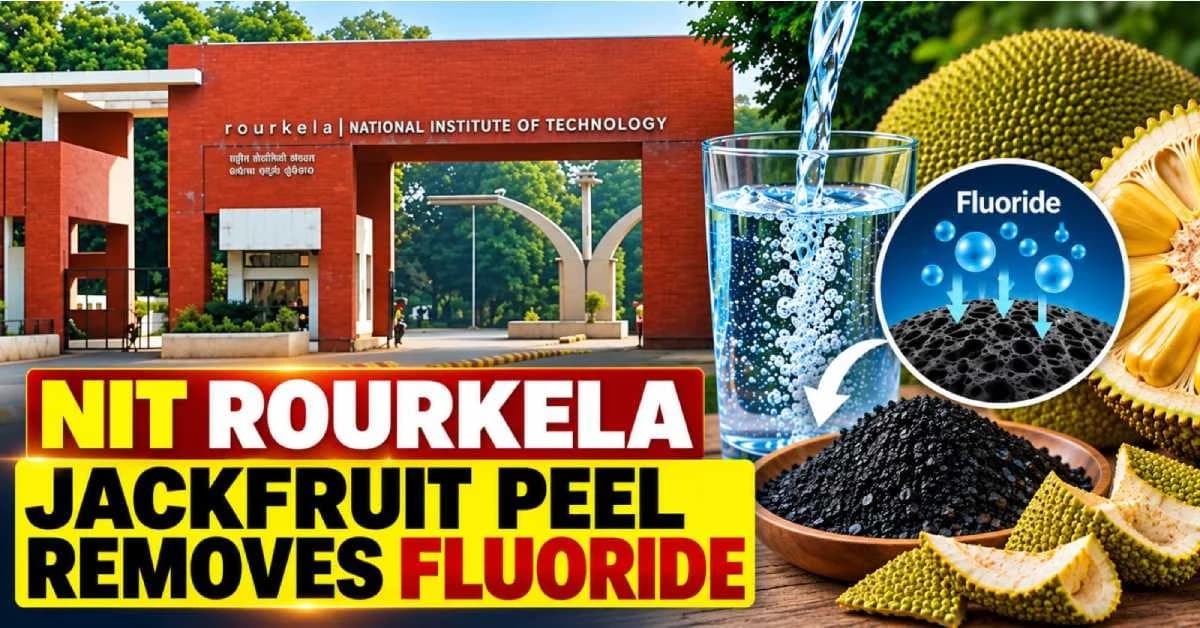
Rourkela, Oct 14: Researchers at the National Institute of Technology (NIT) Rourkela have developed a low-cost and sustainable material capable of removing more than 90 per cent of fluoride from contaminated groundwater within minutes, offering a potential solution to a major public health challenge affecting several parts of India, officials said on Wednesday.
The technology converts discarded jackfruit peel into activated carbon and further enhances its fluoride-removal capability through zirconium modification. The innovation has already secured a patent and is being viewed as a promising step towards decentralized water treatment solutions, particularly for rural and semi-urban regions where access to advanced purification systems remains limited.
Excess fluoride in drinking water is a well-documented health concern. According to the World Health Organization (WHO), prolonged exposure to high fluoride levels can lead to dental and skeletal fluorosis, conditions that affect millions of people across fluoride-prone regions. Several states in India continue to face challenges linked to fluoride contamination in groundwater, making affordable treatment technologies a pressing need.
Conventional fluoride-removal methods such as reverse osmosis, ion exchange and activated alumina often come with drawbacks. Reverse osmosis systems generate considerable water wastage and may strip beneficial minerals from water, while some chemical-based treatment methods raise environmental concerns and require higher operational costs.

📱 Get Argus News App
✨Seeking a more sustainable alternative, the NIT Rourkela team transformed agricultural waste in the form of jackfruit peel into activated carbon. The material was then modified with zirconium to improve its ability to attract and capture fluoride ions from water.
Explaining the technology, Prof. Susmita Mishra of the Department of Chemical Engineering said laboratory studies demonstrated that the material could remove more than 90 per cent of fluoride from water within approximately 10 minutes. The tests recorded removal efficiencies ranging between 90 and 97 per cent at fluoride concentrations of around one to five milligrams per litre.
The research was carried out by Prof. Mishra and Dr. Pratima Minz, a research graduate at the institute. The patent application for technology was filed on August 25, 2025.
Researchers believe the innovation could support
community-level water treatment systems in fluoride-affected regions while
simultaneously promoting a waste-to-resource approach by utilizing agricultural
by-products.
Also Read: Odisha Cabinet Lauds PM Modi’s 25 Years in Public Service, Clears 16 Proposals
Currently at Technology Readiness Level 4 (TRL-4), the innovation has been validated at the laboratory scale. The research team estimates the synthesis cost of the material at approximately Rs 37 per gram, based on electricity and chemical inputs used during production.
The next phase of the project will focus on developing a physical prototype and evaluating its long-term performance, deployment feasibility and operational costs under real-world conditions. If successfully scaled up, the technology could offer an affordable and environmentally friendly solution for ensuring safer drinking water in fluoride-affected communities.
Related Topics
Explore more stories