



NASA's Warning for Odisha: Bhitarkanika Driving South Asia's Mangrove Surge While Mahanadi Delta Struggles | Exclusive
Key Points
* Odisha's Brahmani-Baitarani delta system is among the key contributors to the regional expansion.
* Scientists find cyclones often cause temporary degradation, not permanent mangrove loss, highlighting Odisha's ecological resilience.
Bhubaneswar: A newly released NASA Earth study tracking global mangrove change over four decades has uncovered a striking environmental contrast evolving along Odisha's coastline.
While South Asia has emerged as one of the world's fastest-growing mangrove regions since 1984, satellite imagery suggests that Odisha's celebrated success story seems quite chequered.
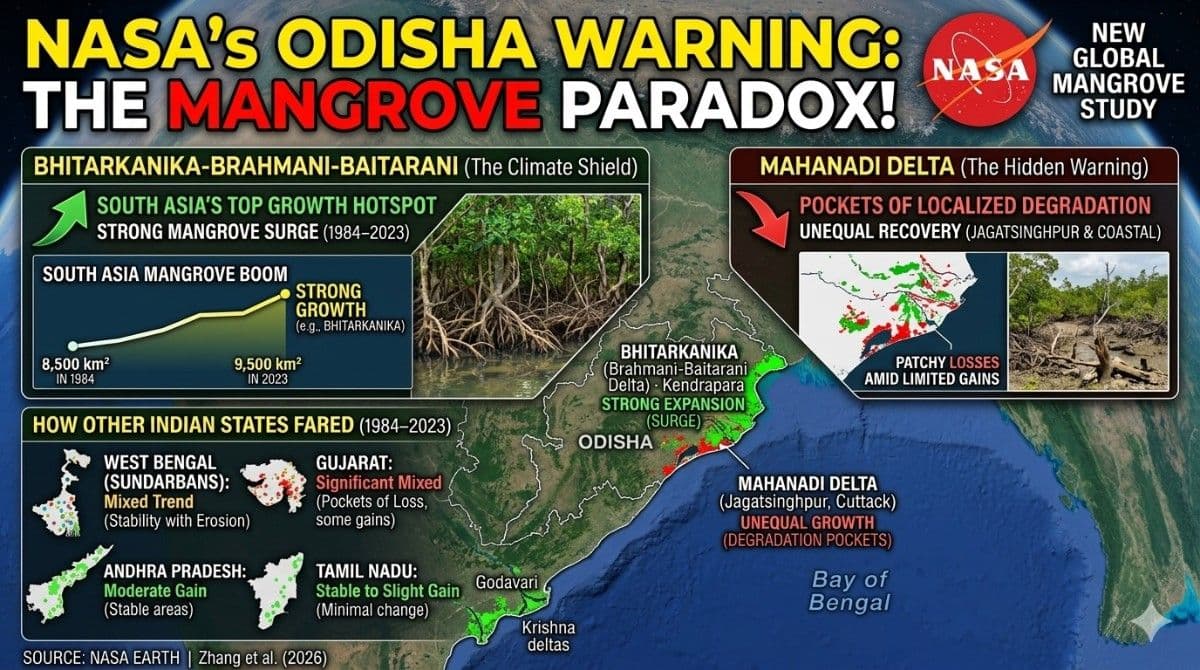
A closer examination of the NASA map reveals that the Bhitarkanika-Brahmani-Baitarani delta system has recorded strong mangrove expansion, whereas parts of the Mahanadi delta continue to exhibit signs of localized degradation.
The finding introduces a new dimension to Odisha's climate resilience narrative: even as the state contributes to South Asia's mangrove revival, pockets of ecological stress remain visible from space.

📱 Get Argus News App
✨What the NASA Map Actually Shows
The headline global finding of the study led by Zhang et al. (2026) is that South Asia's mangrove cover increased from roughly 8,500 sq km in 1984 to nearly 9,500 sq km in 2023.
However, the finer spatial map tells a more nuanced story.
Across Odisha's northern coastline, particularly around the Brahmani-Baitarani estuarine complex and Bhitarkanika ecosystem, indicating substantial positive change in mangrove area over the study period.
But farther south, around the Mahanadi delta and adjoining coastal stretches, the pattern becomes fragmented. The region displays a mosaic of gains and losses. Such mixed signatures typically indicate localized degradation occurring alongside regeneration.
For Odisha policymakers, that distinction may be more important than the headline growth figures.
Bhitarkanika Emerges as Climate Shield
The strongest gains visible on the map coincide with the Bhitarkanika ecosystem in Kendrapara district.
Over the past two decades natural regeneration and sediment deposition from the Brahmani and Baitarani rivers have strengthened mangrove expansion in the region, the study observed.
The NASA imagery suggests this landscape has become one of South Asia's most successful mangrove recovery zones.
The implications extend far beyond biodiversity.
Dense mangrove forests reduce storm surges, absorb wave energy and shield coastal settlements from cyclonic winds. As Bay of Bengal cyclones become more intense under climate change, Bhitarkanika's ecological value is increasing rapidly.
In effect, the ecosystem is functioning as Odisha's largest natural climate adaptation infrastructure.
The Mahanadi Delta's Hidden Warning
The NASA map, however, simultaneously highlights a concern.
Unlike Bhitarkanika, the Mahanadi delta does not display a uniformly positive growth pattern.
Several spots along the deltaic coastline show either stagnant growth or negative change, suggesting mangrove stress and fragmentation.
This observation aligns with long-standing concerns among coastal ecologists.
Historically, the Mahanadi delta suffered extensive mangrove destruction due to shrimp aquaculture, agricultural conversion, embankment construction and coastal development.
Jagatsinghpur district represents perhaps the most dramatic example.
Historical records show the district's mangrove area collapsing from more than 170 sq km in the mid-twentieth century to single-digit levels by the early 2000s.
Although regeneration has occurred since then, the NASA map indicates recovery remains uneven.
Unlike Bhitarkanika's contiguous mangrove landscape, the Mahanadi delta appears to be experiencing a tug-of-war between restoration and fresh ecological pressures.
Odisha's Success Story Is Not One Story
The NASA findings effectively split Odisha's coastline into two distinct environmental narratives.
The first is the Bhitarkanika model.
Here, natural sediment deposition, strong legal protection and ecological regeneration have combined to produce sustained mangrove growth.
The second is the Mahanadi delta model.
In this region, gains are occurring, but they are interspersed with visible pockets of degradation, suggesting ongoing anthropogenic pressure.
This divergence is important because it demonstrates that state-level mangrove statistics can mask local realities.
Odisha may be recording net gains overall, yet certain coastal stretches continue to lose mangrove health and density.
How Odisha Compares With Other Indian States
The NASA map also offers important insights into India's broader mangrove geography.
The Sundarbans of West Bengal display a mixed pattern. Large sections remain stable, but several coastal fringes show negative likely associated with erosion, salinity intrusion and cyclone impacts.
Gujarat presents another complex picture. While some areas in the Gulf of Kutch exhibit gains, the state also contains notable clusters of decline. This mirrors recent assessments showing that Gujarat has accounted for a substantial portion of India's recent mangrove losses.
Andhra Pradesh appears relatively stable, with moderate gains around the Godavari and Krishna delta systems.
Against this backdrop, Odisha's Bhitarkanika belt stands out as one of the clearest mangrove expansion zones visible anywhere on India's eastern seaboard.
Yet Odisha is also unusual in displaying both one of India's strongest gain zones and one of its most visible localized stress zones within the same coastline.
Why This Matters for Climate Policy
The NASA study carries a larger lesson for Odisha. The challenge is no longer simply increasing mangrove acreage. The challenge is ensuring that recovery is geographically balanced.
The Bhitarkanika model demonstrates what is possible when natural sediment flows, legal protection and ecological restoration work together.
The Mahanadi delta demonstrates what happens when development pressures continue to fragment fragile coastal ecosystems.
For policymakers, the message from space is unmistakable.
Odisha's mangrove future may not be decided in Bhitarkanika, where recovery is already underway. It may instead be decided in the Mahanadi delta, where the battle between degradation and regeneration remains unresolved.
That
is the most important Odisha-specific finding hidden inside NASA's global
mangrove map.
Also Read: Odisha Launches India's Biggest-Ever Tourism Land Bank: 5,500 Acres to Unlock Rs10,000 Crore Investment, Create Up to 2 Lakh Jobs by 2031| Exclusive Analysis
Related Topics
Explore more stories