



Odisha Launches India's Biggest-Ever Tourism Land Bank: 5,500 Acres to Unlock Rs10,000 Crore Investment, Create Up to 2 Lakh Jobs by 2031| Exclusive Analysis
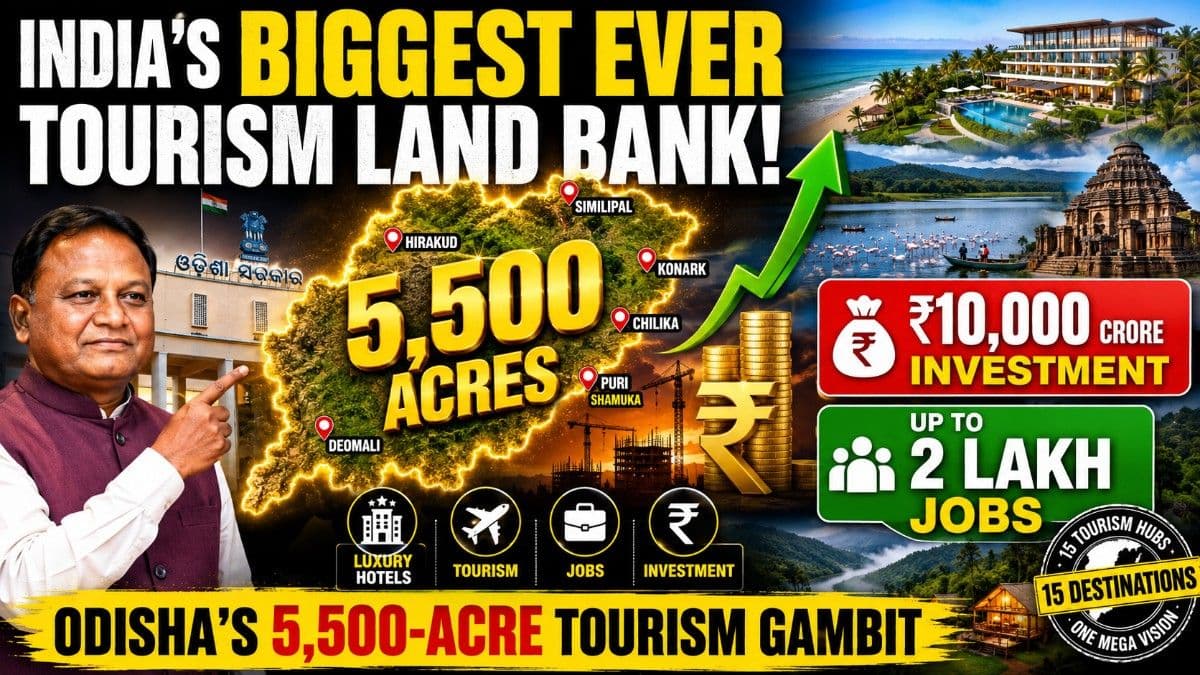
Key Points
* State can expect Rs 8,000–10,000 crore private hospitality investment by 2031, if implemented with all seriousness.
* Tourism expansion could generate up to 2 lakh direct and indirect livelihoods, especially in tribal regions.
Bhubaneswar: In a move that could fundamentally alter India's tourism investment landscape, Odisha has approved what may be the largest dedicated tourism land bank ever created by any Indian state.
The Odisha Cabinet's decision to create a 5,500-acre tourism land bank, backed by a Rs 1,500 crore state-funded programme over five years, is not merely another tourism policy announcement. It represents a strategic attempt to solve the single biggest obstacle that has historically discouraged large hospitality investments across India: land availability and clear titles.
More importantly, the initiative has the potential to unlock Rs 8,000-10,000 crore in private investments and generate nearly 2 lakh direct and indirect employment opportunities by the end of the decade.
The scale alone places Odisha in a league of its own.

📱 Get Argus News App
✨Why This Is Potentially Historic
For years, states such as Gujarat, Rajasthan, Goa and Madhya Pradesh have attracted hospitality investors by offering tourism-friendly ecosystems. However, most of their land aggregation efforts evolved gradually over decades.
Odisha is attempting something radically different.
Instead of waiting for investors and then searching for suitable land parcels, the state is creating a ready-to-deploy inventory of tourism land spread across fifteen major destinations.
The land bank covers iconic tourism circuits including:
- Shamuka, Puri
- Konark
- Chilika
- Hirakud
- Similipal
- Satkosia
- Bhitarkanika
- Daringbadi
- Deomali
- Koraput
- Mayurbhanj and other emerging destinations
The flagship project remains the massive 1,515-acre Shamuka Tourism Destination near Puri, envisioned as a master-planned coastal tourism city rather than a collection of isolated hotels.
That distinction is critical.
Historically, tourism development in India has often occurred in fragmented pockets. Odisha's model instead seeks to create integrated tourism ecosystems with hotels, convention facilities, wellness centres, entertainment zones, eco-tourism infrastructure and supporting urban services.
Bigger Than Any Comparable Tourism Land Aggregation
A comparison with other pioneering tourism states illustrates the magnitude.
Madhya Pradesh's tourism land repository spans roughly 2,100 acres distributed across wildlife, heritage and urban tourism sites.
Gujarat's highly successful tourism strategy concentrated land around mega destinations such as the Statue of Unity region and the Rann of Kutch, with individual tourism zones generally ranging between 500 and 1,000 acres.
Odisha's proposed 5,500-acre inventory exceeds both in terms of consolidated tourism-specific land availability.
What makes the initiative particularly significant is that the acreage is being assembled upfront.
This gives Odisha a rare advantage: the ability to market entire tourism districts and destination clusters rather than individual plots.
For global hospitality investors, master-planned destinations often offer stronger returns because supporting infrastructure, connectivity and destination branding develop simultaneously.
Solving Odisha's Biggest Tourism Bottleneck
The timing of the initiative is equally significant.
Over the last two years, Odisha has already secured approvals for 55 major hotel and resort projects worth Rs3,211 crore.
These include proposals from several leading hospitality brands such as:
- World of Hyatt
- ITC Hotels
- Radisson
- Lemon Tree Hotels
- Atmosphere Core
Yet many projects have struggled to move beyond announcements.
The reason has been remarkably simple: land issues.
Developers frequently encountered delays involving acquisition disputes, title verification, environmental permissions and local clearances.
Industry executives often describe land as the most expensive and uncertain stage of hospitality investment.
The new tourism land bank directly attacks this problem.
The state will identify, map, verify and clear-title land before offering it to investors.
For hospitality companies, this dramatically reduces project risk and shortens development timelines.
Rs10,000 Crore Investment Opportunity
The most important question is whether the initiative can genuinely attract large-scale private capital.
Evidence from other states suggests the answer could be yes.
Madhya Pradesh leveraged a much smaller tourism land inventory to secure hospitality commitments exceeding Rs3,000 crore.
Gujarat's tourism-ready zones around Kevadia and Kutch helped attract more than Rs 4,000 crore in private investments.
Odisha's proposition is arguably stronger for three reasons.
First, it combines coastal tourism, eco-tourism, heritage tourism and mountain tourism within a single investment ecosystem.
Second, destinations such as Puri, Konark and Chilika already enjoy strong national brand recognition.
Third, the sheer scale of available land allows developers to build destination-scale projects.
Given these advantages, tourism industry watchers believe Odisha can realistically target between Rs8,000 crore and Rs 10,000 crore of private investment by 2031, particularly if global hotel chains continue expanding in India's rapidly growing leisure travel market.
Employment: The Silent Transformation
While investment figures attract headlines, employment could become the initiative's most transformative outcome.
Tourism remains among the most labour-intensive sectors of the economy.
Unlike manufacturing, where automation often reduces workforce requirements, hospitality generates jobs across multiple skill levels.
Industry benchmarks suggest that every premium resort room creates roughly:
- 1.5 direct jobs
- 3 indirect livelihood opportunities
Applying those metrics to Odisha's proposed tourism expansion produces impressive numbers.
Estimated Impact
Direct Employment
- 40,000–50,000 jobs
Indirect Livelihoods
- 1.2 lakh–1.5 lakh opportunities
Total Economic Impact
- Up to 2 lakh livelihoods linked to tourism expansion
These jobs would span:
- Hotel management
- Culinary services
- Housekeeping
- Transportation
- Local guiding
- Event management
- Food supply chains
- Adventure tourism
- Wellness services
- Tourism retail
For Odisha's rural economy, the impact could be particularly profound.
The Tribal Economy Angle
One of the least discussed aspects of the programme is its potential impact on tribal and remote districts.
Land parcels have been identified in areas such as:
- Deomali
- Koraput
- Daringbadi
- Mayurbhanj
- Similipal region
These locations possess enormous tourism potential but limited industrial opportunities.
Tourism offers an alternative development pathway.
Instead of migration to cities, local youth can find employment close to their communities.
Traditional artisans can access new markets.
Handloom clusters can benefit from tourist spending.
Local food, cultural performances and indigenous crafts can become commercial assets rather than disappearing traditions.
If implemented effectively, tourism could become one of the strongest non-industrial job creators in Odisha's tribal belt.
The Environmental Question
A project of this scale inevitably raises environmental concerns.
Several identified locations lie near ecologically sensitive landscapes:
- Chilika Lagoon
- Bhitarkanika Mangroves
- Similipal Biosphere Reserve
- Satkosia Gorge
Historically, tourism development in environmentally fragile regions has triggered conflicts between conservation and commercial interests.
Odisha appears to be attempting a different model.
Instead of granting land first and securing approvals later, the state proposes obtaining environmental, forest and coastal clearances before land parcels enter the bank.
This front-loaded clearance approach significantly reduces the risk of future violations.
The use of GIS-based GO PLUS mapping will allow authorities to digitally verify ecological zones before land allocation.
The objective is to prevent accidental encroachment into protected forests, mangroves and marine ecosystems.
Eco-Tourism Rather Than Concrete Tourism
Perhaps the most innovative feature is the differentiated development model.
Sensitive destinations such as Similipal and Satkosia are expected to follow low-density tourism principles.
Instead of high-rise resorts, the emphasis will be on:
- Eco-cottages
- Nature lodges
- Glamping facilities
- Sustainable tourism infrastructure
Such models generate revenue while preserving ecological character.
Globally, eco-tourism destinations often command higher room tariffs than conventional mass-tourism projects.
That means Odisha could potentially earn more tourism revenue while developing less land.
A Tourism Policy or an Economic Strategy?
Viewed narrowly, the 5,500-acre land bank is a tourism project.
Viewed strategically, it is an economic transformation initiative.
The state is effectively building a pipeline that connects land reform, infrastructure creation, private investment, employment generation, tribal development and environmental management.
Few sectors offer such a broad multiplier effect.
Tourism spending circulates through transport, food processing, handicrafts, construction, retail, culture and services.
If the land bank succeeds, Odisha may not simply attract more tourists. It could emerge as one of India's fastest-growing hospitality investment destinations.
The real significance of the Cabinet decision therefore lies beyond acreage figures and budget allocations.
For the first time, Odisha is attempting to industrialise tourism at scale.
And with
5,500 acres already being assembled, the state is making a clear statement to
investors: the era of waiting for land may finally be over.
Also Read: National Security / Why Bhubaneswar Got India's First Coastal Security Command Centre While Andhra Pradesh and West Bengal Missed Out| Exclusive Analysis
Related Topics
Explore more stories