



Nadda Rolls Out NAS 2026: Odisha Holds Strong Edge But Remote Village GIS Mapping, Bike Ambulance Network Remain the Missing Link| Special Story
Key Points
* The state's primary operational bottleneck is not fleet size, but mapping thousands of non-motorable, remote interior forest trails in tribal districts into conventional navigation systems.
* Achieving true NAS 2026 compliance relies on bridging decentralized, district-funded bike networks into a unified GIS dashboard for automated bike-to-four-wheeler handoffs.
Bhubaneswar: The Centre's rollout of the Operational Guidelines on National Ambulance Services (NAS), 2026 marks a decisive shift from merely transporting patients to delivering an integrated continuum of emergency care.
For Odisha, the transition is less about building a new ambulance ecosystem and more about strategically upgrading an already robust one. While the state enjoys one of India's strongest emergency medical transport networks, immediate technological and operational refinements will determine how seamlessly it aligns with the new national framework.
Among major states, Odisha enters the NAS 2026 era from a position of relative strength. Unlike several states that will require large-scale fleet augmentation or structural reforms, Odisha already possesses one of the country's most diversified ambulance networks, making it structurally better prepared to implement the new guidelines.
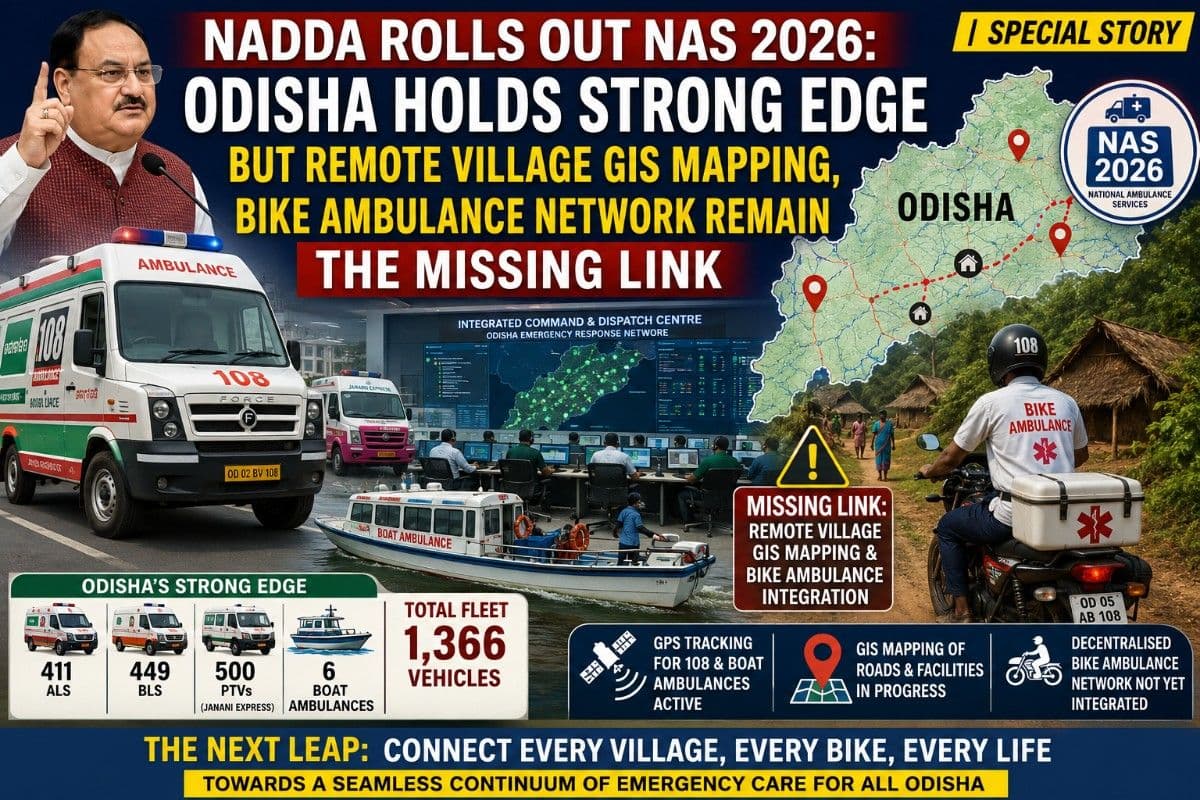
Its centrally managed emergency fleet comprises 411 Advanced Life Support (ALS) ambulances, 449 Basic Life Support (BLS) ambulances, 500 Patient Transport Vehicles (PTVs) and six specialised Boat Ambulances, giving the state a fleet strength of 1,366 vehicles.

📱 Get Argus News App
✨The numbers become even more significant when compared nationally. Odisha has more ALS ambulances than Uttar Pradesh (375), Maharashtra (233), Tamil Nadu (205) and Madhya Pradesh (167) despite having a much smaller population. While Bihar has a larger ALS fleet (567), it lacks the intermediate patient transport layer that Odisha has already institutionalised through its Janani Express network. Maharashtra has successfully deployed bike ambulances, but Odisha has instead developed specialised riverine ambulance services suited to its unique geography.
This diversified fleet gives Odisha a significant advantage in meeting the NAS 2026 emphasis on ambulance categorisation, population-based deployment and continuum of care.
Odisha's SWOT Under NAS 2026
Strengths
Odisha's biggest advantage lies in its strong advanced-care ecosystem. With 411 ALS ambulances, the state comfortably exceeds the national benchmark of one ALS ambulance per five lakh population.
Equally important is the state's Integrated Patient Transport & Health Helpline Services (IPTHHS) Phase-II (2024-29), under which emergency transport is already being managed through an integrated command structure operated by EMRI Green Health Services.
Odisha has also diversified its fleet according to terrain. Besides conventional ambulances, it operates Boat Ambulances in inaccessible riverine regions while maintaining an extensive Janani Express network for maternal transport, creating an existing multi-tier emergency response architecture that closely mirrors the philosophy of NAS 2026.
Weaknesses
The challenge lies not in fleet numbers but in geographical distribution.
Several tribal and western districts historically received predominantly BLS coverage with limited advanced care capability. Although state-level numbers comfortably meet national norms, district-level disparities remain an operational concern under the new population-based deployment framework.
The second weakness is technological integration. The transition from legacy 108 and 102 systems towards a fully unified GIS-enabled 112 command architecture will require substantial software integration, data harmonisation and real-time monitoring capability.
Opportunities
NAS 2026 provides Odisha an opportunity to optimise its existing resources rather than simply adding more ambulances.
The state's 500 Janani Express vehicles can increasingly handle non-critical maternal and referral transport, allowing BLS and ALS ambulances to remain dedicated for emergencies and trauma response.
The mandatory AIS-125 compliance and national standardisation framework also opens avenues for phased fleet modernisation using National Health Mission funding.
Threats
The biggest operational challenge is human resources.
NAS 2026 standardises Emergency Medical Technician (EMT) competencies across the country. Upgrading skills of existing personnel without affecting round-the-clock services will require careful planning.
The second challenge remains Odisha's difficult terrain. Dense forests, hilly landscapes and riverine barriers continue to test the state's ability to achieve uniform response times despite a strong ambulance fleet.
The Real Test Lies Beyond the Highways
However, Odisha's biggest challenge under NAS 2026 is not the ambulance fleet – it is the last few kilometres where roads disappear.
While the state already possesses a sophisticated GPS-enabled tracking ecosystem for its primary fleet, achieving complete compliance with the new guidelines requires integrating hundreds of decentralised local emergency assets into one digital command platform.
At present, all 108 ambulances and six Boat Ambulances operate with real-time GPS tracking under a central dispatch dashboard. Odisha has also created GIS databases covering administrative boundaries, health infrastructure and road networks through ORSAC and the Odisha Disaster Resource Network.
Yet significant gaps remain.
Thousands of interior forest trails, seasonal pathways and non-motorable tribal habitations in districts such as Kandhamal, Malkangiri, Rayagada, Sundargarh and Koraput are still outside conventional digital mapping systems.
More importantly, the state's locally managed bike ambulances – funded through District Mineral Foundations, Zilla Swasthya Samitis and tribal development programmes – continue to operate independently of the central emergency dispatch network.
Why Bike Ambulance Integration Matters
For Odisha, bike ambulances are not an alternative to four-wheel ambulances; they are the critical first-mile link where roads simply do not exist.
In districts like Kandhamal, bike ambulances already transport expectant mothers and critically ill patients from inaccessible villages to the nearest motorable road, where Janani Express or 108 ambulances take over.
Under NAS 2026, these bike ambulances must evolve from isolated district initiatives into digitally connected assets within an Integrated Command and Dispatch Centre (ICDC).
Once integrated, the command centre can simultaneously dispatch both the bike ambulance and a four-wheeler, calculate a common GIS-based rendezvous point, monitor both vehicles in real time, continuously update their estimated arrival times and ensure patient handover during the Golden Hour.
This transformation would replace manual coordination with predictive, technology-driven emergency response.
The Missing Digital Layer
Odisha's immediate task under IPTHHS Phase-II is therefore not fleet expansion but micro-level GIS integration.
District-funded bike ambulances require standardised GPS tracking hardware linked to the central dispatch server. Every inaccessible tribal village must have digitally mapped "catch-points" where bike ambulances can transfer patients to four-wheel ambulances.
Equally important, ASHA workers and ANMs can assist in creating precise GPS coordinates for village entry points, allowing the system to automate dispatch decisions based on terrain.
Until these decentralised bike networks become fully visible on a unified command dashboard, Odisha's emergency response in remote tribal regions will continue to depend partly on local knowledge rather than technology.
Bottom Line
Odisha begins the NAS 2026 era with one of India's strongest structural foundations. Its diversified fleet, high ALS capacity, established command infrastructure and terrain-specific ambulance models place it among the country's best-positioned states for implementation.
The state's
next leap, however, will not come from buying more ambulances. It will come
from digitally connecting every bike ambulance, every remote tribal pathway and
every inaccessible village into a single GIS-enabled emergency ecosystem. Once
that final technological bridge is completed, Odisha can truly deliver the
seamless continuum of emergency care envisioned under the National Ambulance
Services Guidelines, 2026 –from the most remote forest hamlet to the state's
most advanced hospitals.
Also Read: In last 10-yrs, Odisha Breast Cancer Up 71%, Cervical Cancer 13% Up: Is there a Manganese Link?| Special Story
Related Topics
Explore more stories