



In last 10-yrs, Odisha Breast Cancer Up 71%, Cervical Cancer 13% Up: Is there a Manganese Link?| Special Story
Key Points
Bhubaneswar: With nearly one in five groundwater samples exceeding safe manganese limits, and contamination concentrated in districts already carrying significant burdens of breast, cervical, gastrointestinal and oral cancers, the moot question staring at the State:
Is chronic heavy-metal exposure silently contributing to Odisha's rising cancer cases?
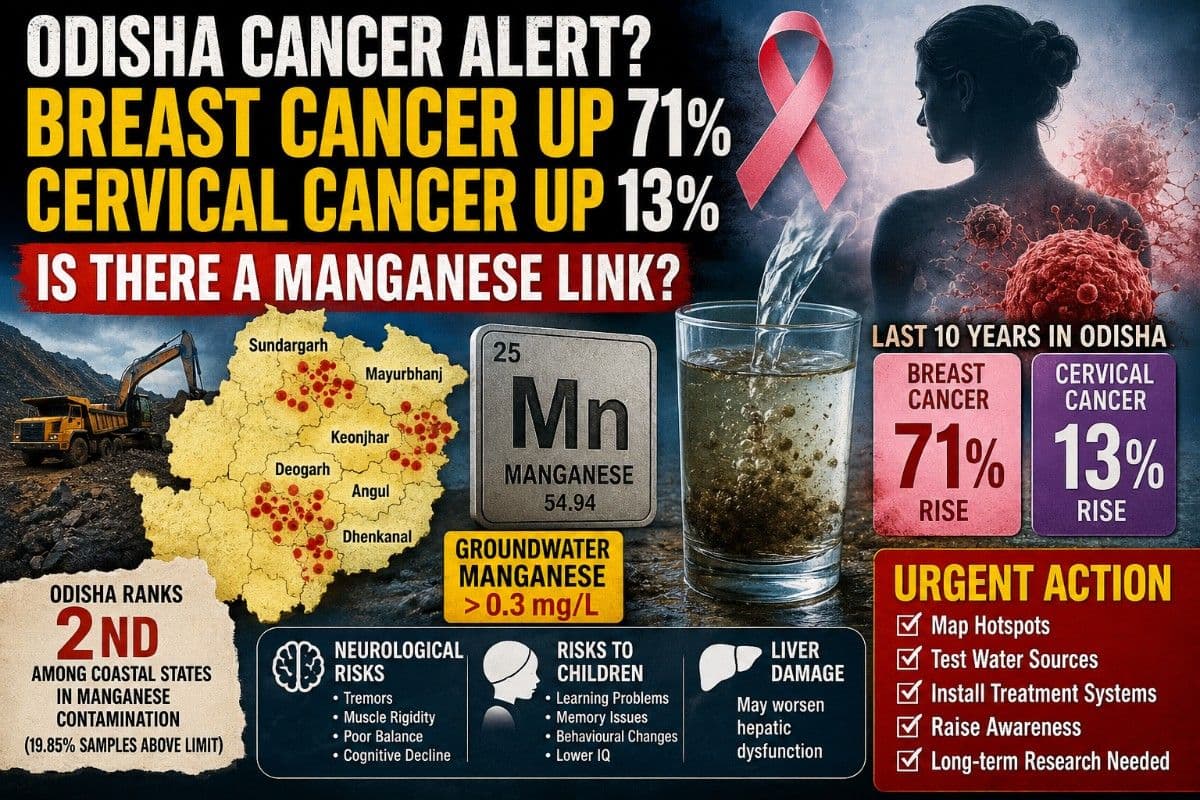
According to the latest Ground Water Quality Report-2025, 19.85% of groundwater samples in Odisha contain manganese above the permissible limit of 0.3 mg/L, making the state the second-most affected coastal state after West Bengal (22.46%).
The Alarming Revelation

📱 Get Argus News App
✨What makes the finding particularly alarming is that the contamination clusters are concentrated in Odisha's north-central and northwestern districts, many of which overlap with the state's mining and industrial corridors – regions where cancer registries have repeatedly documented high prevalence of breast, cervical, gastrointestinal and oral cancers.
While direct causation cannot be established without detailed epidemiological studies, emerging international research increasingly points toward a possible association between chronic manganese exposure and several forms of cancer.
Odisha's Manganese Burden Among Highest on Coast
According to the national groundwater assessment:
|
State |
Manganese >0.3 mg/L |
West Bengal
22.46%
Odisha
19.85%
Goa
16.67%
Karnataka
13.56%
Tamil Nadu
9.09%
Gujarat
1.52%
Kerala
0%
The report identifies Odisha as one of the most prominent manganese hotspots among coastal states, with contamination substantially higher than Karnataka, Tamil Nadu, Gujarat and Kerala.
Unlike seasonal pollution caused by agricultural runoff, the manganese contamination pattern remains stable across both pre-monsoon and post-monsoon surveys.
Why Experts Are Concerned
The groundwater atlas reveals that manganese contamination forms dense clusters across Odisha's granite, gneiss and khondalite rock formations, indicating a largely geogenic origin – meaning the metal is naturally released from weathering rocks into aquifers.
This is important because geogenic contamination is:
- Persistent
- Difficult to eliminate naturally
- Capable of affecting communities for decades
- Often overlooked because water appears visually clean
The contamination is particularly concentrated in the mineral-rich belts that also host extensive iron ore, manganese ore and industrial activities.
The Cancer Connection: What Science Says
Manganese is an essential trace nutrient required in small amounts by the human body. However, prolonged exposure to elevated levels through drinking water can trigger oxidative stress, DNA damage and cellular dysfunction.
Several international studies have identified associations between chronic manganese exposure and increased risks of:
Breast Cancer
Among all cancers investigated, breast cancer has shown one of the strongest observed associations with elevated manganese accumulation in tissues.
Cervical Cancer
Emerging research suggests chronic heavy metal exposure may interact with inflammatory and cellular processes linked to cervical cancer progression.
Other Cancers
Scientists have also explored possible links with:
- Oral cancers
- Nasal cancers
- Kidney cancers
- Other site-specific malignancies
The evidence remains under study, but public health experts increasingly view heavy metal contamination as a factor deserving closer scrutiny.
A Troubling Geographic Overlap
The CGWB's groundwater quality maps reveal persistent manganese hotspots across Odisha's mineral-rich northern and central districts.
Dense clusters of contamination are visible across parts of Keonjhar, Sundargarh, Mayurbhanj, Angul, Dhenkanal, Deogarh and adjoining regions, with the pattern remaining largely unchanged between pre-monsoon and post-monsoon surveys.
Significantly, cancer registry data indicate that Odisha's central and western belts report elevated burdens of breast, cervical, gastrointestinal and oral cancers.
Breast cancer cases in the state have risen by nearly 71% over the last decade to more than 7,000 estimated cases annually, while cervical cancer cases have increased by around 13% to over 3,800.
Several of these high-cancer-burden districts fall within or adjacent to the manganese-rich geological zones identified by groundwater surveys.
Although no study has yet established a direct causal relationship between manganese-contaminated groundwater and cancer incidence in Odisha, the geographic overlap raises important public health questions that warrant detailed scientific investigation.
These are the very cancer categories that scientific literature frequently investigates in relation to manganese exposure.
Not Just Cancer: Other Health Risks of Manganese
Cancer is not the only concern.
Long-term consumption of manganese-rich drinking water has been associated with:
Neurological Disorders
Often called "manganism," chronic exposure can produce symptoms resembling Parkinson's disease:
- Tremors
- Muscle rigidity
- Poor balance
- Cognitive decline
Developmental Problems in Children
Studies suggest excessive manganese exposure may affect:
- Learning ability
- Memory
- Behavioural development
- IQ levels
Liver Damage
Because manganese is processed through the liver, prolonged accumulation may worsen hepatic dysfunction.
What Needs to Happen Next
Public health specialists say the findings warrant urgent action:
Immediate Measures
- Mapping village-level manganese hotspots
- Testing all drinking water sources in affected districts
- Installing iron-manganese removal systems
- Expanding community awareness campaigns
Research Priorities
- Long-term epidemiological studies
- Cancer-cluster investigations
- Biomonitoring of exposed populations
- Joint groundwater-health surveillance systems
Related Topics
Explore more stories