



Modi Takes on Coaching Giants: Why Odisha Stands to Gain Big From Free JEE-NEET Classes| Special Report
Key Points
Bhubaneswar: From the nuisance of buying out key exam papers by Sachdeva New PT in 2004 to the Latur-based RCC controversy in 2026, the coaching-leak nexus has come a full circle. With 2026 witnessing a political conflagration over the integrity of high-stakes examinations, the Modi-led government has decided to take on the coaching bull by the horns.
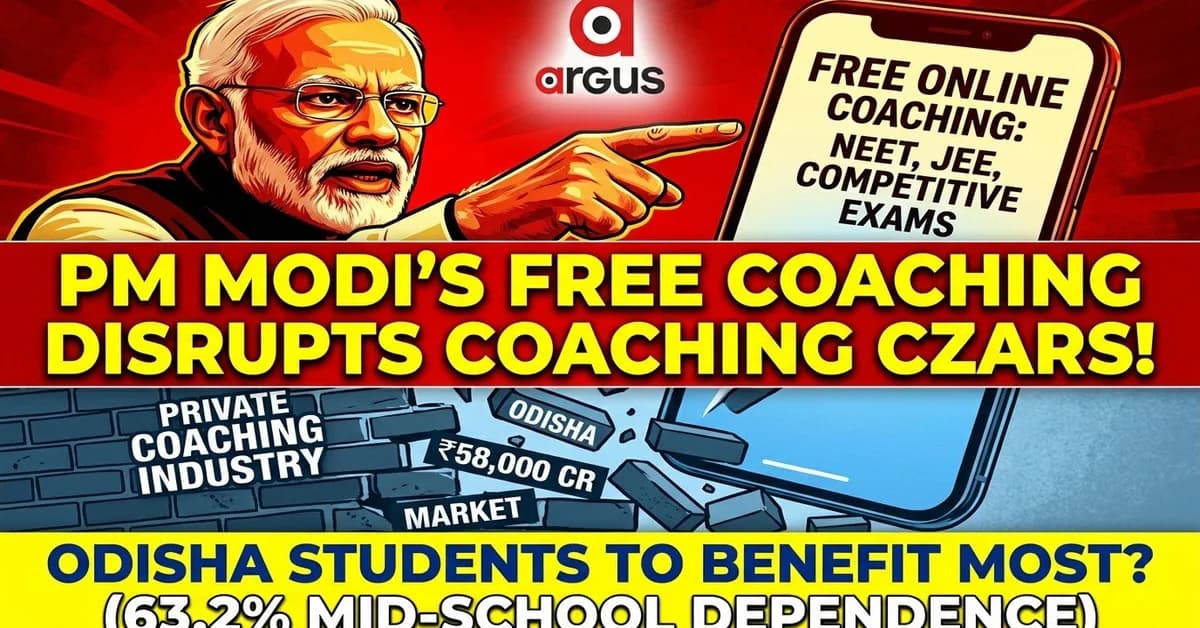
After the July saga, Prime Minister Narendra Modi, in his Independence Day address to the nation from the ramparts of the Red Fort, made a landmark announcement of providing free online coaching to students appearing for high-stakes examinations such as NEET, JEE and other competitive tests.
Even if the PM’s announcement is set to benefit millions of students across the country, Odisha could emerge as one of its biggest beneficiaries, given the state’s unusually deep dependence on private coaching at the school level and its growing competitive-exam economy.
Odisha’s takeaway could be unusually big

📱 Get Argus News App
✨The reason lies in a striking feature of Odisha’s education landscape: coaching is not merely an urban phenomenon here. Data from the NSSO/Comprehensive Modular Survey show that 63.2% of middle-school students in Odisha take private coaching, more than twice the all-India figure of 29.6%. The dependence remains high across the rural-urban divide –60.1% in rural Odisha and 70.3% in urban areas.
The number becomes more revealing when compared with the national picture. Odisha’s overall middle-school coaching participation is placed at 63.2%, against 29.6% nationally, putting the state among the country's most coaching-dependent regions. Only a handful of states, including Bihar, West Bengal and Tripura record higher levels.
That creates a ready-made market for a free competitive-learning platform. The logic is simple.
Families that are already accustomed to paying for supplementary education during school years are more likely to enter the expensive JEE, NEET and other competitive coaching ecosystem once children reach higher secondary classes. The existing cycle – school, private tutor, foundation course and eventually high-fee competitive coaching – could therefore be interrupted by a credible free alternative.
For rural Odisha, the potential payoff is even larger. The rural coaching participation rate of 60.1% is almost double the cited national rural average of 29.1%. A digital platform that brings quality competitive preparation into homes could reduce not only tuition expenditure but also the need for students to migrate to Bhubaneswar, Cuttack or coaching hubs outside the state.
Coaching institutions under threat
The stakes are not small. India’s private coaching industry has evolved into a parallel education economy, valued at more than Rs58,000 crore, with the market projected to reach around Rs1.45 lakh crore by 2033. More than seven crore students are estimated to be part of the coaching ecosystem.
Odisha itself has developed a sizeable coaching economy, estimated at around Rs2,000 crore-Rs2,500 crore annually. Engineering and medical coaching commands the highest fees, with JEE, NEET and related courses generally costing around Rs80,000 to Rs1.5 lakh or more a year, while the wider competitive-coaching ecosystem can push annual family expenditure towards Rs2 lakh when associated costs are included.
Bhubaneswar has emerged as the principal coaching hub, with Cuttack and other urban centres forming the next layer. The ecosystem includes national brands as well as strong local players. As per an estimate, there are around 1,313 large-scale private coaching centres across Odisha, with the overwhelming majority being single-owner or localised operations.
A credible free alternative therefore threatens the industry's most basic proposition: paying for access to quality study material, lectures, mock tests and examination-oriented preparation. Once these become freely available through a government-backed national platform, coaching czars will have to sell something beyond access.
How Modi’s free coaching model will work
The proposed architecture is essentially digital rather than brick-and-mortar. The initiative is expected to build on existing government digital education infrastructure, particularly SATHEE (Self Assessment Test and Help for Entrance Exams), developed with IIT Kanpur, and the SWAYAM ecosystem.
The model envisages a combination of live interactive classes, recorded lectures and modular learning material, national-level mock examinations aligned with NTA formats, and AI-enabled doubt resolution supported by human mentors. The idea is to replicate the critical components of a conventional coaching programme without requiring students to pay a coaching fee or move to another city.
For Odisha, this could be particularly significant because the state already has a large pool of students and families accustomed to supplementary learning. The government would not have to create demand; the demand already exists. What changes is who supplies it.
Can free online coaching take on the coaching czars?
This is where the real test begins. Free content alone cannot destroy the coaching industry. The private sector's advantage has traditionally been its combination of faculty, testing, competition, discipline, constant monitoring and personalised doubt-solving.
But the government has one weapon that even expensive coaching chains cannot easily match: scale combined with institutional credibility. If lectures are curated by faculty from IITs, central universities and other top educators, the quality of the core academic material can be standardised nationally.
The private coaching industry will then have to compete on a different battlefield. Merely selling lectures, question banks and routine mock tests may no longer be enough. Institutes could increasingly be forced towards personalised mentoring, intensive offline supervision, psychological support and performance tracking – areas where human intervention remains difficult to replicate digitally.
There are, however, caveats. Online learning cannot automatically solve the motivation deficit of self-paced students, millions of simultaneous doubts can test the system’s technological capacity, and the digital divide remains a concern in remote rural pockets.
Yet Odisha
enters this experiment with an unusual advantage: a population already deeply
conditioned to seek supplementary education. If Modi’s free coaching platform
succeeds in converting that existing coaching appetite into a free digital
learning habit, the biggest disruption may not happen in Kota or Delhi. It
could begin quietly in the homes of Odisha’s next generation of JEE and NEET
aspirants.
Also Read: From Latur Earthquake to NEET Tremor: How Chemistry Tutor Shivraj Motegaonkar Built ₹100Cr Empire Before Emerging NEET Paper Leak’s Key Man| Special Report
Related Topics
Explore more stories