



MMDR Amendment Act 2026: LoP Naveen Patnaik’s Odisha Revenue Loss Charge Against PM Modi -led Centre Explained
Key Points
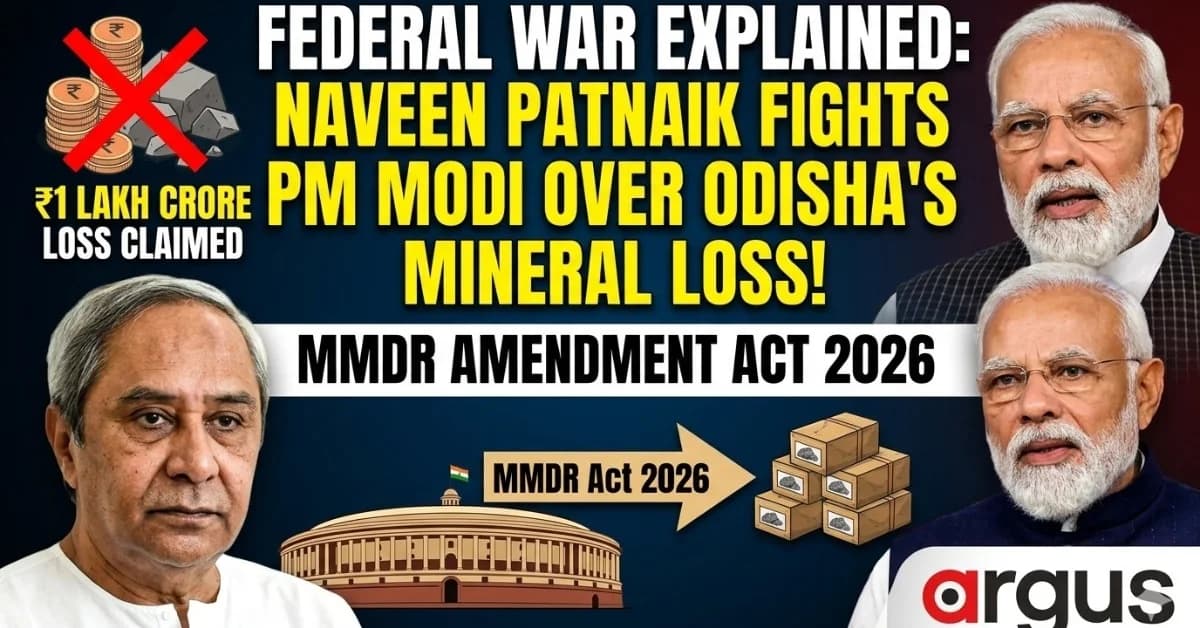
Bhubaneswar: The passage of the Mines and Minerals (Development and Regulation) Amendment Act, 2026 has opened a fresh and potentially consequential federalism battle between the Centre and mineral-rich states.
At the heart of the controversy is a simple but politically explosive question: who should have the final say over taxation of mineral rights and mineral-bearing land – the states where the minerals lie, or Parliament at the national level?
The legislation has triggered sharp opposition, with critics accusing the Centre of taking away a crucial fiscal power of mineral-rich states.
In Odisha, former Chief Minister and Leader of Opposition Naveen Patnaik has consistently raised the pitch, arguing that the amendment could seriously erode the State's mineral-linked revenues and undermine the federal balance.

📱 Get Argus News App
✨With the political chorus growing louder, the Centre has released a detailed fact sheet defending the legislation.
The government says the amendment is not about taking away mineral revenue from states but about preventing a proliferation of levies, reducing the cost of minerals and creating a predictable national framework for mining.
The Supreme Court's landmark 2024 ruling in Mineral Area Development Authority v. Steel Authority of India is at the centre of the legal dispute.
The nine-judge Bench held that the power to tax mineral rights lies with states under Entry 50 of the State List, while also holding that Parliament can impose limitations on that taxing power in the interests of mineral development.
So, is the 2026 amendment an assault on state fiscal autonomy, as the Opposition alleges, or a legitimate national economic intervention, as the Centre argues?
Here is the argument — and the counter-argument — point by point.
1. Has the Centre taken away the states' power to tax minerals?
The Opposition's argument
Naveen Patnaik's central objection is that the amendment effectively takes away a fiscal power that states were recognised as possessing by the Supreme Court.
The Opposition argues that mineral-rich states such as Odisha have historically carried the environmental, social and infrastructure burden of mining. If they are denied the ability to impose additional levies on mineral rights and mineral-bearing land, they would lose an important instrument to compensate themselves for those costs.
For Odisha, the issue is particularly significant because mining is not merely an industrial activity but one of the State's largest sources of public revenue.
The Centre's counter
The government's argument is that the amendment does not dismantle the mining revenue-sharing architecture. Instead, it seeks to prevent multiple and uncoordinated levies from different states from making Indian minerals disproportionately expensive.
The Centre's case is essentially that minerals are a national economic input. Iron ore, coal and other minerals extracted in one state feed steel, power, construction and manufacturing across the country.
The government's argument, therefore, shifts the debate from state taxation rights to national economic efficiency.
The larger question: Can Parliament impose such restrictions in the interests of mineral development? Interestingly, the 2024 Supreme Court judgment itself said Parliament can impose limitations on the states' taxing power under Entry 50.
That makes the legal battle more nuanced than a simple Centre-versus-State power dispute.
2. Will Odisha lose more than ₹1 lakh crore?
Naveen Patnaik's argument
This is perhaps the most politically potent part of the Odisha Opposition's case.
Patnaik has argued that the amendment threatens to wipe out more than ₹1 lakh crore in past mining-related claims that Odisha could otherwise have pursued following the Supreme Court judgment.
The State also faces an estimated ₹12,000 crore annual revenue impact, according to the Opposition's assessment.
For a state that has historically relied heavily on mineral revenues to finance infrastructure and welfare, such a reduction is being projected as a major fiscal shock.
Centre's counter
The Centre disputes the interpretation that Odisha's entire mineral revenue stream is under threat.
Its argument is that royalty, auction premiums and other established revenue streams continue to accrue to states. The government has particularly highlighted the scale of auction-premium collections by mineral-rich states.
According to the government, Odisha's auction-premium earnings since the introduction of the auction regime are not being retrospectively taken away.
That distinction is important.
3. What happens to the Supreme Court's 2024 judgment?
This is where the dispute acquires its strongest constitutional dimension.
Opposition's argument
The nine-judge Supreme Court Bench in July 2024 recognised that states possess the legislative competence to tax mineral rights.
The judgment specifically held that the taxing field under Entry 50 of List II belongs to the states. At the same time, the Court said Parliament could impose limitations on that power in the interests of mineral development.
The Opposition's contention is that the 2026 amendment goes far beyond imposing a limitation. By effectively prohibiting state levies unless permitted within a central framework, it is alleged to have neutralised the practical effect of the Supreme Court verdict.
That is why the legislation is being portrayed as a constitutional confrontation rather than merely a mining-policy reform.
Centre's counter
The government's likely constitutional defence rests on the second half of the Supreme Court's own reasoning.
The 2024 judgment did not say that the state's taxing power was completely immune from parliamentary intervention. It explicitly observed that Parliament can impose limitations — including potentially very significant restrictions — on state taxation of mineral rights in the interests of mineral development.
Therefore, the Centre's position is essentially:
The Supreme Court recognised the State's taxing field, but it also recognised Parliament's power to place limitations on that field. The 2026 law is being presented as an exercise of that limiting power.
4. What happens to retrospective mining dues?
Opposition's argument
The 2024 judgment had potentially opened the door for states to recover mineral-tax dues retrospectively.
That created enormous financial implications for mineral-producing states.
The Opposition argues that the 2026 amendment effectively closes that window by invalidating unrecovered past levies. In Odisha's case, the potential claims have been estimated at more than ₹1 lakh crore.
Hence the political charge that Parliament has legislated away revenue that states had become entitled to pursue after the Supreme Court verdict.
Centre's counter
The Centre frames the issue differently.
Its argument is that allowing companies to suddenly face enormous retrospective tax liabilities dating back years or decades creates legal and investment uncertainty.
From the government's perspective, an investor deciding whether to establish a steel, power or mineral-processing project cannot reasonably be expected to factor in unpredictable retrospective tax demands from multiple state governments.
The government therefore presents the extinguishing of unrecovered past claims as a form of fiscal certainty.
This is the sharpest economic trade-off in the entire controversy:
States see retrospective dues as legitimate revenue. The Centre sees them as retrospective uncertainty capable of damaging investment.
5. Is the amendment a corporate bailout?
Opposition's argument
Patnaik has accused the Centre of favouring a small number of mining companies at the expense of mineral-rich states.
The argument is straightforward: if companies no longer face large retrospective liabilities or multiple state levies, their costs fall. The revenue forgone by states effectively becomes a saving for mining operators.
Hence the Opposition's description of the amendment as corporate-friendly.
Centre's counter
The Centre rejects that framing and argues that lower mineral extraction costs eventually travel through the economy.
Mining is the first link in a long chain.
Expensive iron ore and coal affect the cost of steel. Steel affects construction, automobiles, machinery and infrastructure. Coal and other minerals affect power generation and industrial production.
The government's argument is therefore that rationalising mining taxation is not merely about helping miners. It is about reducing the input cost of the wider economy.
The counter-question, however, remains: how much of the tax saving actually reaches consumers, and how much remains with mining companies?
That is a question the law itself cannot answer automatically; it depends on market competition and pricing behaviour.
6. Is the Centre taking control of mineral-bearing land?
Opposition's argument
Another major legal objection relates to Entry 49 of the State List, concerning taxes on lands and buildings.
The Opposition's position is that mineral-bearing land remains within the state's constitutional domain and that Parliament cannot simply use the MMDR framework to take over that taxing field.
The 2026 amendment is therefore being portrayed as an expansion of central jurisdiction into an area constitutionally reserved for states.
Centre's counter
The Centre's response is to distinguish between ordinary land taxation and taxation connected with mineral development.
Its case is that mineral extraction is not merely a land issue. It has implications for national mineral security, industrial production and strategic supply chains.
The government also stresses that the amendment does not take away state control over minor minerals such as sand, gravel, granite and clay.
Thus, the Centre's narrative is that it is creating a national framework for major and strategic mineral development while leaving the states with substantial authority over minor minerals.
7. What about the claim that states will lose most of their mining revenue?
Opposition's argument
The Opposition's political messaging focuses on the possible loss of a lucrative additional revenue stream at a time when states are already under pressure to fund welfare schemes, infrastructure and social programmes.
For Odisha, the concern is amplified because mineral revenues have historically played an important role in the State's fiscal architecture.
Centre's counter
The government's strongest numerical defence is that states continue to retain around 90% of total mineral-sector revenues, according to its factsheet.
The Centre also points to auction premiums as a major revenue source that remains with the states.
This is an important distinction:
The amendment does not mean the Centre will collect all mining revenue.
The actual dispute is over the additional taxing power and retrospective claims that states argue are being taken away.
That makes the Opposition's phrase "loss of mineral revenue" politically powerful, but economically it needs to be broken down into royalty, auction premium, DMF, GST and state-specific taxes or cesses.
8. Does the amendment make Indian minerals cheaper?
Centre's argument
This is the government's strongest economic argument.
The Centre says multiple taxes, cesses, fees and other charges imposed at different stages can make domestic mineral extraction expensive.
The government has cited instances of numerous levies operating around mining activities and argues that the cumulative burden can make Indian minerals less competitive than imported alternatives.
The logic is simple:
Higher domestic mineral costs → higher industrial input costs → higher manufacturing costs → weaker competitiveness.
The amendment is therefore being positioned as an industrial policy measure rather than merely a mining-tax measure.
9. Will this increase India's dependence on imported minerals?
Centre's argument
The government links the amendment to Atmanirbhar Bharat and Viksit Bharat.
Its argument is that if Indian minerals become more expensive because of cumulative state levies, domestic industries could increasingly turn to imported raw materials.
The government has cited India's substantial mineral imports to underline the strategic vulnerability.
The objective, therefore, is to make domestic mineral production more competitive and reduce import dependence.
Opposition's counter
The Opposition's answer is that self-reliance cannot mean weakening the fiscal rights of mineral-producing states.
States could argue that the better solution is to rationalise taxation through consultation rather than eliminate or centralise the taxing space.
That brings the debate back to the federal question: Should uniformity be imposed by the Centre, or negotiated between the Centre and mineral-rich states?
The real fault line: Revenue versus national economic interest
At first glance, the MMDR controversy looks like a fight over mining taxes.
But beneath the numbers lies a much bigger constitutional and economic conflict.
Opposition's, including Naveen Patnaik, argument is essentially that minerals belong to the State's economic domain and that the State should retain the fiscal ability to capture a fair share of the wealth extracted from its territory.
The Centre's argument is that minerals are strategic national inputs and that fragmented taxation can undermine India's manufacturing competitiveness, energy security and supply-chain resilience.
Both sides are therefore talking about "public interest" – but defining it differently.
For Odisha, public interest means greater state revenue from its mineral wealth.
For the Centre, public interest means cheaper mineral inputs, investment certainty and national industrial competitiveness.
Bottom line
The Opposition's strongest argument is federalism plus revenue: Odisha was given a constitutionally recognised taxing power, and the new law substantially curtails its ability to monetise that power — including potential retrospective claims.
The Centre's strongest argument is national economic interest plus certainty: mineral taxation cannot be allowed to become so fragmented that Indian raw materials become expensive, industries lose competitiveness and investors face unpredictable retrospective liabilities.
The crucial
point for Odisha is that the amendment does not simply mean the State will
stop earning mineral revenue. Royalty, auction premiums and other
established revenue streams remain important.
Also Read: Odisha Eyes Electrical Equipment Manufacturing Boom; Joins Gujarat in Race to Woo High-Employment Sector at August Investor Meet| Special Report
Related Topics
Explore more stories