



Ministers Over Bureaucrats: Why CM Mohan Majhi Ended 5T Era Babu-Led Virtual Cabinets to Restore Political Supremacy in Odisha | Exclusive
Key Points
Bhubaneswar: In the run-up to the 2024 elections, the BJP was scathing in its attack on the erstwhile Naveen Patnaik-led BJD government’s growing practice of the much-touted 5T-era bureaucrat-led virtual Cabinet meetings, where, according to across the spectrum criticism, elected representatives were increasingly reduced to a rubber-stamp role.
When the BJP government completed two years in office in June this year, political observers reminded the Mohan Majhi government of that unfulfilled promise.
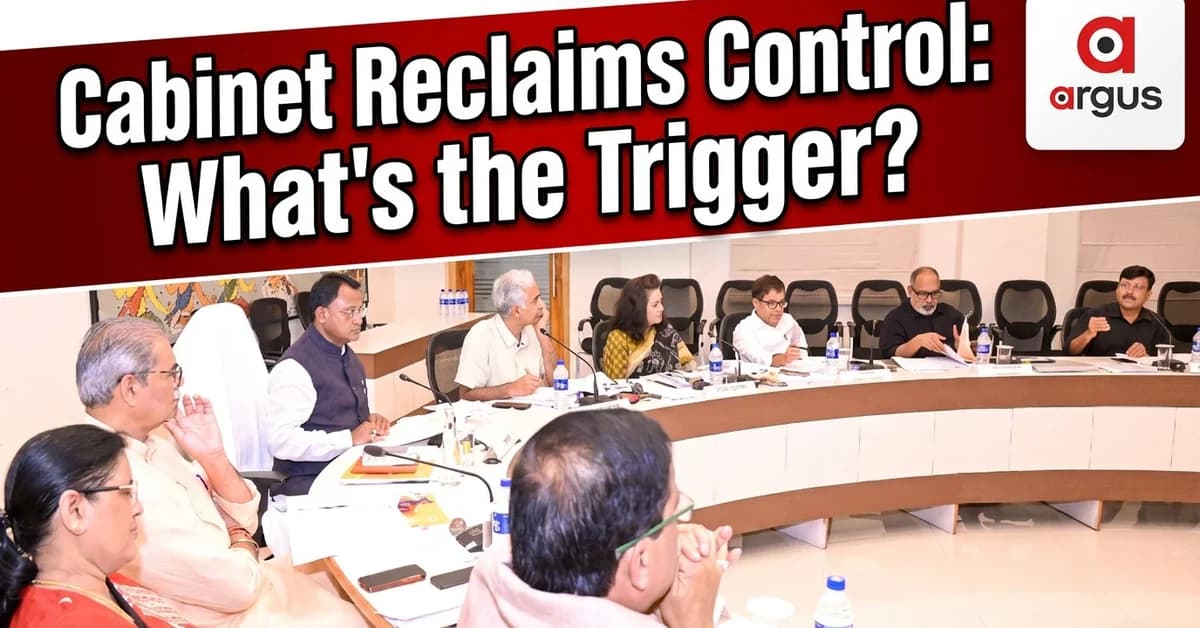
However, on Thursday, the Mohan Majhi government announced a pathbreaking decision: the Odisha Cabinet will now meet twice a month, bringing a fixed fortnightly rhythm to the State’s highest political decision-making forum.
The move is significant not merely because of the frequency.

📱 Get Argus News App
✨It comes at a politically and administratively opportune time –with over half a dozen districts in the throes of persistent flooding and waterlogging, farmer protests over AgriStack-linked procurement rules raising their head, and the government simultaneously pursuing a major MoU and investment-signing spree.
The pertinent fact is that Prime Minister Narendra Modi normally holds Union Cabinet meetings every Wednesday, although the schedule can vary depending on exigencies. States, however, have traditionally followed their own timelines.
A fixed fortnightly or weekly Cabinet rhythm is still relatively uncommon among state governments, with the new Odisha system placing it closer to the more structured models seen in states such as Telangana and the high-frequency systems of Uttar Pradesh and Maharashtra.
More importantly, the Odisha decision appears to mark a deeper political correction: the Cabinet is being repositioned as a forum where ministers, not bureaucratic workflows, set the tempo of governance.
Where Odisha Now Stands: The Cabinet Calendar Across States
|
State |
Broad Cabinet Meeting Rhythm
Governance Character
Odisha
Twice a month / fortnightly
Fixed governance rhythm aimed at quicker policy clearance, advance preparation of Cabinet notes and regular political review
Telangana
Twice a month under a structured calendar
Institutionalised regularity; the model has also emphasised periodic review of implementation
Uttar Pradesh
Usually weekly
High-frequency decision-making to handle the administrative volume of India’s most populous state
Maharashtra
Usually weekly
High-volume Cabinet business supported by extensive digital and paperless processes
Assam
Frequent, flexible schedule
Regular Cabinet decision-making, with an emphasis at times on decentralised governance beyond the capital
Union Cabinet
Normally weekly, often Wednesday
National-level policy, financial and legislative decisions, subject to the Prime Minister’s schedule
The significance of Odisha’s move lies in the fact that the State has now attempted to convert Cabinet functioning from an event-driven process into a predictable political institution.
A fixed calendar means the bureaucracy cannot indefinitely wait for a Cabinet meeting to be announced before completing policy papers. Departments will have to work backwards from the next scheduled meeting.
That changes the power equation.
Looking Back At Odisha Cabinet Odyssey
Odisha’s Cabinet system has never historically followed a rigid calendar. Its evolution broadly reflects the changing style of political leadership, administrative technology and the balance between political executives and the bureaucracy.
|
Period |
Broad Cabinet Practice |
Dominant Character |
|
1980s Congress era |
Need-based and irregular |
Cabinet meetings were driven by major political decisions, legislation, disasters and administrative urgency |
|
1990–1995: Biju Patnaik era |
Frequent but uneven |
Centralised and rapid decision-making, with meetings called according to the urgency of major development and administrative decisions |
|
1995–2000 Congress era |
Irregular |
Political churn and major crises, culminating in the 1999 Super Cyclone, shaped the Cabinet agenda |
|
2000–2019: Naveen Patnaik era |
Organised but largely need-based |
A more systematised bureaucratic process emerged, with Cabinet meetings linked to policy launches, legislation and major welfare decisions |
|
2019–2024: 5T phase |
Rare physical meetings, rapid virtual and digital decision-making |
The digital workflow accelerated file clearance but also generated criticism over the growing dominance of the bureaucracy and the reduced visibility of political deliberation |
|
2024–2026: Mohan Majhi era |
No rigid fortnightly system initially |
Return of a more conventional political Cabinet structure, but without a fixed calendar |
|
From August 2026 |
Twice a month |
First formal attempt to institutionalise a fixed, recurring fortnightly Cabinet rhythm in Odisha |
The 5T era represented the sharpest technological break in this history.
The argument then was that the virtual and digital Cabinet system promised speed. Files could move quickly. Ministers could access proposals electronically. Major policy decisions could be cleared without waiting for lengthy physical sittings.
But administrative experts and political leaders argument was that speed came with a democratic cost.
When physical political deliberation becomes less frequent and departmental proposals move through a highly centralised bureaucratic digital chain, the danger is that the elected Cabinet may merely endorse a policy whose essential architecture has already been settled elsewhere.
The Majhi government’s new decision appears designed to correct precisely that imbalance.
The Trigger Factor: When Political Intervention Changed the Bureaucratic Note
The strongest argument for a more frequent Cabinet is not merely that it clears more files. It is that a politically active Cabinet can modify, question or even overturn the assumptions contained in departmental notes.
Recent big developments illustrate the importance of such political intervention.
|
Issue |
Administrative/Departmental Direction |
Political or Cabinet-Level Intervention |
Tangible Outcome |
|
AgriStack and paddy procurement |
Digital integration created anxiety among farmers over registration requirements and procurement access |
Political feedback from the ground forced the government to address farmer concerns and review the linkage |
The procurement process was recalibrated to prevent farmers from being excluded because of immediate digital registration hurdles |
|
Industrial and investment policies |
Departments prepared policy amendments and incentive structures |
Ministers gained a forum to assess whether proposals were politically and economically adequate |
Policy decisions could be strengthened to improve Odisha’s competitiveness for high-value investments |
|
Renewable energy and semiconductor ecosystem |
Departmental proposals focused on policy alignment and administrative extensions |
Political scrutiny can test whether incentives are strong enough for investors and aligned with national programmes |
Cabinet-level intervention can reshape fiscal and policy support rather than simply approve routine departmental drafts |
|
Digital governance and OSWAS expansion |
Technology departments focused on deeper automation and paperless governance |
Political leadership has to assess whether digitisation reaches citizens and lower administrative levels |
Digital systems can be pushed towards inclusion rather than becoming a tool concentrated within the Secretariat |
|
Flood, agriculture and seasonal decisions |
Departments respond through individual administrative channels |
Ministers bring district-level political feedback into the decision process |
Faster approval of relief, agricultural and infrastructure measures |
The essential difference is simple.
A bureaucratic note is a proposal. A Cabinet decision is supposed to be a political decision.
In the new system, the Odisha government has decided that Cabinet notes will have to be prepared in advance and presented before the scheduled meetings, creating a tighter deadline-driven administrative process.
That could become the most consequential part of the reform.
Once departments know that the Cabinet will sit every fortnight, secretaries and senior officials can no longer operate on an indefinite timetable. Policy proposals, financial approvals, project notes and amendments must be ready in advance.
The fixed calendar, therefore, changes not only how often ministers meet. It changes how the bureaucracy prepares to face the ministers.
Ministers Over Bureaucrats: The Structural Shift
The contrast between the two models can be understood this way:
|
Governance Factor |
Earlier Event-Driven/Digital Model |
New Fortnightly Cabinet Model |
|
Cabinet timing |
Meetings could be called as required |
A predictable twice-a-month political calendar |
|
Bureaucratic workflow |
Files could move through a centralised digital chain |
Departments face recurring deadlines for Cabinet business |
|
Ministerial scrutiny |
Digital circulation could facilitate rapid approval |
Ministers get more regular opportunities for discussion and intervention |
|
Policy correction |
Corrections may wait for the next major review |
A political response can theoretically come within a fortnight |
|
Field feedback |
Administrative data can dominate the process |
Ministers can bring constituency and district-level feedback into Cabinet |
|
Political accountability |
Decision-making can appear bureaucratically driven |
The elected executive is more visibly positioned at the centre |
This does not mean bureaucracy becomes less important. On the contrary, a fortnightly Cabinet could demand more efficient bureaucracy.
But the hierarchy becomes clearer: the bureaucracy prepares, analyses and recommends; the political executive decides.
That is the real significance of Thursday’s decision.
Public Agenda & Impact
For the common man, the success of the new system will not be measured by how many Cabinet meetings are held. It will be measured by whether decisions begin reaching the ground faster.
A fixed fortnightly Cabinet schedule can potentially create impact across five areas.
First, faster disaster response. During the monsoon, Odisha frequently faces a compressed cycle of floods, waterlogging, crop damage and infrastructure disruption. A fortnightly Cabinet allows relief packages, emergency funding and policy corrections to come up before the political executive more regularly instead of waiting for an uncertain meeting date.
Second, quicker correction of welfare glitches. If beneficiaries face problems in a digital scheme, direct benefit transfer, procurement process or registration platform, the government has a regular political window to intervene.
Third, speedier infrastructure clearance. Roads, irrigation projects, drinking water schemes, bridges and major urban works often require Cabinet-level approvals involving finance, land, policy exemptions or revised costs. Delays at the Cabinet stage can escalate project costs. A predictable calendar could reduce that uncertainty.
Fourth, greater accountability of departments. With a meeting approaching every 15 days, departmental secretaries and senior officers have a more rigid governance deadline. Files cannot simply remain pending because the next Cabinet meeting is unknown.
Fifth, better alignment with Central schemes and investment opportunities. Odisha is currently pursuing major industrial investments and central-government-linked development programmes. A faster Cabinet can help the State respond more quickly to financial, policy and incentive requirements.
The immediate political context is equally important.
Odisha is dealing with flood-related distress in several districts. Farmers have raised concerns over the new digital architecture around agricultural registration and procurement. Many elderly beneficiaries faced delay in pension disbursement. At the same time, the Majhi government is signing MoUs and attempting to project Odisha as a major investment destination.
All three pressures require the same thing: speed with political accountability.
That may explain why the timing of the decision matters as much as the decision itself.
The Majhi government is not merely promising more meetings. It is attempting to establish a new rhythm of governance in which ministers must meet regularly, bureaucrats must prepare in advance, policies must be reviewed faster and political feedback must enter the decision-making chain before files become fait accompli.
The BJP had attacked the previous 5T model on the ground that bureaucratic power had increasingly overshadowed the elected political executive.
However, two years after, the Majhi government has now taken its clearest structural step to answer that criticism.
Whether twice-a-month Cabinet meetings translate into better governance will depend on what happens after the meetings – on implementation, monitoring and accountability.
But politically, the message is already unmistakable:
In
Odisha’s new governance architecture, the bureaucracy may still prepare the
notes. The ministers are being brought back to the centre of the decision.
Also Read: Dy CM KV Singh Deo’s Hard Talk: Why Odisha Must Go the ‘Yogi Way’ to Fix Bureaucracy Violating Study Tour Protocols
Related Topics
Explore more stories