



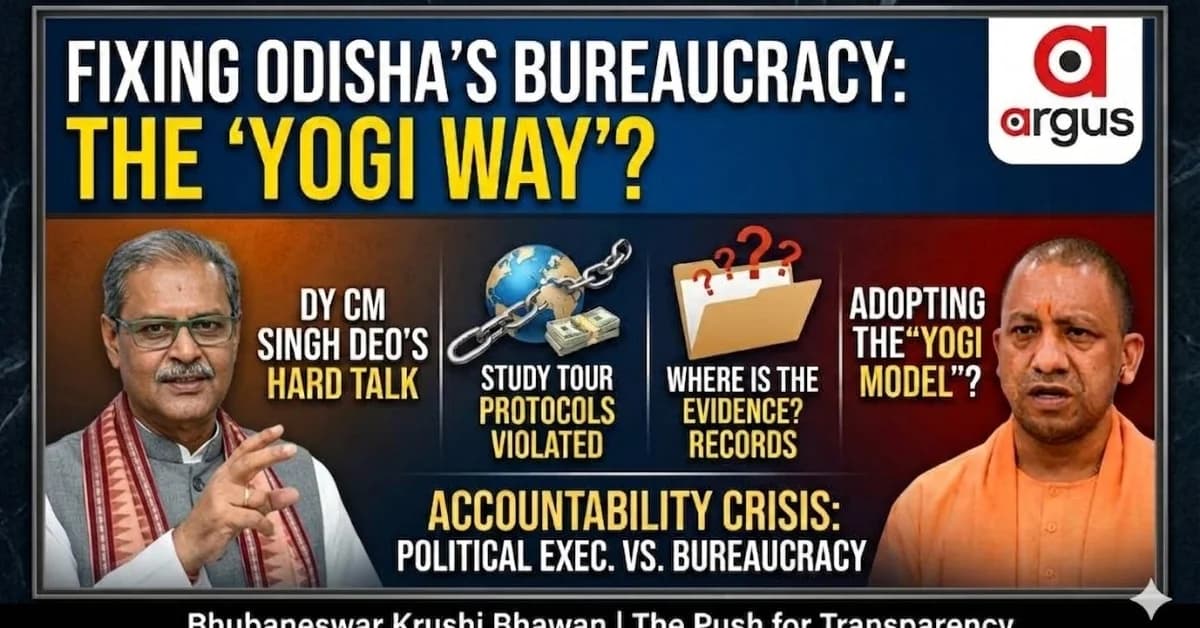
Dy CM KV Singh Deo’s Hard Talk: Why Odisha Must Go the ‘Yogi Way’ to Fix Bureaucracy Violating Study Tour Protocols
Key Points
Bhubaneswar: It looked, at first, like another annual review meeting in Bhubaneswar.
Field officials from blocks and districts had arrived at Krushi Bhawan with the familiar gusto of a state-level conference – formal kurtas, files and folders in hand, officers settling into cushioned chairs, flower bouquets on the tables and a presentation screen carrying the sober title: “State Level Conference for Horticulture Officers.”
The stage was set for presentations, progress reports and the usual review of targets.
But then the mood changed.

📱 Get Argus News App
✨When Deputy Chief Minister and Agriculture Minister KV Singh Deo took the podium, what followed was anything but a routine departmental review. The minister was visibly displeased after the Directorate of Horticulture told him that records relating to officials’ study tours and field visits had been documented and processed internally.
For Singh Deo, that answer appeared to miss the larger point: if public money is spent sending officials across the country or abroad to learn, where is the accountability to the elected government, and more importantly, where is the evidence that farmers benefited?
That question turned a routine horticulture conference into an unusually blunt confrontation between the political executive and the bureaucracy.
What Was the Meeting – And Why Did The Minister Get Angry?
The State-Level Conference for Horticulture Officers was convened at Krushi Bhawan, Bhubaneswar, with senior departmental officials and field officers from across Odisha. The broad agenda was to take stock of horticulture programmes, crop diversification, post-harvest infrastructure, subsidies, modern farming practices and the delivery of schemes to cultivators.
The department is also dealing with major implementation challenges, including delays in planned cold-storage infrastructure, with 58 units envisaged across sub-divisions.
But the meeting acquired a different character when the discussion moved to officials’ exposure visits and study tours.
The department had been sending officials to progressive agricultural states and even abroad to study newer technologies and farming practices. One prominent example was the seven-day Malaysia exposure tour, involving 28 people – 14 senior agriculture/horticulture officials and 14 progressive farmers.
The stated purpose was straightforward: study climate-resilient farming, mushroom cultivation, greenhouse technology and modern fruit grading and packaging.
Yet when the minister sought the corresponding follow-up and evaluation reports, the answer that such records had been maintained or processed internally did not satisfy him.
That was the trigger.
The minister's question was essentially simple: If officials were sent to learn something new, why was the elected government not being given a formal account of what they learnt, what was implemented and what changed for farmers?
The department, according to the inputs available, had not furnished a single follow-up evaluation report to the minister or the Department Secretary over the preceding two years establishing such outcomes.
And that is where the minister's plain speaking began.
What Was The Protocol?
The issue was not merely about paperwork.
The minister's objection was rooted in the chain of accountability governing a government department.
Officials are the implementing machinery of the government. The elected executive decides the policy direction, approves programmes and remains politically accountable for how public money is spent.
That makes a study tour funded by the government more than an official itinerary.
It is public expenditure.
It is also expected to produce an institutional outcome.
The department's own travel and training structures cover exposure visits, capacity building and extension activities, while centrally supported horticulture programmes also provide funding avenues. The Malaysia exposure tour, for instance, was linked to the broader climate-resilient agriculture framework.
At the grassroots level, the government has also increased the monthly travel allowance for field-level agricultural overseers from Rs450 to Rs1,500, precisely to strengthen field monitoring.
So the minister's argument was not difficult to understand: if the government is spending more to put officers in the field and is spending money to send them on exposure visits, the government must know what those visits produced.
The protocol, as the minister interpreted it, required the reporting chain to run upwards – from the field and Directorate to the Secretary and ultimately to the political executive.
How Was The Protocol Violated?
The execution of any inter-state or international study tour involves three distinct administrative phases:
First, the Pre-Tour Sanction & Financial Authorization
- The Proposal: The Director of Horticulture drafts a detailed itinerary explaining the exact commercial and technical purpose of the trip (e.g., studying cold storage logistics or high-density mango orchards).
- Target KPI (Key Performance Indicator): The proposal must clearly outline what the state stands to gain and exactly how many progressive farmers are being paired with officials.
- Administrative Approval: The file must move through the chain of command: Director of Horticulture → Department Secretary → Cabinet Minister (Deputy CM).
- Funding Allocation: Funds are released only after the Minister signs off, drawing from Central schemes like MIDH (Mission for Integrated Development of Horticulture) or State Plan Budgets.
Second, has been the On-Tour Execution Protocols
- Daily Tour Diary: Travelling officials are legally required to maintain a daily tour diary logging every farm, research institute, and technological unit visited.
- Farmer Mentorship: Officials must actively mentor the accompanying local farmers, capturing field data and photographic evidence.
Third, and the most important one has been the Post-Tour Reporting & The Chain of Command (Where They Failed)
- The Mandatory 14-Day Deadline: Within 14 days of returning, travelling officials must submit a highly technical Tour Report and a "Lab-to-Land" Implementation Plan.
- Whom to Report To: The report follows a strict hierarchical ladder:
1. Junior/Assistant Horticulture Officers (AHOs) submit to the Deputy Director of Horticulture (DDH).
2. The DDH compiles and submits the data to the Director of Horticulture (Odisha).
- The Director is legally obligated to submit the master executive brief to the Agriculture Secretary and the Cabinet Minister's Office for final review.
The Broken Link: The officials processed these files strictly "internally" at the Directorate level. They failed to present the numbers, cost benefits, or implementation strategies to the newly elected BJP ministry, keeping the Cabinet entirely in the dark.
That disconnect appears to have particularly angered the minister.
After all, the agriculture budget has risen dramatically — from around RS7,000 crore to nearly Rs14,000-15,000 crore. Singh Deo's contention was that such an expansion in public spending must translate into visible outcomes.
In his formulation, the budget is for farmers, not for administrative entertainment.
What Dy CM Must Implement Now to Track Errant Bureaucracy: The Yogi way!
Uttar Pradesh (UP) – The "Integrated Portal & Target-Linked" Model: UP is a massive producer of horticultural goods. To maintain transparency, they use a tightly regulated tracking pipeline.
- Pre-defined Visual Proof: In UP, any exposure visit requires geotagged, time-stamped photographs of the officials on-site with local farmers, uploaded in real-time onto state agricultural portals.
- Direct Presentation to the Ministry: Before travel allowances (TA/DA bills) are cleared by the treasury, the team leader must present a formal presentation directly to the Agriculture Production Commissioner (APC) or the Minister's monitoring committee.
- Strict Accountability: If no visible policy or localized training module is rolled out in UP districts within 30 days of a tour's completion, the travel cost is financially docked directly from the responsible official's salary.
Also is the Shivraj Singh Chouhan MP Model: Madhya Pradesh (MP) – The "Impact Evaluation & Farmer-Led" Model
Madhya Pradesh relies heavily on specific policy goals (like their strict Organic Farming Policy) to drive their travel mandates.
- The Farmer-First Mandate: In MP, administrators cannot go on study trips alone. Bureaucrats are only sanctioned to travel if they are directly accompanying a majority quota of local district farmers.
- Decentralized Reporting: Upon return, reports cannot simply be archived in a cabinet file. Returning officers are mandated to host open "Kisan Pathshalas" (Farmer Schools) or Krishi Vigyan Kendra (KVK) workshops at the block level.
- Output Audits: MP conducts annual performance audits on departments. The state tracks whether the high-tech methods observed during tours (like Israel-model micro-irrigation) were actually adopted by local clusters within 6–12 months of the trip.
How Odisha System Failed
While states like UP and MP treat study tours as a strict pipeline linking Public Funds ➔ Field Learning ➔ Ministry Review ➔ Grassroots Implementation, the Odisha horticulture wing treated it as an internal departmental loop.
The Message: Fall In Line Or Face The Music
The most consequential part of the episode was not the anger itself.
It was the warning that followed.
Singh Deo gave the department seven days to furnish the pending tour and evaluation records through the Secretary. If the reports were not produced, he warned that domestic and international travel funding for the department would be frozen.
He also made it clear that officials unwilling to comply with the government's directions could face serious consequences.
That makes the episode bigger than a horticulture department spat.
It is a message being read across the bureaucracy: respect the protocol, maintain the reporting chain, remain accountable to the elected executive – or be prepared to face administrative action.
The timing and setting matter.
The minister did not issue the warning behind a closed office door. He did it at a state-level conference in the presence of officers who had come from across Odisha, turning what could have remained an internal administrative issue into a public assertion of political authority.
And that is precisely why the episode has attracted attention.
For farmers and farmer organisations, the minister's public rebuke has found resonance because their complaint is often different from the language of files and departmental notes: what reaches the field?
Farmer groups have backed the demand for officials to get out of air-conditioned offices, undertake regular field visits and demonstrate the practical benefits of government programmes and exposure tours. They have also pointed to issues such as delayed cold-storage infrastructure and the need for technical knowledge to actually reach cultivators.
In that sense, the minister's outburst has landed on a larger fault line in governance.
The
plain-speaking message from the minister was therefore broader than
horticulture: fall in line, follow the protocol, account for public money and
remain answerable to the elected government – or get ready to face the music.
Also Read: Odisha Cotton Yield Beats Gujarat, Maharashtra: How Double Engine Push Made State India’s No.1| Exclusive
Related Topics
Explore more stories