



Mahanadi Waterfront: Odisha Joins Elite States League to Go for Eco-Resilient Urbanism
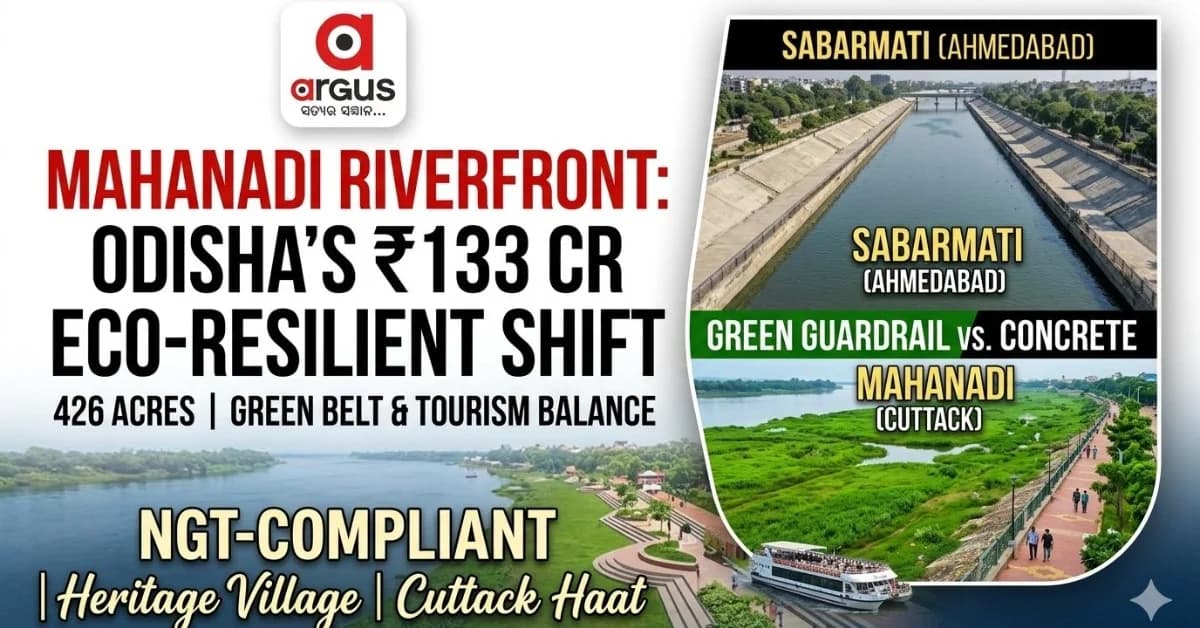
Key Points
₹133.71 Crore Contract: The Odisha Cabinet cleared the bidding outcome for a major Engineering, Procurement, and Construction (EPC) upgrade across a 426-acre layout in Cuttack.
66% Eco-Guardrail: To comply with National Green Tribunal (NGT) norms, 284 acres are legally preserved as an untouched riverine green belt for flood absorption.
3.2-km Cultural Promenade: The remaining 142 acres will feature Phase-I amenities from Balijatra Ground to the Odisha State Maritime Museum, including a Cuttack Haat and Heritage Village
Bhubaneswar: In a leap towards macro-scale urban regeneration, the Odisha government has authorized a Rs133.71 crore engineering contract to completely upgrade the Mahanadi Riverfront in Cuttack.
Spanning a massive 426-acre layout, the rollout sets a rare national precedent: balancing aggressive civic beautification with strict environmental compliance mandated by the National Green Tribunal (NGT).
Balancing Green Belts with Tourism
Unlike traditional Indian riverfront developments that rely on rigid concrete channeling (often altering natural hydrology), Odisha is adopting a hybrid eco-resilient model.

📱 Get Argus News App
✨· Ecological Preservation: A dominant 284 acres (66% of total land) is legally locked down as an untouched riverine green belt to manage monsoon flood absorption.
· Civic & Cultural Infrastructure: The remaining 142 acres host a phased 3.2-km promenade stretching from the Balijatra Ground to the Odisha State Maritime Museum. It includes advanced commercial nodes like a Cuttack Haat, a Heritage Village, and designated inland vessel cruise networks.
Comparative Assessment: Where Odisha Stands Nationally
By allocating more than two-thirds of its development area to an ecological green lung, Odisha establishes a new, sustainable benchmark for high-value river transformations across India.
|
Waterfront Project |
Development Philosophy |
Key Limitation / Environmental Risk
Odisha's Strategic Advance
Sabarmati (Ahmedabad)
Extreme concrete channeling; massive commercial land reclamation.
Alters natural river hydrology; high risk during extreme flood events.
Retains natural floodplains by preserving 284 acres exclusively for ecological absorption.
Hoogly (Kolkata)
Leisure promenades laid over older colonial-era ghat architecture.
High conflicts with intense maritime cargo transport and local industry.
Strict zoning separating public heritage tourism from major industrial commercial estuaries.
Mahanadi (Cuttack)
Eco-Resilient Hybrid Architecture balancing green lung with cultural commerce.
Requires strict post-construction monitoring against illegal masonry encroachments.
Mandates 5 years of comprehensive O&M directly in the primary EPC tender contract execution layout.
A FLASH BACK
The Mahanadi Waterfront Development Project in Cuttack has evolved from a small civic beautification proposal into a multi-crore, eco-resilient urban transformation scheme. Its timeline shows a shift from early conceptual delays to rapid budgetary and executive acceleration.
The chronological timeline tracks how the vision reached its current stage:
1. The Genesis: Early 2020s
· The Concept: The idea was originally envisioned as part of Cuttack’s wider urban revitalization master plan. The initial scope was modest, backed by a preliminary allocation of Rs 50 crore aimed at simple riverbank landscaping
· The NGT Bottleneck (2022): The project faced immediate delays when the National Green Tribunal (NGT) intervened. Orders were issued to halt unchecked development to protect the Mahanadi's active floodplains and delicate riverine ecology. The project had to be completely re-engineered around strict environmental compliance.
2. Scaling Up Allocation By BJP Govt
· November 2025: Marking the historic Balijatra festival, Chief Minister Mohan Charan Majhi dramatically scaled up the state's vision, expanding the fiscal framework by announcing a Rs 200 crore master plan. The goal was to shift from a standard park to a world-class river tourism hub. [
· Late 2025 Budgetary Backing: The state formally locked in the funding mechanism by providing an initial Rs 150 crore allocation specifically earmarked within the 2025–26 State Budget.
3. The Three-Phase Framework (January 2026)
· January 2026: The Housing & Urban Development (H&UD) Department finalized the master plan execution via the Cuttack Development Authority (CDA). It established a rigid, three-phase layout across a 426-acre footprint:
o Phase I: Development of a 3.2-km main promenade stretching from the Balijatra ground edge to the Odisha State Maritime Museum.
o Phase II: Subsurface networks, underground utilities, and massive tree plantations.
o Phase III: Commercial and cultural assets including Cuttack Haat, a Heritage Village, and thematic gardens.
4. Fast-Track Directives: Balancing Ecology & Tourism (March 2026)
· March 2026: Chief Minister Majhi ordered an immediate fast-track of Phase-I. To permanently resolve the NGT framework, the state codified the 66% Green Guardrail: legally locking 284 acres into an untouched ecological green belt, leaving exactly 142 acres for cultural tourism. Authorities were directed to study the infrastructure of Ahmedabad's Sabarmati model while adapting it to Cuttack's unique flood hydrology
5. Final Stage: EPC Bidding Outcome & Cabinet Green Light (October 13, 2026)
· October 13, 2026: The Odisha Cabinet officially cleared the bidding outcomes for the project, approving a final execution cost of ₹133.71 crore (excluding GST).
·
The Next Steps: Awarded on an Engineering, Procurement, and Construction (EPC) model,
on-site physical construction is scheduled to begin in November 2026
with a strict completion deadline of November 2028. Crucially, the
tender binds the selected firm to 5 years of comprehensive post-construction
operation and maintenance (O&M) to ensure asset longevity.
Also Read: Astaranga Phase 2: Odisha Cabinet Greenlights Major Blue Economy Push
Related Topics
Explore more stories