



Astaranga Phase 2: Odisha Cabinet Greenlights Major Blue Economy Push
Key Points
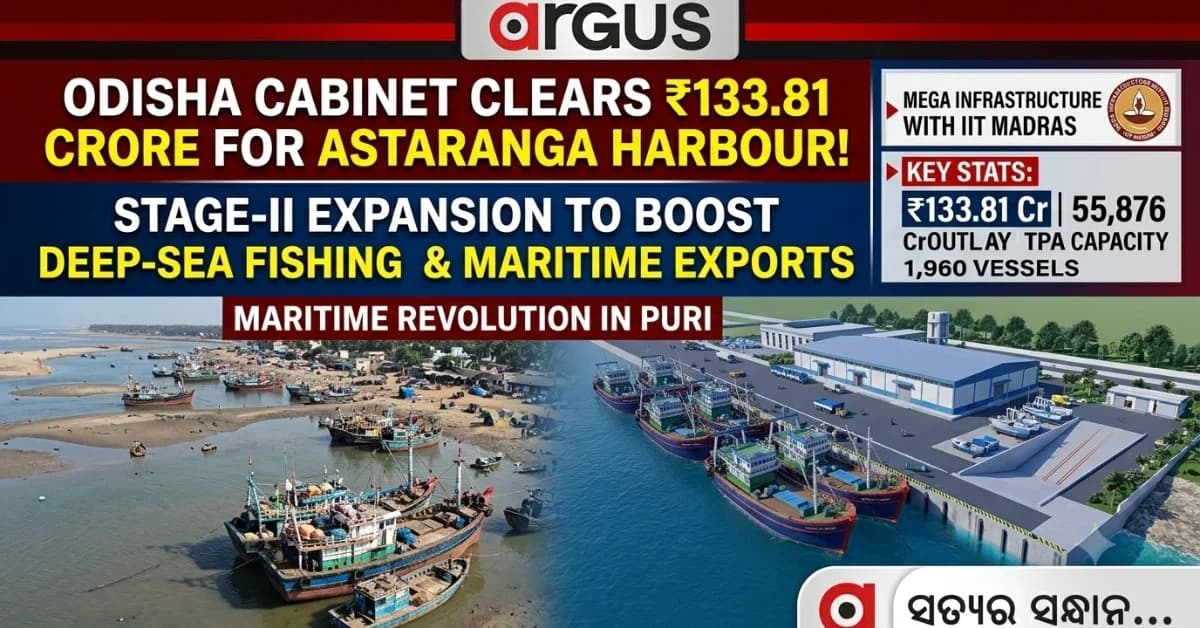
₹133.81 Crore Outlay: The Odisha Cabinet has approved Stage-II expansion of Astaranga Fishing Harbour in Puri to build a modern marine export hub.
Deep-Sea Capacity Boost: Designed with IIT Madras, the upgraded harbour adds 55,876 TPA landing capacity and accommodates 1,960 active vessels.
Global Export Standard: The project introduces a 624m diaphragm wall and 24/7 cold-chain infrastructure to directly meet EU and Japanese import standards.
Bhubaneswar: In a major
expansion of its maritime logistics and deep-sea production capability, the
Odisha Cabinet has cleared a Rs133.81 crore financial bid for Stage-II of the Astaranga
Fishing harbour in Puri district.
The mega-infrastructure project,
designed in collaboration with IIT Madras as the Project Management Consultant,
shifts Odisha from artisanal shorelines to an integrated, high-capacity marine
export ecosystem.
The Shift: From Mud Jetty to Export Hub
Historically, the Nuagarh landing point operated under severe seasonal limits. Traditional craft and multi-day trawlers were forced to navigate shallow, silting basins near the Devi River mouth, suffering extensive post-harvest loss due to poor sanitation and lack of cold chains.
The Stage-II expansion completely transforms this landscape. It introduces a heavily engineered 624-meter RCC diaphragm wall and dedicated outfitting, landing, and repair quays to anchor high-tonnage vessels safely. Supported by round-the-clock power and water utilities, the harbor guarantees rigorous cold-chain integrity required to bypass intermediaries and pass global export audits.

📱 Get Argus News App
✨Impact Analysis: Astaranga Capacity Metrics
The following structural specifications detail how the new development elevates Odisha's marine commerce footprint:
|
Infrastructure Parameter |
Baseline/Design Specification |
Strategic Economic Value |
|
Total Project Outlay |
₹133.81 Crore (Excluding GST)
Public capital injection directly scaling state maritime assets.
Annual Landing Capacity
55,876 Metric Tonnes Per Annum (TPA)
Secures massive aggregation capacity for high-value marine catch.
Vessel Accommodations
1,960 Active Vessels (268 Trawlers, 64 Purse Seiners, 1,628 Crafts)
Consolidates disparate coastal fleets into a single, high-efficiency hub.
Core Quays & Hard Features
624m Diaphragm Wall, 200m Landing Quay, 1,680 sqm Sloping Ramp
Ensures structural resistance against cyclical monsoonal and cyclonic wave actions.
For which, policy watchers feel, the cabinet clearance for the Astaranga Fishing Harbour Stage II completely rewires Odisha’s maritime strategy as introduces three major shifts to its Blue Economy framework:
1. Operationalizing the ₹2,295-Crore Deep-Sea Fishing Mission
The most critical angle is infrastructural convergence. In July 2026, the state cleared the Odisha Deep Sea Fishing Mission, aiming to deploy advanced long-liners and high-tonnage vessels to harvest high-value deep-sea resources like tuna. However, large deep-sea vessels cannot function without heavy-duty onshore ecosystems. By greenlighting the Stage-II harbor expansion now, the cabinet has explicitly provided the physical launchpad for this mission. The new structural design specifically accommodates 268 heavy trawlers and 64 purse seiners, moving Odisha's fleet away from near-shore waters and into the Exclusive Economic Zone (EEZ).
2. Transitioning from "Production Quantity" to "International Value"
Previously, Odisha's fisheries story focused strictly on landing volumes, where it ranked 4th nationally. The Astaranga clearance adds a strict quality and global compliance angle:
· Phytosanitary Upgrades: With round-the-clock water and automated utilities, the harbor shifts operations from traditional unhygienic earth-mending spaces to hazard-regulated export nodes.
· Direct-to-Global Pipeline: This allows Odisha to stop selling raw, un-iced catches to intermediate traders in neighboring states. Instead, seafood can be processed to pass European Union and Japanese import standards right at the Puri district coastline.
3. Creating a Decentralized Self-Sustaining Maritime Cluster
Historically, major maritime repairs and supply chains were centralized around Paradip. Astaranga Stage II breaks this monopoly by adding an integrated slipway, mechanical boat-repair installations, and net-mending gear sheds.
This creates a localized maritime industrial ecosystem in southern/central Odisha. It keeps the financial circulation of vessel servicing, parts manufacturing, and ice logistics entirely within the local coastal district economy.
Existing Fishing Harbours in Odisha
Odisha currently has 4 primary operational fishing harbours. These major dedicated facilities are strategically spread across its coastal districts:]
1. Paradip Fishing Harbour(Jagatsinghpur District) — The largest and highest-capacity mechanized fishing harbor in the state.
2. Dhamra Fishing Harbour (Bhadrak District)
3. Nuagarh / Astaranga Fishing Harbour Stage I (Puri District
4. Bahabalpur/Balaramgarhi (Balasore District)]
(Note: In addition to these 4 primary harbours, the state's marine network is supported by 25 minor fishing jetties and 69 to 75 localized Fish Landing Centres (FLCs).
Capacity Addition from Astaranga Stage II
The Stage-II upgrade at Astaranga expands the state's commercial capability:
· Production/Landing Volume: It adds an annual fish landing capacity of 55,876 Metric Tonnes Per Annum (TPA).
· Economic Value: This volume is estimated to inject ₹496.36 crore annually into the local maritime economy.
· Post-Harvest Loss Mitigation: By providing clean water, consistent power, and modern auction halls, the harbor is projected to slash post-harvest fish spoilage losses from 20% down to just 7%.
· Fleet Support: It adds dedicated parking and docking space for 1,960 active mechanized vessels (including 268 large trawlers and 64 purse seiners).
National Rankings: Odisha's Position
In terms of pure infrastructure density and commissioned minor/major fishing harbours, Tamil Nadu and Kerala historically top the country. For instance, Tamil Nadu features the highest volume of operational minor fishing harbours (around 20) alongside major hubs like Chennai and Tuticorin
So, Where is Odisha Placed?
· In Infrastructure: With its 4 major commissioned fishing harbours, Odisha sits comfortably in the mid-tier pack nationally among India's 9 maritime states, closely matching states like West Bengal and Goa in total harbour assets.
· In Total Fish Production: Globally and nationally, Odisha is highly competitive. According to the state's latest Economic Survey, Odisha ranks as the 4th largest fish producer in India, outputting over 11.92 lakh metric tonnes across marine, freshwater, and brackish-water aquaculture ecosystems.
The Astranga Phase 2 clearance, therefore, will provide the impetus to State’s deep Sea fishing mission.
Related Topics
Explore more stories