



Low Pressure Rain Makes Hirakud Inflow Surge, 5 More Gates May Open Soon| Exclusive
Key Points
Bhubaneswar: Even as swelling Brahmani and Baitarani looming above normal floods in northern Odisha, there has been a disquieting news coming from Hirakud. The Central Water Commission (CWC) inflow data spells big trouble downstream right in Cuttack, Jagatsinghpur and Puri.
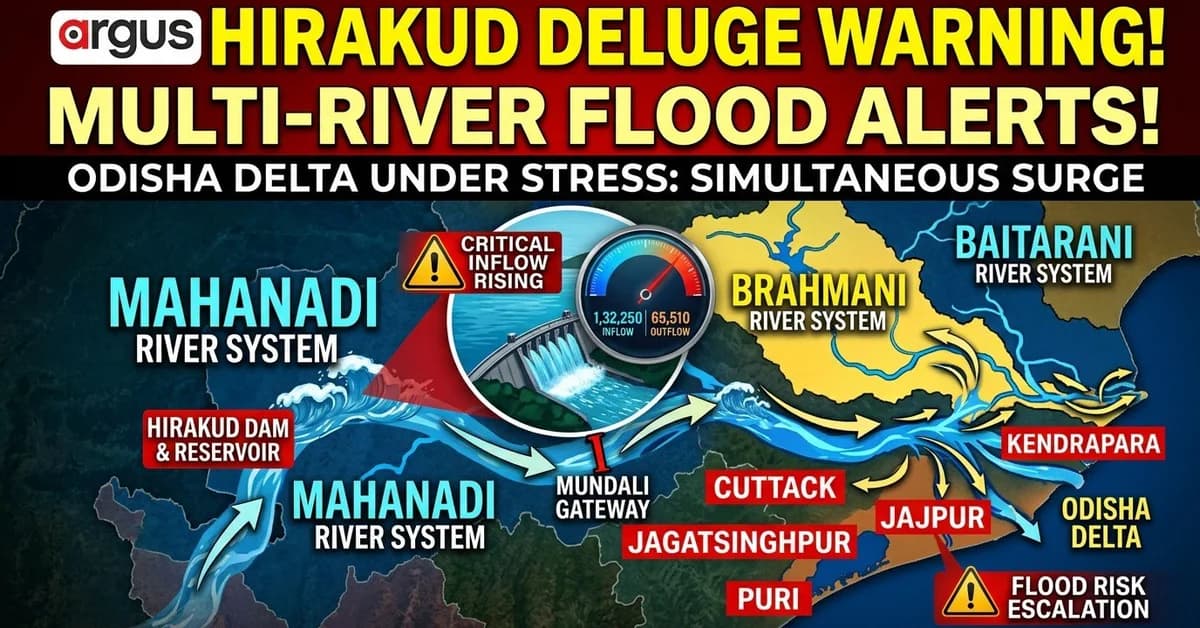
According to the CWC, Odisha Water Resources Department information, Hirakud's inflow has surged to 1,32,250 cusecs against an outflow of just 65,510 cusecs, leaving the reservoir with a net inflow surplus of about 66,740 cusecs. The reservoir level was recorded at 617.41 ft against the Full Reservoir Level (FRL) of 630 ft, while only two gates were open at the time of observation, with the gate-opening trend marked as “Rising.”
Hirakud's inflow surge is the first warning
The numbers indicate that Hirakud is now entering a distinctly different phase of flood management. The latest inflow is equivalent to roughly 3,745 cumecs, closely matching the sharp upstream surge shown indicated by CWC.

📱 Get Argus News App
✨The immediate concern is that the inflow is almost double the present outflow. In simple terms, for every 100 cusecs being released, nearly another 100 cusecs is effectively being added to the reservoir. The reservoir level may still appear to have a cushion below the FRL, but that does not mean the flood threat is distant.
This is because a large reservoir responds with a time lag. The water level does not instantly reflect the volume of water rushing into it. The CWC data suggests inflow climbing beyond 3,400 cumecs, while canal outflow remains comparatively limited.
The upstream situation makes the development more worrying. The current low-pressure system is expected to keep feeding rainfall into the Mahanadi's upper catchment. The IMD predicts heavy to very heavy rainfall is expected over Chhattisgarh and adjoining upstream areas through August 19, leaving little opportunity for the basin to drain naturally before another pulse arrives.
Will five more Hirakud gates open soon?
The mathematics makes additional gate opening increasingly difficult to avoid if the present inflow trend persists.
At the latest observation, Hirakud was receiving 1,32,250 cusecs but releasing only 65,510 cusecs. That leaves a difference of:
1,32,250 − 65,510 = 66,740 cusecs
That is the immediate storage pressure being imposed on the reservoir.
With only two gates open and the operational trend already marked “Rising,” authorities have limited scope to absorb a continuing upstream surge merely through the existing discharge.
The critical point is that engineers cannot afford to wait for the reservoir to approach 630 ft before acting. The hydrograph analysis indicates that proactive releases are necessary while storage space still exists. Waiting until the reservoir reaches its ceiling would sharply reduce the flood-moderation cushion and could force a much larger discharge later.
This is why another five gates, taking the total to around seven, could become operationally necessary soon if inflow remains at or above the current level or rises further. This is an inference from the inflow-outflow imbalance and the recorded “Rising” gate trend.
The downstream numbers make the urgency clearer. Water is already moving through the Mahanadi system at 1,03,000 cusecs at Khairmal, 1,14,000 cusecs at Barmul and 1,66,694 cusecs at Mundali. Water released from Hirakud takes approximately 36–50 hours to reach Mundali, creating a crucial window for authorities to prepare.
Why this spells danger for the deltaic region
The real danger is not Hirakud alone. It is the simultaneous loading of multiple river systems into an already stressed delta.
Mundali is the critical gateway where the Mahanadi enters the coastal distribution system. From there, its waters spread through distributaries including the Kathajodi, Kuakhai, Devi, Chitrotpala and Luna. At the same time, the Brahmani and Baitarani systems are already carrying substantial floodwater.
That means the delta is effectively being asked to accommodate water from multiple directions at the same time.
The present Mundali discharge of 1.66 lakh cusecs is already substantial. The CWC, OWR data warns that additional Hirakud releases could push Mundali's flow sharply higher as the reservoir discharge travels downstream.
The geography makes the situation more sensitive. When Mahanadi, Brahmani and Baitarani waters reach the coastal plain together, their drainage can be slowed by downstream conditions, including high tides. The result can be prolonged waterlogging and riverine inundation rather than a quick movement of floodwater into the sea.
This puts the low-lying and river-connected areas of Cuttack, Jagatsinghpur, Puri and Kendrapara, besides parts of Jajpur, on the watchlist for a secondary escalation once the Hirakud discharge wave travels downstream. In such a scenario, there is very likely that these districts facing severe inundation risks if the combined river systems overwhelm the delta's drainage capacity.
Bottomline: The next 36 hours are crucial
The immediate task for authorities is therefore not simply to monitor Hirakud's water level but to manage the entire Mahanadi system as one connected flood basin.
The Water Resources Department needs to continuously reassess the inflow trajectory, coordinate Hirakud releases with downstream gauge levels, alert vulnerable settlements along the Mahanadi distributaries and ensure that Cuttack, Jagatsinghpur, Puri and Kendrapara administrations receive advance discharge estimates.
The 36–50 hour travel window to Mundali offers valuable preparation time.
The
immediate warning is simple: Hirakud still has storage cushion, but the
inflow is consuming it rapidly. With upstream rainfall continuing and the
gate-opening trend already rising, the question is no longer whether the dam
needs to release more water, but how early and how gradually it can do so
without creating a second flood wave in an already burdened coastal delta.
Also Read: Baleswar Flood Crisis Set to Deepen Next Week as Jalaka River Smashes All-Time Record | Exclusive
Related Topics
Explore more stories