



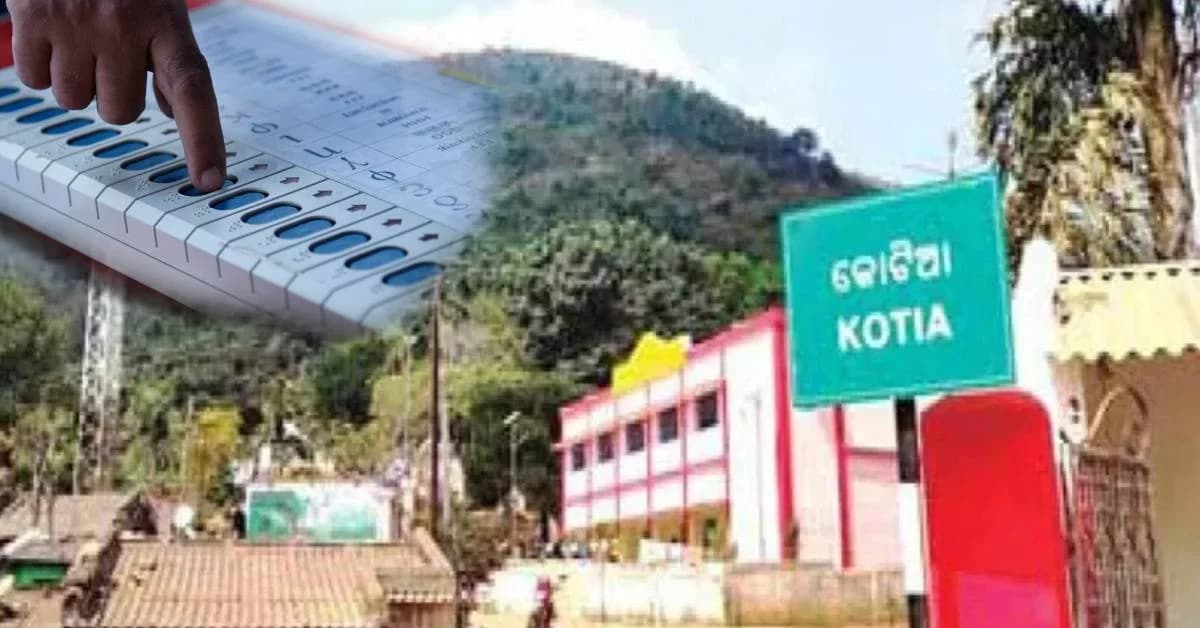
Kotia Row / Kotia row escalates: Koraput Activist seeks MHA intervention over Andhra polls in Odisha territory
Key Points
Advocate Anup Kumar Patro has urged the Centre to halt Andhra Pradesh's proposed Kotia polls, citing constitutional violations, tribal rights concerns, disputed territorial claims, and alleged breaches of Supreme Court status quo directives.
Bhubaneswar, Nov 3: Raising serious constitutional, legal and administrative concerns, advocate and rights activist Anup Kumar Patro has submitted a second detailed representation before the Ministry of Home Affairs (MHA), seeking urgent intervention against the proposed local body elections scheduled by the Andhra Pradesh authorities on November 5, 2026 in the disputed Kotia Gram Panchayat region of Odisha's Koraput district.
The representation, addressed to the Union Home Secretary, alleges that the State of Andhra Pradesh has mobilised administrative machinery and election-related personnel within territory that, according to the petitioner, forms part of Odisha's notified Fifth Schedule Area.
The petitioner contends that such actions violate constitutional provisions, undermine judicially mandated status quo arrangements, and threaten the rights and welfare of tribal communities residing in the region.
Also read: President's Secretariat Seeks Report from Home Ministry on Advocate's Petition over Kotia Dispute

📱 Get Argus News App
✨Petition Filed in Continuation of Earlier Representations
Patro's latest appeal follows a series of earlier constitutional representations submitted to the highest constitutional authorities.
According to the memorandum:
- A constitutional petition was submitted to the President of India on October 21, 2026.
- The President's Secretariat subsequently forwarded the matter to the Ministry of Home Affairs through an official communication on October 27, 2026, with a copy marked to the petitioner.
- A supplementary constitutional petition was also submitted directly to the MHA on October 31, 2026.
In his latest representation, Patro has urged the Union Government to exercise its constitutional responsibilities and intervene immediately to prevent what he describes as "illegal administrative expansionism" and "unconstitutional electoral activities" in the Kotia region.
Kotia's Historical and Constitutional Status
A substantial portion of the petition focuses on the historical and constitutional status of Kotia Gram Panchayat.
The petitioner argues that the roots of Odisha's claim over the area trace back to the formation of the erstwhile Province of Orissa on April 1, 1936 under the Government of India (Constitution of Orissa) Order, 1936.
According to the representation, the 28 constituent habitations comprising Kotia Gram Panchayat, including 21 revenue villages and seven hamlets, became part of the undivided Koraput district and have remained under Odisha's revenue, administrative, civil and policing jurisdiction ever since.
The memorandum further states that the undivided Koraput district was subsequently re-notified as a Scheduled Area under the Scheduled Areas (States of Bihar, Gujarat, Madhya Pradesh and Orissa) Order, 1977, commonly known as Constitution Order (C.O.) 109, issued by the President of India under Article 244(1) and Paragraph 6 of the Fifth Schedule.
"Only President Can Alter Scheduled Area Boundaries"
One of the central constitutional arguments advanced in the representation is that the authority to alter or redefine Scheduled Area boundaries rests exclusively with the President of India under Paragraph 6(2) of the Fifth Schedule.
The petitioner contends that neither the Government of Andhra Pradesh nor the Andhra Pradesh State Election Commission possesses constitutional competence to modify or supersede the territorial limits of a Scheduled Area notified through a Presidential Order.
The memorandum also notes that Andhra Pradesh came into existence in 1956 and that neighbouring district formations such as Vizianagaram and Parvathipuram Manyam were created much later.
Consequently, the petitioner argues that any unilateral assertion of administrative authority by these successor entities over pre-existing Scheduled Areas of Odisha would be constitutionally unsustainable.
Concern Over Alleged Dismantling of Public Infrastructure
The representation also raises concerns regarding the condition and continuity of public infrastructure in the border villages.
According to Patro, postal and administrative facilities constitute the primary link between remote tribal residents and the Indian state. The petition emphasises that such infrastructure plays a critical role in:
- Delivery of Direct Benefit Transfers (DBT);
- Access to Post Office Savings Bank services and financial inclusion schemes;
- Communication of official notices, legal correspondence and government services.
The petitioner argues that any reduction, relocation or weakening of such facilities could adversely affect vulnerable tribal communities and create conditions for administrative uncertainty in the region.
Reference to Historic Supreme Court Proceedings
The representation revisits the long-standing Odisha-Andhra Pradesh boundary dispute and references Original Suit No. 10 of 1968, filed by the State of Odisha under Article 131 of the Constitution.
According to the petitioner, both states had provided undertakings before the Supreme Court on December 2, 1968 to maintain status quo with respect to administrative control in the disputed area.
The memorandum asserts that the apex court subsequently observed that interstate boundary disputes fall within Parliament's legislative domain under Article 3 of the Constitution and that unilateral alterations to the existing position should be avoided until a final settlement is reached.
Patro argues that any election exercise conducted by Andhra Pradesh authorities in the disputed villages would amount to a breach of those longstanding understandings and judicial directions.
Allegations of Parallel Administrative Structures
The petitioner has further alleged that Andhra Pradesh authorities have created parallel local administrative entities bearing names resembling villages located within Odisha's Kotia cluster.
Among the examples cited are:
- Ganjeivadara, allegedly mirroring Odisha's Ganjeipadara;
- Patusinari, allegedly corresponding to Phatusineri;
- Dhulibhadra, allegedly resembling Phagunasiniri.
The memorandum claims such nomenclature duplications are intended to support jurisdictional assertions in the disputed territory.
Patro further contends that conducting local body elections under Andhra Pradesh's legal framework in these villages amounts to an unlawful encroachment upon Odisha's administrative jurisdiction.
Concerns Over Tribal Rights and Human Rights Issues
The representation places significant emphasis on the rights of tribal communities residing in the Scheduled Area.
According to the petitioner, residents are increasingly being subjected to overlapping administrative systems, resulting in the issuance of multiple voter identity cards, dual ration cards and parallel welfare entitlements.
The memorandum argues that such circumstances create legal uncertainty and expose tribal communities to administrative confusion.
The petitioner also warns that any erosion of Odisha's governance framework in the area could weaken protections available under state-specific laws governing Scheduled Areas, including:
- The Odisha Scheduled Areas Transfer of Immovable Property Regulation, 1956;
- Tribal land safeguards;
- Rights relating to minor forest produce;
Provisions relating to local self-governance under the Panchayats (Extension to Scheduled Areas) Act (PESA).
The representation additionally expresses concern that dual voter enrolments could adversely affect electoral roll integrity and democratic processes.
Security and Federal Concerns Raised
Patro has also flagged potential law-and-order implications arising from the simultaneous presence of rival administrative and security establishments in the disputed border region.
According to the petition, parallel exercises by competing authorities could increase tensions among local residents, trigger public order concerns and strain principles of cooperative federalism.
The memorandum describes the situation as a potential constitutional and administrative flashpoint requiring immediate attention from the Union Government.
Key Demands Placed Before the Ministry of Home Affairs
In his representation, the activist has urged the Ministry of Home Affairs to exercise its constitutional authority and take a series of immediate measures.
The demands include:
Immediate Restraint on Elections: The Union Government has been requested to direct Andhra Pradesh and the Andhra Pradesh State Election Commission to stay, cancel or suspend all election-related activities scheduled for 5 November 2026 within the territorial limits of Kotia Gram Panchayat.
Deployment of Central Observers and CAPF: The petitioner has sought the deployment of senior Central observers along with Central Armed Police Forces (CAPF) personnel to ensure peace, monitor developments and preserve the status quo on the ground.
Verification of Electoral Rolls: The representation requests the Election Commission of India to undertake verification of voter records, including biometric deduplication and administrative scrutiny, to identify and eliminate alleged duplicate voter registrations.
Formal Inter-State Settlement Process: Patro has urged the Centre to establish a tripartite dispute-resolution mechanism involving Odisha, Andhra Pradesh and the Ministry of Home Affairs, anchored on the 1936 territorial demarcation and the 1977 Presidential Notification governing Scheduled Areas.
Protection of Civic and Postal Infrastructure: The petition also seeks directions to the Department of Posts and concerned ministries for strengthening, modernising and protecting postal, banking and other public service infrastructure across the Kotia Scheduled Area.
Appeal for Immediate Central Action
Concluding his representation, Patro has warned that continued administrative inaction could weaken constitutional governance in the region and leave tribal residents vulnerable to what he terms "unconstitutional administrative displacement."
He has urged the Ministry of Home Affairs to act expeditiously to preserve constitutional order, uphold the federal structure, protect the rights of tribal communities and prevent any alteration of the existing status of the Kotia region pending resolution of the long-standing border dispute.
The representation has now placed renewed attention on the
sensitive Kotia issue, a decades-old territorial dispute that continues to
remain a point of contention between Odisha and Andhra Pradesh.