



In El Niño Yr & Before Rath Yatra, Mohan Majhi Government's 44th Cabinet Clears Long-Pending Balangir Irrigation Push | Special Report
Key Points
Bhubaneswar: With Odisha staring at the prospect of an El Niño-impacted monsoon and just days before the world-famous Rath Yatra, the Mohan Charan Majhi government has attempted to shield one of the state's most drought-prone districts from climatic uncertainty.
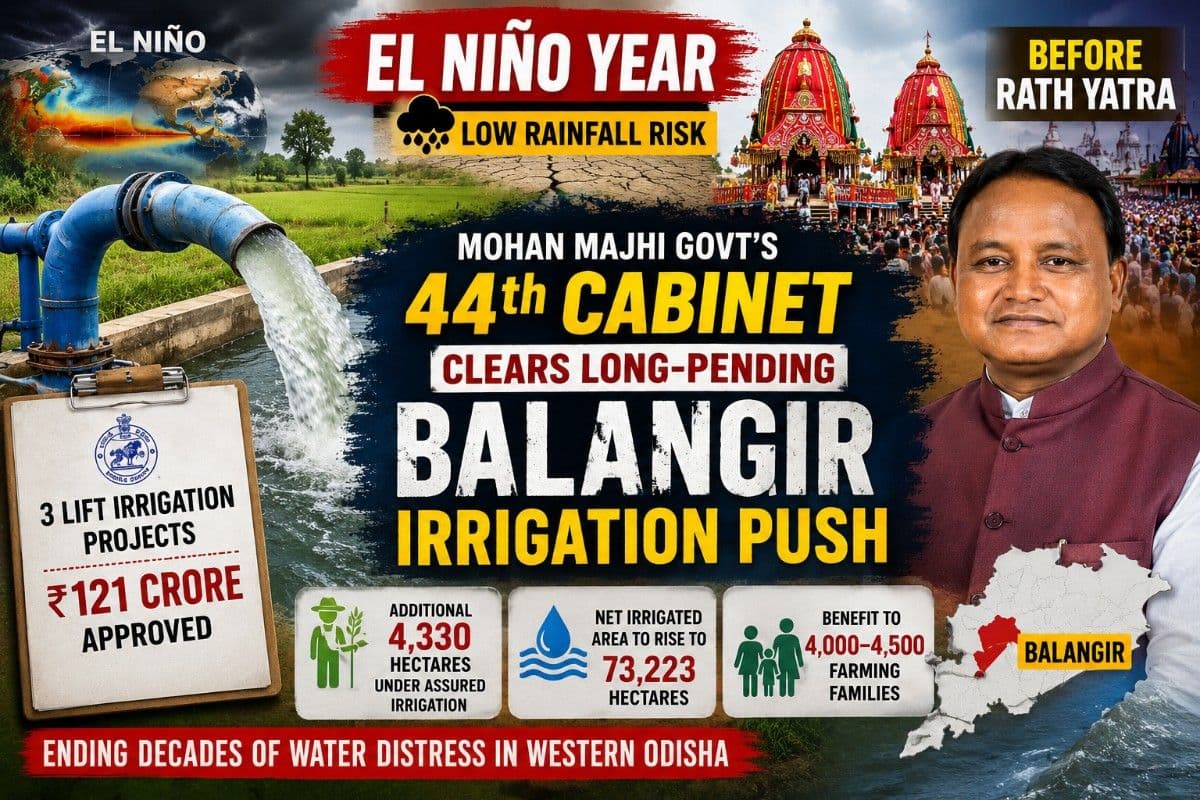
In its 44th Cabinet meeting held on Tuesday, the state government approved three major lift irrigation projects under the Parvati Giri Lift Irrigation Project (PGLIP) for Balangir district, addressing a long-standing demand for assured irrigation in western Odisha.
The timing of the decision is significant. Global weather agencies have confirmed the emergence of a strong El Niño, while the India Meteorological Department (IMD) has indicated the possibility of below-normal rainfall over parts of western Odisha, including Balangir, during the ongoing monsoon. For a district that has historically battled recurrent droughts, crop failures and farmer distress due to erratic rainfall, the Cabinet's approval assumes strategic importance beyond routine infrastructure expansion.
The Cabinet sanctioned more than Rs121 crore for the three lift irrigation projects. Once completed, they are expected to bring an additional 4,330 hectares under assured irrigation, reducing dependence on increasingly unpredictable monsoon rains and strengthening climate resilience in one of Odisha's most vulnerable agricultural belts.

📱 Get Argus News App
✨A Demand Rooted in Decades of Water Distress
The approval also marks a response to a demand that has echoed across Balangir for well over a decade.
While demands for assured irrigation have existed for generations in the drought-hit district, the present expansion is closely linked to the state's Parvati Giri Lift Irrigation Project, launched during 2011-12 to provide irrigation to upland areas beyond the reach of conventional canal networks. Over the past nearly 15 years, local farmers, public representatives and water experts have consistently sought expansion of lift irrigation infrastructure to cover vast rain-fed pockets that remain outside major irrigation commands.
Balangir's undulating terrain has historically limited the effectiveness of gravity-fed canal systems, leaving thousands of hectares dependent almost entirely on seasonal rainfall. Every weak monsoon has translated into lower kharif output, reduced rabi cultivation and heightened economic uncertainty for farming families.
Climate-Proofing Agriculture
The latest projects are expected to significantly improve the district's irrigation profile.
According to government estimates, Balangir currently has a net irrigated area of 68,893 hectares. The newly approved projects will increase this by 4,330 hectares, representing a meaningful expansion in assured irrigation coverage for a district where every additional hectare under irrigation directly reduces vulnerability to rainfall deficits.
More importantly, the projects are designed to function as climate adaptation infrastructure.
Unlike rain-fed agriculture, lift irrigation draws water from dependable sources such as rivers or reservoirs and transports it to higher agricultural lands through pumping systems. This reduces farmers' dependence on timely monsoon rainfall – a crucial advantage during El Niño years when rainfall often becomes deficient or erratic.
The projects are also expected to complement the state's bridge-cum-weir programme, which stores monsoon water within riverbeds, ensuring sustained water availability even after rainfall declines. Together, these interventions are intended to stabilise kharif cultivation while enabling expansion of rabi cropping, an area that traditionally suffers due to inadequate post-monsoon soil moisture.
Beyond Irrigation: A Shift in Farming Economics
Officials believe the projects could fundamentally alter agricultural practices in the command areas.
Reliable irrigation will allow farmers to move beyond single-crop cultivation and adopt multiple cropping patterns, including higher-value crops during the rabi season. The availability of assured water is also expected to improve cropping intensity, enhance productivity and reduce the risk of crop failure during adverse weather years.
Since lift irrigation is particularly suited to Balangir's upland geography, the projects will extend irrigation benefits to areas that conventional canal systems cannot reach, improving geographical equity in water distribution.
Thousands of Farmers Likely to Benefit
Although the government has not officially announced the beneficiary count, the additional 4,330 hectares of irrigation coverage is expected to directly support around 4,000 to 4,500 farming families, based on the district's predominance of small and marginal landholdings.
For these farmers, the significance extends beyond access to water. Assured irrigation offers greater income stability, enables cultivation during multiple seasons, reduces vulnerability to monsoon shocks and strengthens resilience against climate variability.
With Odisha entering what meteorologists warn could be a challenging El Niño season, the Cabinet's decision positions irrigation infrastructure not merely as a development project but as a critical climate adaptation measure.
For Balangir
– a district synonymous with drought and agricultural distress – the approval
represents one of the most consequential irrigation interventions in nearly
fifteen years, arriving at a moment when rainfall uncertainty once again
threatens rural livelihoods.
Also Read: ₹74.78-Crore Package to Inject Fresh Lifeline Into Odisha’s Kendu Leaf Economy, Benefit 8–9 Lakh Tribal and Rural Workers| Special Report
Related Topics
Explore more stories