



₹74.78-Crore Package to Inject Fresh Lifeline Into Odisha’s Kendu Leaf Economy, Benefit 8–9 Lakh Tribal and Rural Workers| Special Report
Key Points
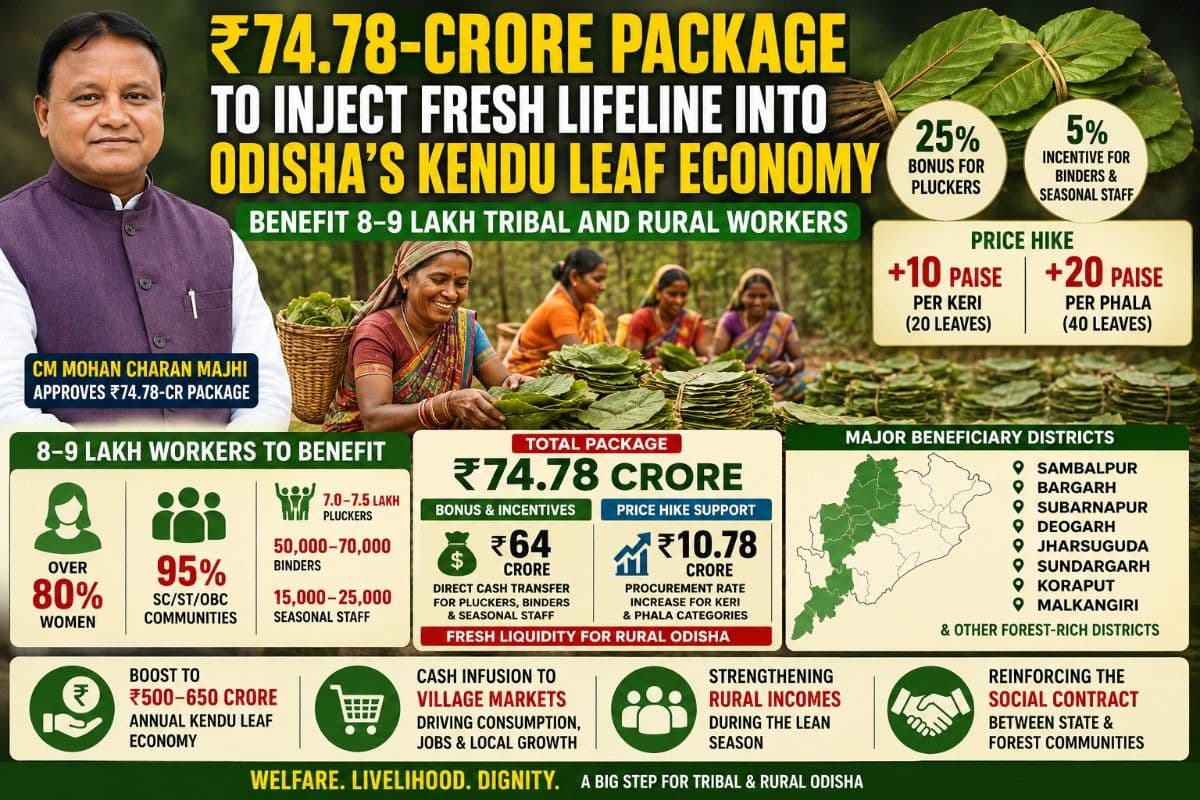
Bhubaneswar: Chief Minister Mohan Charan Majhi’s approval of a Rs74.78-crore bonus and incentive package for kendu (tendu) leaf pluckers, binders and seasonal staff is expected to pump fresh cash into one of Odisha’s largest forest-based rural economies, with the biggest impact likely to be felt across western and southern Odisha.
The decision includes a 25% bonus for pluckers, a 5% incentive for binders and seasonal staff, and a hike in the procurement price of processed kendu leaves by 10 paise per keri (20 leaves) and 20 paise per phala (40 leaves).
Government estimates indicate that approximately 8 lakh to 9 lakh registered workers will benefit directly from the package. More than 80% of them are women, while nearly 95% belong to SC, ST and OBC communities, making the intervention one of the largest targeted rural income transfers in the forest sector.
Where the Impact Will Be Felt Most

📱 Get Argus News App
✨The kendu leaf trade operates through 19 forest divisions, but the concentration of beneficiaries is highest in:
Major beneficiary districts
Highest concentration
Sambalpur
Bargarh
Subarnapur
Deogarh
Jharsuguda
Sundargarh
Koraput
Malkangiri
Additional beneficiaries are spread across forest-rich districts such as Nabarangpur, Kalahandi, Nuapada, Balangir, Boudh, Rayagada and Kandhamal, where kendu collection forms a crucial seasonal source of cash income.
How Many People Are Likely to Benefit?
|
Category |
Estimated beneficiaries |
|
Pluckers |
7.0–7.5 lakh |
|
Binders |
50,000–70,000 |
|
Seasonal staff |
15,000–25,000 |
|
Total |
8–9 lakh |
In districts such as Malkangiri, Koraput, Sundargarh and Sambalpur, thousands of households depend on kendu leaf earnings to finance food purchases, education expenses, debt repayments and agricultural inputs during the lean season.
What the Rs74.78 Crore Means on the Ground
Bonus & incentives
Rs64 crore
Direct cash transfer
For pluckers, binders and seasonal staff
Price hike support
Rs10.78 crore
Procurement rate increase
For keri and phala categories
Total package
Rs74.78 crore
Fresh rural liquidity
Expected immediate injection into local markets
The immediate effect will be a liquidity infusion into village markets. Since most beneficiaries are daily-wage-dependent families, the bonus is expected to circulate quickly through local grocery shops, farm-input dealers, transport operators and rural service providers.
Forest economists estimate that every rupee paid to kendu workers generates a multiplier effect in local consumption, especially in tribal-dominated blocks where formal employment opportunities remain limited.
A Bigger Economy Than It Appears
Odisha’s kendu leaf trade is not a marginal forest activity. It is a Rs500–650 crore annual revenue ecosystem that has become deeply intertwined with the politics and welfare architecture of western Odisha.
Estimated gross revenue
Annual range
|
Financial year |
Estimated revenue |
|
2021–22 |
Rs450–550 crore |
|
2022–23 |
Rs500–600 crore |
|
2023–24 |
Rs550–650 crore |
|
2024–25 |
Rs500–600 crore |
|
2025–26 |
Rs500–550 crore* |
*Estimated, subject to final auction realization and bonus settlement
Unlike paddy or wheat, kendu leaves do not have a nationally fixed MSP. Odisha determines prices administratively through the state-controlled Odisha Forest Development Corporation (OFDC), making procurement rates highly sensitive politically.
Why Odisha’s Model Is Different
Odisha follows a processed-leaf model involving grading and bundling into kerries and phalas. This labour-intensive system produces higher-quality bidi-grade leaves and allows the state to command a premium in national auctions.
However, the same system creates a larger administrative chain, which has historically led to conflicts whenever bonus payments are delayed.
The latest package comes after worker protests in districts such as Malkangiri, where collectors had demanded immediate finalisation of bonus rates and payment schedules.
From Protest to Policy
Industry observers say the decision reflects a broader shift from the “incremental support” era (2019–2023) to a “package-based intervention” approach (2024–2026).
During the earlier period, procurement rates were raised gradually and bonuses were often linked to specific events. The current approach involves larger, more visible welfare packages aimed at stabilising rural incomes and preventing unrest among forest-dependent communities.
Political Significance
The importance of the announcement extends beyond economics. With 95% of beneficiaries belonging to SC, ST and OBC communities, and with the trade concentrated in electorally significant western and southern districts, the kendu leaf sector remains one of Odisha’s most influential forest-based political constituencies.
For many families in Sambalpur, Sundargarh, Koraput, Malkangiri, Kalahandi and Nuapada, the annual kendu season functions almost like a parallel rural employment programme.
By releasing the Rs74.78-crore package, the government is not only settling a pending welfare demand but also attempting to reinforce what officials describe as the “social contract” between the state-run forest trade and forest-dwelling communities ahead of the ongoing harvesting season.
The Bottom Line
Impact
• Rs74.78 crore approved for bonus, incentives and price hike
• 8–9 lakh workers likely to benefit directly
• Over 80% women; 95% SC/ST/OBC
• Major impact in Sambalpur, Bargarh, Sundargarh, Koraput and Malkangiri
• Fresh cash expected to boost rural consumption across western and southern Odisha
• Reinforces the political and economic centrality of the Rs500+ crore kendu leaf economy