



In 2 Years, Odisha Added 1.43 Lakh Formal Jobs, But 2025-26 Payroll Numbers Tell a Different Story | Exclusive Analysis
Key Points
Bhubaneswar: Odisha's formal employment story under the BJP government appears encouraging.
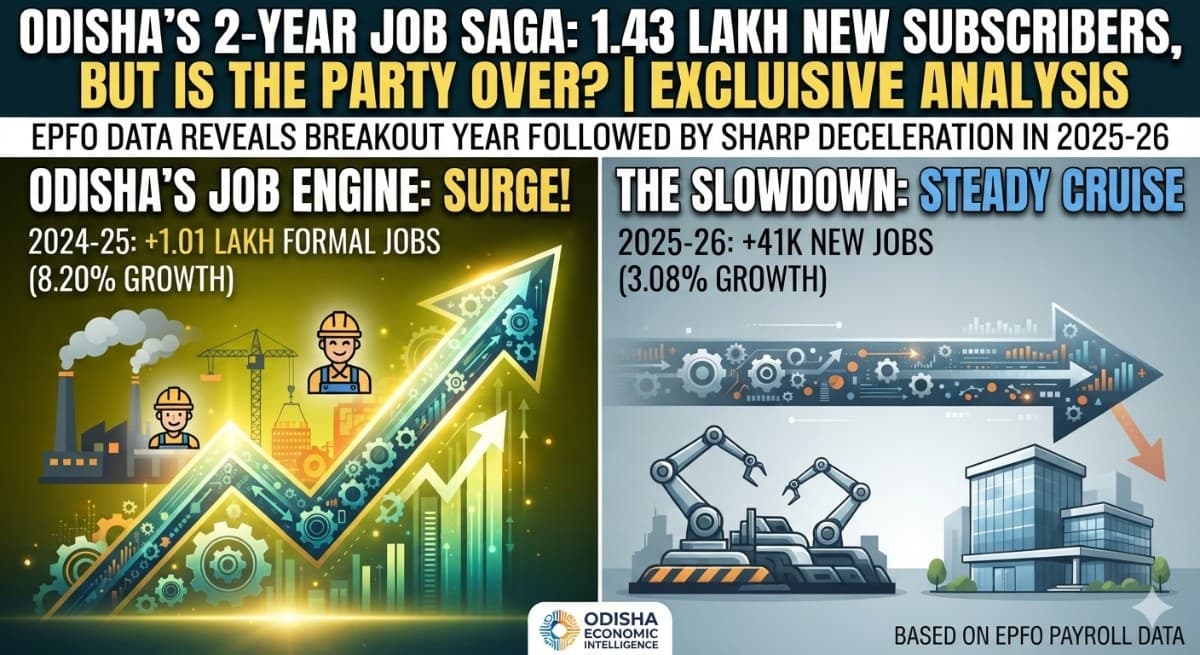
Data from the Employees' Provident Fund Organisation (EPFO) shows that the state's formal workforce expanded by 1,43,330 members over the last two financial years, taking total EPFO subscribers from 12.43 lakh in 2023-24 to 13.86 lakh in 2025-26.
However, a closer reading of the payroll data reveals a more nuanced picture. After witnessing a spectacular surge in formal job creation during 2024-25, Odisha's employment engine lost considerable momentum in 2025-26, raising questions about the evolving labour market dynamics here.
2024-25: A Breakout Year for Formal Employment

📱 Get Argus News App
✨The first full year of the BJP government turned out to be an exceptionally strong year for formal employment. Odisha added 1,01,937 new EPFO members during 2024-25, translating into an impressive 8.20% annual growth in formal jobs.
What makes the performance noteworthy is that Odisha comfortably outperformed the national average formal employment growth of 5.71% during the same period.
The surge reflected accelerated hiring across manufacturing, infrastructure projects, services and expanding industrial activity. Besides fresh recruitment, increasing formalisation of existing workers and better EPFO compliance among employers also contributed to the jump.
The sharp rise suggested that businesses were adding payroll employees at a pace much faster than most parts of the country, giving Odisha one of its strongest formal employment years in recent times.
2025-26: Job Creation Continued, But Growth Lost Steam
The momentum, however, proved difficult to sustain.
In 2025-26, Odisha generated 41,393 net new formal jobs, barely two-fifths of the previous year's addition. Consequently, annual EPFO growth slowed sharply from 8.20% to 3.08%.
Although the state still registered positive employment growth, the expansion merely matched the national average of 3.07%, indicating that Odisha had lost the competitive edge it enjoyed a year earlier.
The slowdown does not indicate job losses.
Rather, it reflects a significant moderation in the pace at which new workers entered the organised workforce. In other words, Odisha continued creating formal jobs, but the employment engine shifted from rapid acceleration to steady cruising.
Which Sectors Powered Formal Jobs in 2025-26?
National EPFO payroll data offers valuable clues to the sectors that continued generating formal employment during 2025-26 and likely influenced states including Odisha.
The biggest contributor remained Expert Services, which continued to add around 20 lakh organised jobs nationally despite slower expansion than the previous year. These include professional services, consultancy, technical support and specialised business services that increasingly dominate India's formal labour market.
The second major engine (5.3 lakh) was Trading and Commercial Establishments, reflecting sustained growth in organised retail, wholesale trade and commercial enterprises.
Technology-related establishments dealing with computer manufacturing, marketing, servicing and IT-enabled activities also continued expanding their formal workforce (added 3.1 lakh), reinforcing India's digital economy-led employment pattern.
Engineering, electrical and mechanical manufacturing establishments remained significant employers (added 6 lakh), while Financing Establishments witnessed another year of substantial payroll expansion as banks, NBFCs, insurance-linked businesses and financial intermediaries continued formal hiring, adding over 4 Lakh.
Interestingly, Iron Ore Mining emerged as one of the fastest-growing employment categories nationally in percentage terms during 2025-26, while establishments involved in the storage, transportation and distribution of petroleum and gas also accelerated recruitment.
Why Didn't Odisha Fully Benefit from These National Job Engines?
The answer lies in the state's industrial composition.
While Odisha possesses a rapidly growing services sector, much of its expansion remains concentrated in tourism, retail trade, hospitality and public administration.
The state still lacks the deep concentration of corporate financial services, insurance headquarters, fintech firms and large private consulting ecosystems that generated a sizeable share of India's organised jobs in 2025-26.
Consequently, Odisha captured only a limited portion of the employment boom witnessed nationally in financing, insurance and advanced business services.
The Mining Paradox: Rich in Minerals, Modest in Payroll Growth
Another apparent contradiction emerges from mining.
National EPFO data shows iron ore mining became one of the fastest accelerating employment categories during 2025-26. Odisha, being India's largest mineral-producing state, would ordinarily be expected to gain substantially.
However, mining today is increasingly driven by mechanisation, automation, digital fleet management and high-capital investments rather than large-scale manpower expansion. Modern mines produce significantly higher output with comparatively fewer permanent workers than in previous decades.
Moreover, Odisha has approved industrial investments worth over Rs5.66 lakh crore in recent years. But most of these mega projects are still under implementation. Large industrial investments typically generate construction employment first, followed by contract jobs, while permanent payroll additions reflected in EPFO data usually materialise after production begins. This creates a time lag between investment announcements and formal employment gains.
Traditional Employment Segments Also Lost Momentum
The national payroll trends further show that several labour-intensive sectors weakened during 2025-26.
Garment manufacturing and textiles witnessed declining formal employment. Schools reported lower payroll additions, while traditional sectors such as beedi manufacturing and tea plantations continued shedding organised workers. Societies, clubs and associations also registered a sharp contraction in EPFO subscribers.
Although these are national trends, they illustrate the broader structural transition underway in India's labour market, where modern services and technology-driven sectors increasingly replace traditional labour-intensive industries as engines of formal employment.
The Bottom Line
The EPFO data presents two simultaneous realities.
First, the Odisha BJP government can legitimately point to the creation of 1.43 lakh additional formal jobs in two years, taking organised employment to its highest level on record.
Second, the data also sends a cautionary signal. After an exceptional performance in 2024-25, the pace of formal job creation moderated sharply in 2025-26.
As India's employment landscape increasingly shifts towards finance, technology, advanced services and knowledge-intensive industries, Odisha's future payroll growth will depend less on mining and capital-intensive manufacturing alone and more on how successfully it expands its footprint in these high-employment modern sectors.
In short,
the state is still creating organised jobs – but sustaining the next phase of
employment growth will require complementing industrial investment with
stronger ecosystems for services, financial enterprises, technology businesses
and labour-intensive manufacturing that convert economic expansion into
sustained payroll additions.
Also Read: Textiles, HCL Lead Odisha's Labour-Intensive Industrial Evolution as SLWC Clears ₹4,573-Crore Investments | Special Report
Related Topics
Explore more stories