



How Many Jobs Modi Government Created in Odisha? The Official Numbers Tell a Big Story | Special Report
Key Points
Bhubaneswar: How many jobs has the Modi government actually created in Odisha?
In a recent response in the Rajya Sabha, the Ministry of Labour and Employment has tabled the numbers in detail.
Even as different Central schemes measure employment differently, like some count estimated jobs, others candidates placed or settled, while several track loans, loan accounts or persondays of work.
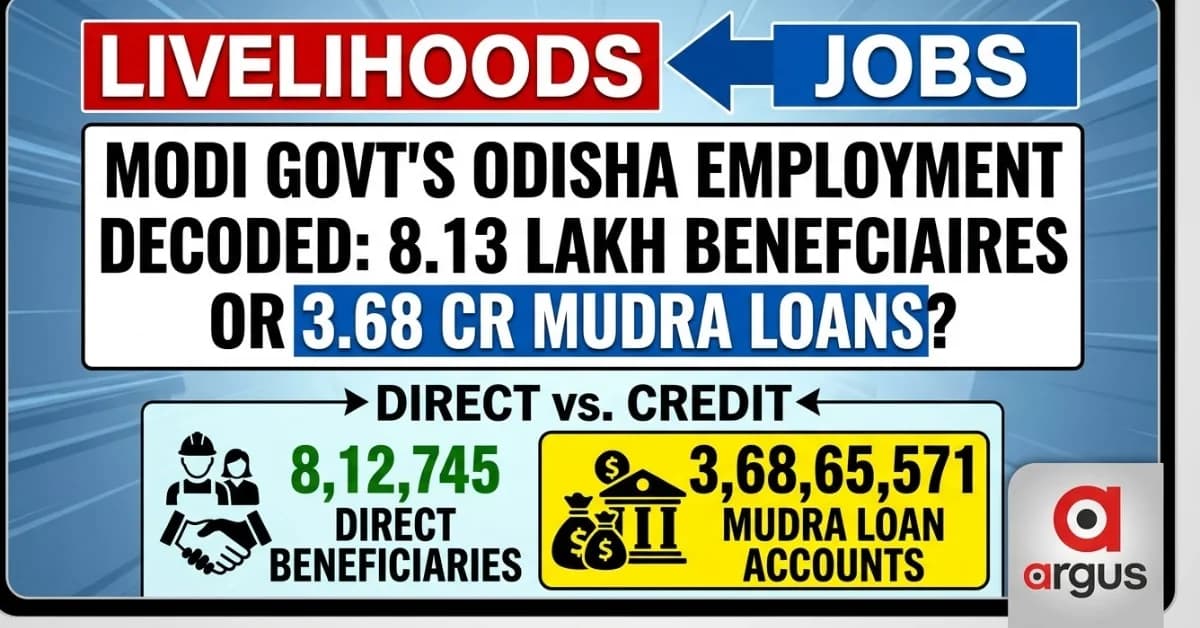
Yet, when only the schemes that provide a direct employment, placement or settlement figure are put together, the government data points to 8.13 lakh direct employment/placement beneficiaries in Odisha.

📱 Get Argus News App
✨It is a cumulative total derived from four different programme metrics operating over different periods. It should therefore be read as a measure of tracked employment beneficiaries.
8.13 lakh: What the four direct employment numbers show
The largest contribution comes from the Prime Minister's Employment Generation Programme (PMEGP).
|
Scheme |
What is measured |
Period |
Odisha figure
PMEGP
Estimated employment generated
Inception to FY 2025-26
3,75,017
RSETIs
Candidates settled
Inception to Jan 2026
2,38,000
DDU-GKY
Candidates placed
FY 2014-15 to Jan 2026
1,77,853
PM Viksit Bharat Rozgar Yojana
First-time employees incentivised
Up to June 2026
21,875
Combined tracked beneficiaries
8,12,745
PMEGP alone accounts for around 46.1% of this combined figure, making it the biggest component.
The Rural Self Employment Training Institutes (RSETIs) account for another 2.38 lakh candidates who were reported as settled, while the Deen Dayal Upadhyaya Grameen Kaushalya Yojana (DDU-GKY) recorded 1,77,853 placements.
The newest component is the Pradhan Mantri Viksit Bharat Rozgar Yojana, under which 21,875 first-time employees in Odisha had been incentivised under Part A by June 2026. The government also reported Rs11.21 crore disbursed under this component.
The bigger employment story
The Union government's employment architecture in Odisha is considerably larger if credit and livelihood support are taken into account.
The Pradhan Mantri Mudra Yojana (PMMY) recorded 3,68,65,571 loan accounts sanctioned in Odisha between April 2015 and June 2026.
That is an extraordinary scale of credit intervention. The loan accounts cannot be converted directly into jobs.
A single entrepreneur may have created employment for several people, while a loan account itself is not equivalent to a job. Similarly, the same individual could potentially appear in different programme datasets.
The PM SVANidhi scheme recorded 90,513 street-vendor loans sanctioned from FY 2021-22 to FY 2025-26.
Meanwhile, the Viksit Bharat–Guarantee for Rozgar and Ajeevika Mission (Gramin) generated 10,24,751 persondays of work.
Again, these figures describe different forms of livelihood support and cannot be added to the 8.13 lakh headcount.
Odisha's labour market has improved
The more revealing indicator may not be the number of beneficiaries under individual schemes, but what has happened to Odisha's overall labour market.
The Periodic Labour Force Survey (PLFS) data cited in the government response shows the Worker Population Ratio for people aged 15 years and above rising from 55.1% in 2022 to 61.3% in 2025.
That is a rise of 6.2 percentage points.
At the same time, Odisha's overall unemployment rate fell from 5.1% in 2022 to 2.9% in 2025.
In other words, the state's employment picture has moved in two directions that matter: more people are working, while the proportion of people reported as unemployed has declined.
What does the data actually establish?
The official numbers support three different conclusions.
First, the Modi government's employment intervention in Odisha is substantial. At least 8,12,745 cumulative direct employment, placement or settlement records are identifiable across four schemes in the Rajya Sabha data.
Second, the government's employment footprint is much larger than direct job counts. More than 3.68 crore Mudra loan accounts indicate the enormous scale of credit-led livelihood support, although these cannot be treated as jobs.
Third, Odisha's labour-market indicators have improved significantly. The rise in WPR and fall in unemployment suggest that the state's employment environment has strengthened between 2022 and 2025.
The real question: Jobs or livelihoods?
This is where the Odisha story becomes more interesting.
The Modi government's employment model in the state is not based solely on conventional government or private-sector recruitment.
It increasingly operates through self-employment, entrepreneurship, skill development, placement, formalisation and credit.
PMEGP supports enterprise creation. RSETIs focus on self-employment. DDU-GKY links rural youth with placements. Mudra provides business credit. PMVBRY attempts to push first-time formal employment.
So, the more accurate description may be that the Centre has built a large employment and livelihood-support ecosystem in Odisha, rather than directly creating 8.13 lakh conventional jobs.
The Bottomline
The official data shows that lakhs of Odisha residents have passed through Central employment, placement or self-employment programmes, while millions more have received credit-based livelihood support.
And the most independent test of the employment story may ultimately be the PLFS: Odisha's WPR rose from 55.1% to 61.3%, while unemployment fell from 5.1% to 2.9% between 2022 and 2025.
The Modi government's employment record in Odisha, therefore, is not simply a story of “8.13 lakh jobs.”
It is a
bigger story of jobs, placements, self-employment, formal employment, credit
and livelihoods, with the official data showing a significant footprint.
Also Read: PLFS April-June 2026: Odisha Has More People in Workforce Than India, But Youth Jobs Remain the Big Concern | Exclusive
Related Topics
Explore more stories