



GRAM SAMPAD: How Odisha BJP’s New ₹3-Crore-Per-Panchayat Rural Push Marks a Sharp Break from Naveen Patnaik’s Model |Special Report
Key Points
Bhubaneswar: Odisha’s Panchayati Raj and Drinking Water Department on Thursday unveiled a new rural infrastructure initiative – GRAM SAMPAD - that could mark one of the sharpest shifts in the State’s approach to village development since the BJP came to power in 2024.
The scheme, formally named Green, Resilient and Accessible Model of Sustainable Assets for Multi-sectoral Panchayat Amenities and Rural Development, promises to provide up to Rs3 crore annually to each Gram Panchayat for the creation of durable, high-value community infrastructure.
But the significance of GRAM SAMPAD goes beyond its Rs3-crore funding promise.
Politically and administratively, the scheme represents a conscious departure from the Naveen Patnaik government’s Ama Gaon, Ama Bikash, later expanded and rebranded as Ama Odisha Nabin Odisha.

📱 Get Argus News App
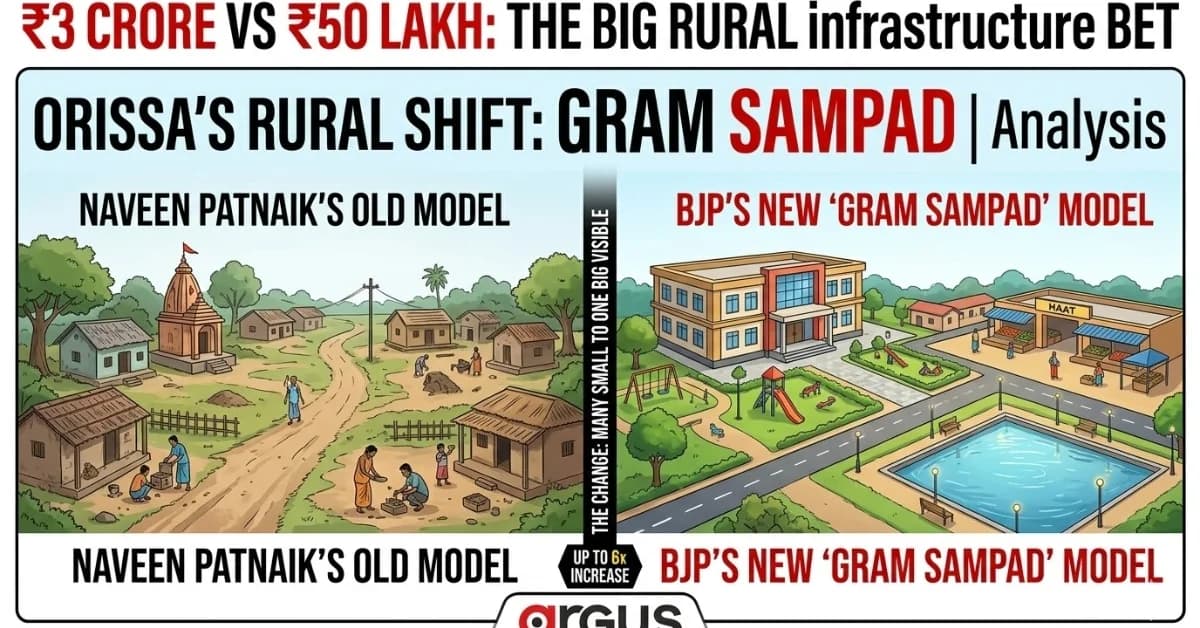
✨While the BJD-era model relied on smaller, dispersed projects and a strong centralised administrative architecture, GRAM SAMPAD proposes to concentrate resources on bigger model assets, with Gram Sabhas and local Panchayati Raj Institutions expected to play a greater role in identifying projects.
In short, the BJP appears to be replacing the “many small projects” model with a “one big visible asset” strategy.
₹3 Crore vs ₹50 Lakh: The Big Rural Infrastructure Bet
The headline number is striking.
Under the previous Ama Odisha Nabin Odisha framework, Gram Panchayats received a flat Rs50 lakh allocation, largely for smaller gap-filling projects, generally ranging from a few lakh rupees to around Rs10 lakh.
GRAM SAMPAD, on the other hand, envisages an annual development grant of up to Rs3 crore per Gram Panchayat.
That potentially represents a six-fold increase in the funding ceiling.
The change could have an equally important impact on the nature of projects. Instead of dividing Rs50 lakh among multiple small works, the new programme seeks to establish at least one major model community asset in every Gram Panchayat.
These could include:
- Model community centres or Kalyan Mandaps
- Rural parks
- Modern market hubs and haats
- Sports playgrounds
- Community ponds
- Upgraded crematoriums and shashans
The objective is clear: bring urban-style civic amenities into rural Odisha.
A well-designed Rs3-crore project can potentially create infrastructure that would have been difficult to finance under the earlier micro-project model. A modern community centre, organised rural market or integrated recreational space could become a highly visible and long-lasting public asset.
That is where GRAM SAMPAD differs fundamentally from its predecessor.
From Micro-Projects to Model Assets
The Naveen Patnaik-era rural development model had its own political and social logic.
By funding numerous smaller works, the scheme ensured that benefits could spread across different localities and communities. Roads, small community structures, local facilities and cultural infrastructure could be financed according to immediate village-level needs.
But such an approach also had a limitation: RS50 lakh spread across multiple projects could often result in many modest interventions, but few transformational assets.
GRAM SAMPAD attempts to reverse that equation.
The BJP government appears to be betting that villages need larger, durable and more visible infrastructure – assets that can transform the social and economic landscape of a Gram Panchayat rather than merely filling smaller infrastructure gaps.
The model also carries an economic objective. Some of the proposed assets, particularly organised haats and community facilities, are expected to generate local revenue, potentially giving Panchayats a more sustainable financial base.
From 5T-Style Centralisation to Gram Sabha?
The second major difference lies in decision-making.
The BJD government’s Ama Odisha Nabin Odisha programme faced political criticism over the role of the administration and the 5T framework in project selection and implementation. Local elected representatives had often complained that bureaucratic structures and district-level oversight dominated decisions.
GRAM SAMPAD seeks to place Gram Sabhas and local PRI members more centrally in identifying infrastructure gaps and selecting projects.
If implemented in its intended spirit, this could represent a major political reset.
The BJP has repeatedly attacked the previous government for what it described as excessive bureaucratisation of governance. The new rural scheme offers the BJP an opportunity to reinforce its larger political narrative – that elected representatives, rather than officials alone, should have greater control over development priorities.
However, the real test will lie in implementation.
The Panchayati Raj Department’s Standard Operating Procedure for fund deployment, asset selection, monitoring and convergence is still being finalised. The degree of genuine decentralisation will ultimately depend on how much freedom Gram Sabhas and Panchayat representatives actually receive.
A scheme can be called decentralised on paper. But if approvals, technical sanctions and project priorities remain heavily controlled from above, the distinction could become blurred.
Cultural Projects Give Way to Urban-Style Amenities
There is also a visible shift in the development philosophy.
The BJD-era Ama Odisha Nabin Odisha programme had a strong focus on Jagannath culture, heritage and local places of worship, apart from other local development activities. The renovation and preservation of temples and culturally significant community spaces became a prominent component of the programme.
GRAM SAMPAD shifts the emphasis toward functional civic infrastructure.
The priority is now likely to be:
Kalyan Mandaps, modern haats, parks, playgrounds, ponds and upgraded cremation facilities.
This is not necessarily a rejection of cultural infrastructure. Instead, it reflects a broader attempt to redefine what rural development should look like.
The BJP’s argument appears to be that the next stage of rural transformation should focus on quality of life infrastructure comparable to urban civic amenities.
The Convergence Model: Bigger Assets Without Only Bigger State Spending
Perhaps the most important structural feature of GRAM SAMPAD is its funding model.
Unlike a standalone State Plan programme, the scheme proposes to pool resources by converging the Viksit Bharat – Guarantee for Rozgar and Ajeevika Mission (VB-GRAM G) with other Central and State schemes.
The idea is to combine different funding streams to create larger and more durable assets.
This convergence approach could allow the government to undertake projects that no single scheme could finance independently.
For instance, different components of a model rural asset could potentially be supported through employment-generation funds, State development grants, sector-specific Central schemes and other available resources.
In theory, this gives GRAM SAMPAD a stronger financial architecture than a scheme entirely dependent on one State budget.
But it also creates a challenge.
Convergence-based projects require strong planning and coordination between departments. If different funding streams are not aligned, projects could face delays. The government will therefore have to ensure that GRAM SAMPAD does not become a complicated exercise in fund convergence on paper.
The success of the scheme will depend on whether the Panchayati Raj Department can convert multiple funding channels into one seamless village-level asset creation system.
GRAM SAMPAD vs Ama Odisha Nabin Odisha
|
Feature |
Ama Odisha Nabin Odisha |
GRAM SAMPAD |
|
Funding ceiling |
₹50 lakh per Gram Panchayat |
Up to ₹3 crore annually |
|
Development approach |
Multiple small, local projects |
Large model community assets |
|
Decision-making |
Strong 5T and administrative oversight |
Greater role proposed for Gram Sabhas and PRI bodies |
|
Major focus |
Cultural infrastructure, Jagannath heritage and local gap-filling |
Urban-style civic amenities and community infrastructure |
|
Project structure |
Numerous smaller works |
At least one major model asset per Gram Panchayat |
|
Funding model |
Predominantly standalone State funding |
Convergence of State, Central and other schemes |
|
Economic objective |
Primarily public development benefits |
Public assets with potential Panchayat revenue generation |
A Better Model? The Answer Depends on Implementation
Supporters of GRAM SAMPAD will argue that the new model is superior for three reasons.
First, scale.
A RS3-crore ceiling can finance infrastructure that simply cannot be created through a ₹50-lakh allocation divided among multiple projects.
Second, local democracy.
If Gram Sabhas genuinely determine the projects, the scheme could strengthen grassroots self-governance and give Sarpanches and Panchayat representatives greater ownership of development.
Third, financial sustainability.
Revenue-generating assets such as modern markets could help Panchayats create a local income base instead of remaining entirely dependent on grants.
Yet the old model also had strengths.
The smaller-project approach ensured a wider geographical spread of benefits. Instead of concentrating a large amount on one or two prominent assets, funds could reach multiple localities and address several immediate problems.
The biggest risk for GRAM SAMPAD, therefore, is that one large model asset could become highly visible but insufficiently inclusive.
A modern Kalyan Mandap in one location may transform that locality. But the government will have to ensure that residents in distant hamlets and peripheral habitations do not feel left out of the development process.
The Rural Poll Angle
The political timing is equally significant.
The launch of a high-value rural infrastructure scheme comes at a time when the BJP is still seeking to consolidate its own governance identity in Odisha after ending the BJD’s 24-year rule.
For the BJP, GRAM SAMPAD offers an opportunity to make a clear argument before rural voters:
The BJP is not merely continuing Naveen Patnaik’s welfare-and-development model – it is trying to replace it with a more ambitious version.
The Rs3-crore figure gives the ruling party a powerful political talking point, especially when contrasted with the earlier Rs50-lakh allocation.
The BJD and Congress, however, questioned whether the headline funding figure will translate into actual assets on the ground. They also argued that grand infrastructure announcements ahead of rural elections are politically timed.
The opposition’s strongest line has been: Show the money .
The Bottom Line
GRAM SAMPAD is more than a new Panchayati Raj scheme. It is the BJP government’s attempt to redraw Odisha’s rural development blueprint.
The model shifts from small works to large assets, cultural emphasis to urban-style amenities, standalone funding to convergence, and bureaucratic oversight toward a stated goal of greater Gram Sabha participation.
On paper, the Rs3-crore-per-Gram-Panchayat framework is significantly more ambitious than the earlier Rs 50-lakh model.
But bigger allocations do not automatically mean better development.
The real success of GRAM SAMPAD will depend on three factors: whether the Rs3-crore ceiling translates into actual funding, whether Gram Sabhas genuinely control project priorities, and whether the assets created remain useful and financially sustainable over the long term.
If those
conditions are met, GRAM SAMPAD could become the BJP’s most visible rural
governance intervention in Odisha – and a potentially powerful alternative to
the BJD’s long-standing rural development legacy.
Also Read: Ministers Over Bureaucrats: Why CM Mohan Majhi Ended 5T Era Babu-Led Virtual Cabinets to Restore Political Supremacy in Odisha | Exclusive
Related Topics
Explore more stories