



Mining Policy / From Failed ORISED To Stronger MMDR Act 2026: All About Odisha’s Big Mining Shift
·1 month ago·7 min read
Key Points
Odisha's mining revenue rose from Rs 1,020 crore (2004-05) to a Rs 50,000 crore target in 2024-25, driven by competitive auctions, royalties and DMF contributions.
Bhubaneswar, Aug 21: Odisha’s mining policy has undergone a major shift in two decades -- from the state’s short-lived ORISED tax regime to a system built around competitive auctions, royalties and District Mineral Foundation funds, and now a central framework seeking to limit additional state levies.
The change is particularly significant because the earlier ORISED model became legally unworkable, while the Mines and Minerals (Development and Regulation) Amendment Act, 2026 seeks to make mining taxation more predictable.
ORISED: A Tax Model That Never Delivered
The Orissa Rural Infrastructure and Socio-Economic Development Act, enacted in 2004, was presented as a way to raise resources for rural infrastructure and socioeconomic development.
However, the model never became a dependable revenue mechanism.
The change is particularly significant because the earlier ORISED model became legally unworkable, while the Mines and Minerals (Development and Regulation) Amendment Act, 2026 seeks to make mining taxation more predictable.
ORISED: A Tax Model That Never Delivered
The Orissa Rural Infrastructure and Socio-Economic Development Act, enacted in 2004, was presented as a way to raise resources for rural infrastructure and socioeconomic development.
However, the model never became a dependable revenue mechanism.

📱 Get Argus News App
✨📰 60 Word News🎬 Argus Podcast📺 Live TV and Breaking News🔔 Free Notification Alerts
Download Free:
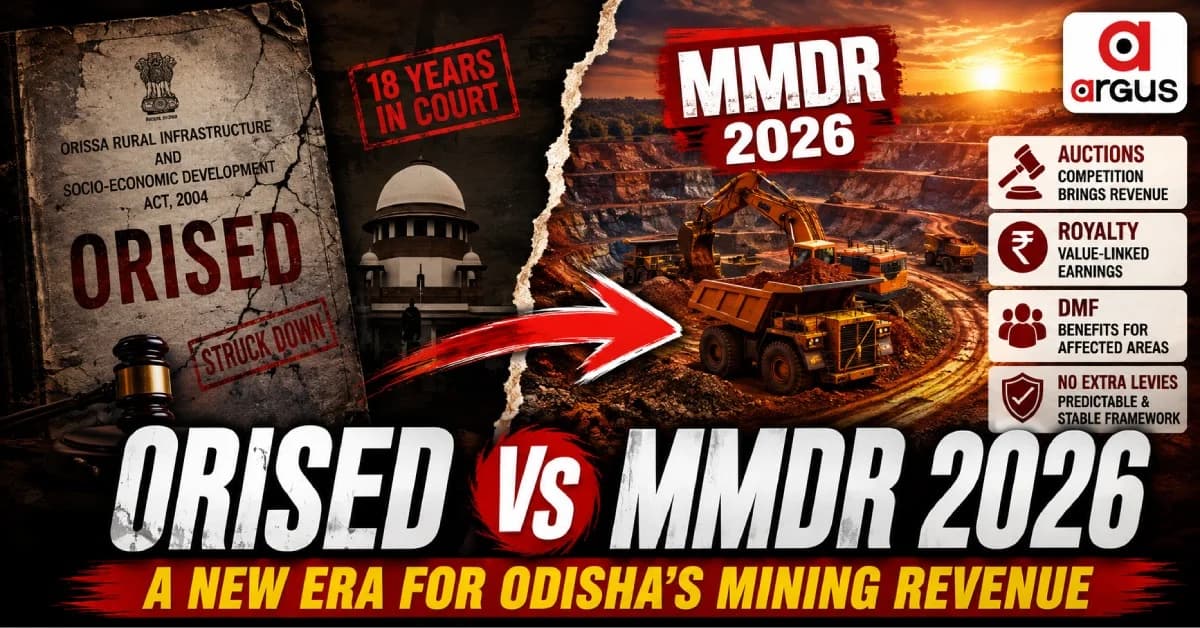
The Orissa High Court struck down the ORISED Act in 2005 as ultra vires (beyond powers). The state's appeal, Civil Appeal No. 1883 of 2006, then remained before the Supreme Court for 18 years.
That meant a law conceived as a revenue instrument spent much of its life in legal uncertainty rather than generating a stable flow of funds.
The structure itself also allowed deductions from the “annual value” used for the levy, including expenses connected with crushing, screening, washing, beneficiation and freight handling.
In effect, the state had created a complicated additional levy without first securing a durable legal foundation for it.
18 Years, But No Revenue Stream
The most striking feature of the ORISED episode is the gap between the political promise of the law and its fiscal outcome.
The framework was projected as a way to make mining contribute more to rural development. Yet after the High Court struck it down, the proposed revenue mechanism could not function as originally intended.
That meant a law conceived as a revenue instrument spent much of its life in legal uncertainty rather than generating a stable flow of funds.
The structure itself also allowed deductions from the “annual value” used for the levy, including expenses connected with crushing, screening, washing, beneficiation and freight handling.
In effect, the state had created a complicated additional levy without first securing a durable legal foundation for it.
18 Years, But No Revenue Stream
The most striking feature of the ORISED episode is the gap between the political promise of the law and its fiscal outcome.
The framework was projected as a way to make mining contribute more to rural development. Yet after the High Court struck it down, the proposed revenue mechanism could not function as originally intended.
The result was a long-running legal dispute rather than a predictable source of public revenue.
That is an important lesson in mineral taxation: a levy is useful only when it is legally enforceable, economically workable and capable of producing revenue consistently.
Mining Revenue Model Changed After 2015
The post-2015 mining regime took a fundamentally different route.
Competitive auctions replaced discretionary allocation of major mineral blocks. Auction premiums began flowing directly to the state treasury, while ad valorem royalties linked revenue more closely to the value of minerals.
The change is visible in Odisha’s mining revenue figures.
Annual mining revenue stood at about Rs 1,020 crore in 2004-05. It rose to around Rs 5,300 crore in 2014-15, while the 2024-25 target was placed at Rs 50,000 crore -- representing roughly a 50-fold increase over the 2004-05 level.
The significance is not merely the size of the increase.
The revenue model itself changed. Instead of depending on a separate state-level levy such as ORISED, the state increasingly benefited from auction premiums and established royalty mechanisms under the national mining framework.
Auctions Replaced Discretion With Competition
The auction system also changed how mineral resources were allocated.
Under competitive auctions, companies bid for mineral blocks and the winning bids determine the premium payable to the government.
For Odisha, this created a direct link between the value companies placed on mineral concessions and the revenue accruing to the state.
The system therefore serves two purposes at once: it provides a transparent mechanism for allocating mineral resources and creates a revenue stream for the state.
That is a considerably more workable proposition than trying to build a separate state taxation mechanism whose legality itself becomes the subject of prolonged litigation.
DMF: Mining Revenue With Local Purpose
The 2015 reforms added another important element -- the District Mineral Foundation, or DMF.
Unlike general state revenue collection, DMF funds are specifically intended for people and areas affected by mining.
The principle is straightforward: if a community bears the environmental and social impact of mineral extraction, it should receive a defined share of the benefits.
The framework therefore created a direct institutional link between mining and local development.
Erstwhile BJD Regime's DMF Record Raises Questions
The problem has been implementation.
A CAG draft audit flagged Rs 983 crore spent in 976 villages that were not directly affected by mining during the BJD-led government. At the same time, no projects were reported in 584 directly affected villages in the period examined.
The audit also flagged Rs 136.77 crore spent from DMF funds on the Raurkela hockey stadium and 1,730 projects executed without Gram Sabha approval.
These findings expose a crucial distinction.
The weakness is not the idea of DMF. It is the diversion or poor targeting of a fund created precisely to benefit mining-affected communities.
The DMF model remains structurally stronger than simply putting another mining levy into a general fund because it creates a dedicated purpose and an identifiable beneficiary group.
Also Read: Dharmendra Pradhan Rebuts Naveen Patnaik Over MMDR Bill 2026
Then Comes MMDR 2026
The Mines and Minerals (Development and Regulation) Amendment Act, 2026, addresses a different problem -- the 'cumulative burden' created when several layers of charges are imposed on mining.
Its new Section 9D restricts state governments from imposing taxes, cess or other levies on mineral rights or mineral-bearing land based on mineral quantity, mineral value, royalty or otherwise, except subject to conditions or restrictions prescribed by the Central Government.
This is a significant change.
The objective is not to stop states from earning mining revenue. The states will continue to receive royalty, auction premiums, DMF contributions and their share of GST.
The Union government says states continue to receive about 90% of mining-sector revenue and that the amendment does not reduce that existing revenue architecture.
Why The Cumulative Burden Matters?
Mining already involves royalty, auction premiums, DMF contributions and other statutory payments.
When these costs are combined with additional state-level taxes, the total burden can become substantial. The concern is particularly important for mines operating on relatively narrow margins.
A mining company does not absorb every additional cost indefinitely. Higher extraction costs affect the economics of the mine and can also raise the cost of minerals supplied to industries.
That creates a chain:
Higher mining cost → higher raw-material cost → higher industrial cost → pressure on consumer prices.
This matters especially for steel, construction, power and other mineral-dependent industries.
Section 9D Protects The Auction Model
There is another important reason for the amendment.
A company bidding for a mineral block calculates the economics of that block before making its investment. The auction premium is part of that calculation.
If additional state levies are subsequently imposed on the same mineral resource, the economics of the original auction can change.
That can weaken the value of future auctions and make companies more cautious about bidding.
Section 9D therefore protects not only mining companies but also the integrity of the auction system itself by seeking to prevent later layers of taxation from undermining the economics on which competitive bids were based.
Also Read: MMDR Amendment Act 2026: LoP Naveen Patnaik’s Odisha Revenue Loss Charge Against PM Modi -led Centre Explained
Protects Downstream Industry
The impact does not stop at the mine.
Iron ore and other minerals are basic industrial inputs. Their cost affects steel producers, construction companies, power projects and manufacturers.
A more predictable mining tax structure therefore gives downstream industries greater certainty over input costs.
For a mineral-rich state such as Odisha, this is particularly important because the mining economy is closely connected to the state's steel and industrial base. This has a direct bearing on employment in Odisha’s mineral-rich districts such as Kendujhar, Sundaragada, Jharsuguda and Jajpur districts.
More Revenue, But With A Clearer Architecture
The transformation can also be seen in Odisha’s revenue trajectory.
From roughly Rs 1,020 crore in annual mining revenue in 2004-05 to a Rs 50,000 crore target in 2024-25, the state’s mineral economy has moved into a completely different revenue scale.
For Odisha, this is more than a tax adjustment.
It represents a shift from uncertain, litigation-heavy revenue extraction to a structured mining economy based on auctions, predictable statutory payments, dedicated community funds and greater fiscal certainty.
That makes the MMDR Amendment Act, 2026 a substantially stronger framework for Odisha's mineral economy than the ORISED model it has effectively moved beyond.
That is an important lesson in mineral taxation: a levy is useful only when it is legally enforceable, economically workable and capable of producing revenue consistently.
Mining Revenue Model Changed After 2015
The post-2015 mining regime took a fundamentally different route.
Competitive auctions replaced discretionary allocation of major mineral blocks. Auction premiums began flowing directly to the state treasury, while ad valorem royalties linked revenue more closely to the value of minerals.
The change is visible in Odisha’s mining revenue figures.
Annual mining revenue stood at about Rs 1,020 crore in 2004-05. It rose to around Rs 5,300 crore in 2014-15, while the 2024-25 target was placed at Rs 50,000 crore -- representing roughly a 50-fold increase over the 2004-05 level.
The significance is not merely the size of the increase.
The revenue model itself changed. Instead of depending on a separate state-level levy such as ORISED, the state increasingly benefited from auction premiums and established royalty mechanisms under the national mining framework.
Auctions Replaced Discretion With Competition
The auction system also changed how mineral resources were allocated.
Under competitive auctions, companies bid for mineral blocks and the winning bids determine the premium payable to the government.
For Odisha, this created a direct link between the value companies placed on mineral concessions and the revenue accruing to the state.
The system therefore serves two purposes at once: it provides a transparent mechanism for allocating mineral resources and creates a revenue stream for the state.
That is a considerably more workable proposition than trying to build a separate state taxation mechanism whose legality itself becomes the subject of prolonged litigation.
DMF: Mining Revenue With Local Purpose
The 2015 reforms added another important element -- the District Mineral Foundation, or DMF.
Unlike general state revenue collection, DMF funds are specifically intended for people and areas affected by mining.
The principle is straightforward: if a community bears the environmental and social impact of mineral extraction, it should receive a defined share of the benefits.
The framework therefore created a direct institutional link between mining and local development.
Erstwhile BJD Regime's DMF Record Raises Questions
The problem has been implementation.
A CAG draft audit flagged Rs 983 crore spent in 976 villages that were not directly affected by mining during the BJD-led government. At the same time, no projects were reported in 584 directly affected villages in the period examined.
The audit also flagged Rs 136.77 crore spent from DMF funds on the Raurkela hockey stadium and 1,730 projects executed without Gram Sabha approval.
These findings expose a crucial distinction.
The weakness is not the idea of DMF. It is the diversion or poor targeting of a fund created precisely to benefit mining-affected communities.
The DMF model remains structurally stronger than simply putting another mining levy into a general fund because it creates a dedicated purpose and an identifiable beneficiary group.
Also Read: Dharmendra Pradhan Rebuts Naveen Patnaik Over MMDR Bill 2026
Then Comes MMDR 2026
The Mines and Minerals (Development and Regulation) Amendment Act, 2026, addresses a different problem -- the 'cumulative burden' created when several layers of charges are imposed on mining.
Its new Section 9D restricts state governments from imposing taxes, cess or other levies on mineral rights or mineral-bearing land based on mineral quantity, mineral value, royalty or otherwise, except subject to conditions or restrictions prescribed by the Central Government.
This is a significant change.
The objective is not to stop states from earning mining revenue. The states will continue to receive royalty, auction premiums, DMF contributions and their share of GST.
The Union government says states continue to receive about 90% of mining-sector revenue and that the amendment does not reduce that existing revenue architecture.
Why The Cumulative Burden Matters?
Mining already involves royalty, auction premiums, DMF contributions and other statutory payments.
When these costs are combined with additional state-level taxes, the total burden can become substantial. The concern is particularly important for mines operating on relatively narrow margins.
A mining company does not absorb every additional cost indefinitely. Higher extraction costs affect the economics of the mine and can also raise the cost of minerals supplied to industries.
That creates a chain:
Higher mining cost → higher raw-material cost → higher industrial cost → pressure on consumer prices.
This matters especially for steel, construction, power and other mineral-dependent industries.
Section 9D Protects The Auction Model
There is another important reason for the amendment.
A company bidding for a mineral block calculates the economics of that block before making its investment. The auction premium is part of that calculation.
If additional state levies are subsequently imposed on the same mineral resource, the economics of the original auction can change.
That can weaken the value of future auctions and make companies more cautious about bidding.
Section 9D therefore protects not only mining companies but also the integrity of the auction system itself by seeking to prevent later layers of taxation from undermining the economics on which competitive bids were based.
Also Read: MMDR Amendment Act 2026: LoP Naveen Patnaik’s Odisha Revenue Loss Charge Against PM Modi -led Centre Explained
Protects Downstream Industry
The impact does not stop at the mine.
Iron ore and other minerals are basic industrial inputs. Their cost affects steel producers, construction companies, power projects and manufacturers.
A more predictable mining tax structure therefore gives downstream industries greater certainty over input costs.
For a mineral-rich state such as Odisha, this is particularly important because the mining economy is closely connected to the state's steel and industrial base. This has a direct bearing on employment in Odisha’s mineral-rich districts such as Kendujhar, Sundaragada, Jharsuguda and Jajpur districts.
More Revenue, But With A Clearer Architecture
The transformation can also be seen in Odisha’s revenue trajectory.
From roughly Rs 1,020 crore in annual mining revenue in 2004-05 to a Rs 50,000 crore target in 2024-25, the state’s mineral economy has moved into a completely different revenue scale.
For Odisha, this is more than a tax adjustment.
It represents a shift from uncertain, litigation-heavy revenue extraction to a structured mining economy based on auctions, predictable statutory payments, dedicated community funds and greater fiscal certainty.
That makes the MMDR Amendment Act, 2026 a substantially stronger framework for Odisha's mineral economy than the ORISED model it has effectively moved beyond.
Related Topics
Explore more stories