



From 2009 Parole Refusal to 2026 Premature Release: The Extraordinary Legal Journey of Dara Singh, Odisha's Most Notorious Convict| Special Report
Key Points
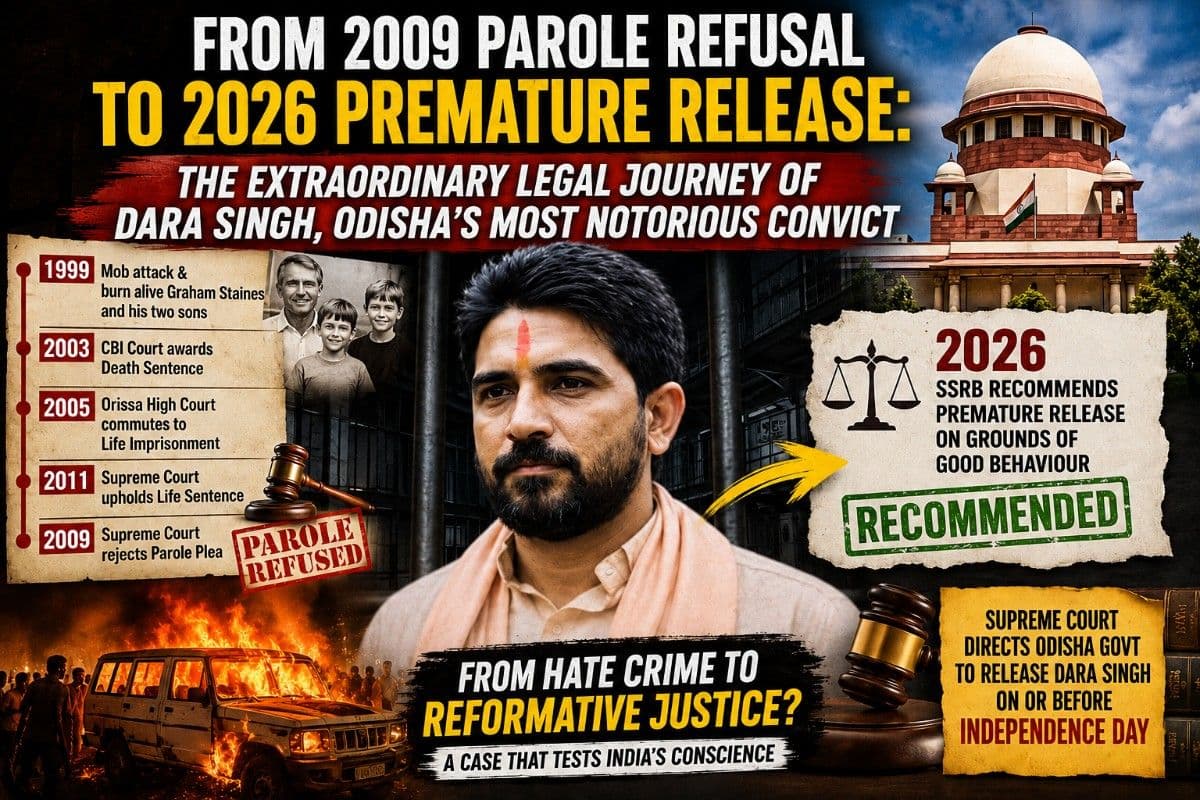
Decades of Incarceration: Dara Singh, the primary convict in the 1999 Graham Staines murders, is set for release after serving over 26 years in prison.
Judicial Milestone: The Supreme Court has directed the Odisha government to process his release by August 15, 2026, following a recommendation by the State Sentence Review Board.
Legal Shift: The case marks a significant point in Indian judicial history, highlighting the evolution from a death sentence to life imprisonment and the eventual application of reformative justice policies.
Bhubaneswar: Born as Rabindra Kumar Pal in Etawah, Uttar Pradesh, the man who would later become infamous as Dara Singh first arrived in Odisha not as a criminal but as a Hindi teacher.
Around 1989, he moved to Maliposhi in Mayurbhanj district, where teaching was only one part of his public life. Deeply influenced by the ideology of cow protection, Dara Singh soon emerged as a prominent face of local Go Suraksha (Cow Protection) committees, when reports of cattle were being smuggled in large numbers from Odisha to neighbouring West Bengal were rampant.
As allegations of police inaction over cattle trafficking mounted, Dara Singh and his followers increasingly took the law into their own hands. Police records from the early 1990s frequently mentioned his name in connection with intercepting cattle-laden trucks, assaulting transporters and setting vehicles ablaze.
In the tribal belt of northern Odisha, where cattle occupy a revered place in local culture, his campaigns earned him a considerable following. Operating largely from Padiabeda in Mayurbhanj's Karanjia subdivision, he became a familiar figure among sections of the tribal population, who often viewed him as a defender of traditional beliefs rather than an outlaw.

📱 Get Argus News App
✨That image, however, collapsed spectacularly on the night of January 22, 1999.
The Crime That Shocked the World
Alleging that Australian missionary Graham Staines was engaged in illegal religious conversions among tribals, Dara Singh allegedly led a mob that surrounded the missionary's station wagon at Manoharpur village in Keonjhar district. The vehicle, in which Staines and his two young sons – Philip (10) and Timothy (6) – were asleep after attending a Christian gathering, was set on fire. All three were burnt alive.
The gruesome triple murder triggered global outrage, severely dented India's international image and became one of the country's most widely discussed hate-crime prosecutions.
The investigation eventually led to the arrest of 51 persons between 1999 and 2000. During trial, 37 were acquitted, while 14 persons, including Dara Singh, were convicted by the designated CBI court. Subsequently, the Orissa High Court acquitted 11 more, leaving only a handful of convictions intact. If Dara Singh is eventually released, virtually no person convicted in the Staines murder case would remain behind bars, except where separate sentences may apply.
The Legal Ordeal: Death Sentence to Life Imprisonment
The legal proceedings spanning more than two decades reflected the evolving judicial understanding of punishment in heinous crimes.
In 2003, the designated CBI Court awarded capital punishment to Dara Singh, describing the murders as among the rarest of rare crimes deserving death.
Two years later, the Orissa High Court, while affirming his conviction, commuted the death sentence to life imprisonment, holding that although the crime was barbaric, it did not satisfy the strict constitutional threshold laid down for imposing capital punishment.
In 2011, the Supreme Court upheld the High Court verdict. While the apex court condemned the killings in the strongest possible terms, calling them an act that "shocked the collective conscience", it agreed that life imprisonment was the appropriate punishment instead of death.
Thus, what began as a death row conviction ultimately became imprisonment for the remainder of his natural life, subject to the statutory powers of remission available to the State.
The 2009 Parole Refusal: Personal Loss Could Not Override Public Interest
Perhaps the most significant judicial indication of the seriousness with which courts viewed Dara Singh came even before the final disposal of his appeals.
On November 27, 2009, the Supreme Court refused his plea for custodial parole.
Dara Singh had sought temporary permission to travel from prison in Odisha to Allahabad for immersion of his deceased father's ashes in the Ganga – a deeply significant Hindu funeral ritual.
A Bench comprising Justices P. Sathasivam and H.L. Dattu declined to permit the journey, holding that the circumstances did not justify temporary release.
Over the years, Dara Singh repeatedly highlighted this rejection to demonstrate the hardships of his incarceration. In successive petitions, he maintained that he had spent more than two decades in prison without being granted parole even once, missing not only his father's last rites but also the funerals of his mother and sisters.
The rejection became symbolic of the judiciary's reluctance to dilute incarceration in one of India's most controversial murder cases.
From Retribution to Reform: The Premature Release Debate
Twenty-six years after the murders, the legal conversation has shifted from punishment to reformation.
Having completed well over the statutory minimum period of imprisonment prescribed for consideration of remission, Dara Singh's case came before the Odisha State Sentence Review Board (SSRB).
The Board does not itself release convicts. It examines whether a life convict has demonstrated sustained good conduct, rehabilitation and fulfilment of statutory requirements before recommending the case to the State Government.
His application had earlier been deferred because the Board sought an updated police verification from his native Auraiya district in Uttar Pradesh, the previous report being from 2022.
At its meeting in July 2026, after considering prison conduct reports and other statutory inputs, the SSRB recommended his premature release on grounds of good behaviour, forwarding the proposal to the Odisha Government for final approval.
Supreme Court's Shift Towards Reformative Justice
Parallel to the administrative process, the Supreme Court has been monitoring Dara Singh's remission plea.
During the latest hearing, the State of Odisha informed the Court that it was actively considering the issue of premature release. Recording this submission, the Bench adjourned the matter for six weeks, expecting the State Government to take a reasoned decision and place it before the Court.
The proceedings underline an important constitutional principle.
A life sentence does not automatically mean imprisonment for only 14 years. In law, it ordinarily means imprisonment for the remainder of the convict's natural life, unless the appropriate government exercises its statutory power under remission policies to release the prisoner earlier.
Therefore, premature release is not a legal right of the convict but a matter of executive discretion, exercised under statutory guidelines and subject to judicial scrutiny.
The Supreme Court's observations also reflect the jurisprudence of reformative justice – the constitutional philosophy that punishment serves not merely to retaliate for crime but also to encourage genuine reformation where the law permits. Courts have repeatedly held that while the gravity of the original offence remains a critical factor, authorities cannot indefinitely deny consideration of remission solely because the crime was heinous if the convict satisfies the legal criteria laid down under the remission policy.
That constitutional balance – between society's demand for accountability and the legal system's commitment to the possibility of human reform – now defines the final chapter of one of Odisha's most consequential criminal cases.
On Tuesday, Dara
Singh’s counsel AP Singh informed the media that Supreme Court has directed the
Odisha govt to release Rabindra Pal alias Dara Singh from prison on or before
Independence Day. However, the detailed court order is yet to be made public.
Also Read: Case Pendency / SC Draws Judicial Lakshman Rekha: High Courts Must Deliver Reserved Judgments Within 3 Months| Special Story
Related Topics
Explore more stories