



Case Pendency / SC Draws Judicial Lakshman Rekha: High Courts Must Deliver Reserved Judgments Within 3 Months| Special Story
Key Points
Bhubaneswar: In a landmark ruling with far-reaching implications for India’s justice delivery system, judicial accountability, and personal liberty, the Supreme Court on Friday laid down binding nationwide timelines for High Courts to pronounce judgments after reserving orders.
The Bench led by Surya Kant and Joymalya Bagchi effectively declared that justice cannot remain trapped indefinitely inside courtrooms after hearings conclude.
At the heart of the ruling lies a powerful constitutional message: once arguments are over, citizens cannot be left waiting endlessly for justice.
The verdict comes amid growing concern over “invisible pendency” - cases where hearings are completed, judgments are reserved, but verdicts remain pending for months or even years.

📱 Get Argus News App
✨The timing
is significant.
India’s district judiciary alone is currently battling a
staggering pendency burden of over 4.91 crore cases, according to the
National Judicial Data Grid data accessed for this report.
The criminal justice burden is particularly alarming:
- Criminal cases pending: 3.79 crore
- Civil cases pending: 1.11 crore
- Magistrial cases alone: over 3.07 crore
- Sessions cases: over 28.7 lakh
- Criminal appeals: over 3.13 lakh
- Bail applications: over 2.82 lakh
Against this backdrop, the Supreme Court’s intervention is being viewed as an attempt to strike directly at procedural paralysis inside the appellate system.
The Trigger: Four Convicts Waiting for Years
The case arose from an extraordinary petition filed by four convicts from Jharkhand, including persons convicted under Section 302 IPC and another under rape charges.
Their grievance exposed a deeply troubling judicial vacuum.
The petitioners told the Supreme Court that:
- their criminal appeals had been fully heard by the Jharkhand High Court in 2022,
- judgments had been reserved,
- but verdicts were never pronounced.
Three of them were serving life imprisonment sentences dating back to 2012 and 2014. Another convict had been sentenced to life imprisonment in 2018.
Despite completion of hearings:
- they remained in jail,
- their appeals remained undecided,
- and their constitutional right to speedy justice remained frozen.
The Supreme Court observed that Article 21 protections do not end after conviction. The right to speedy justice extends into appellate proceedings as well.
What the Supreme Court Found
The Bench sought a sealed status report from the Registrar General of the Jharkhand High Court.
What emerged shocked the apex court.
The report revealed:
- 56 Division Bench matters where judgments had been reserved between January 2022 and December 2024 but not delivered.
- 11 Single Bench matters where verdicts were still pending.
The Supreme Court termed the situation “very disturbing”.
Adding to the controversy, the Court also took note of a newspaper report claiming that after Supreme Court scrutiny began, the Jharkhand High Court disposed of 75 criminal appeals within a week.
That development appears to have convinced the apex court that systemic intervention had become unavoidable.
The New Binding Supreme Court Guidelines
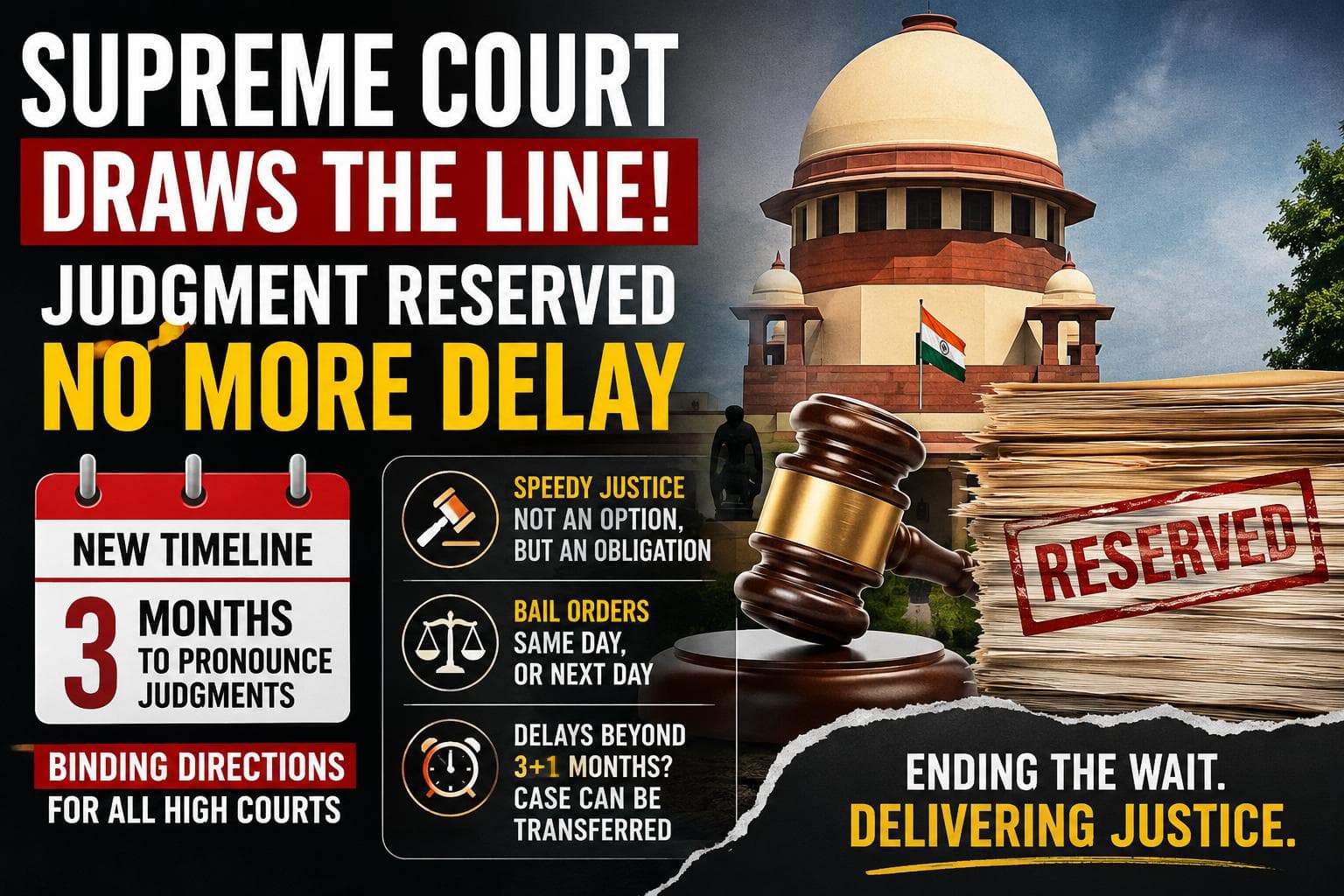
The Supreme Court has now issued what it called “binding directions” for all High Courts across India.
1. Three-Month Deadline for Reserved Judgments
High Courts must endeavour to pronounce reasoned judgments within three months from the date judgment is reserved.
2. Bail Matters Get Top Priority
In cases involving personal liberty:
- bail orders should preferably be pronounced the same day,
- if reserved, they must be delivered the next day and uploaded immediately.
3. Immediate Release Directions
Orders granting bail or suspending sentence must be communicated to jail authorities immediately so that release happens preferably the same day or by the next day.
4. Strict Timeline for Uploading Judgments
If only the operative portion is pronounced:
- the detailed reasoned judgment must be uploaded within 7 days,
- and in exceptional cases within a maximum of 15 days.
5. Automated Monitoring System
Every High Court must create a digital monitoring mechanism where:
- monthly automated alerts go to the Chief Justice,
- pending reserved judgments are tracked,
- and delayed cases are confidentially flagged.
6. Chief Justice Can Reassign Delayed Cases
If a judgment remains pending beyond:
- 3 months,
- plus an additional 2-week reminder period,
the Chief Justice may transfer the matter to another Bench for rehearing.
7. Litigants Get a New Legal Weapon
For the first time, litigants themselves are empowered to act.
If a reserved judgment is not delivered within 3 months:
- parties can file an application seeking pronouncement.
If the delay crosses 3+1 months:
- parties may seek transfer of the matter to another Bench.
8. Mandatory Transparency
Certified copies of judgments must now mention:
- date of reserving judgment,
- date of pronouncement,
- date of uploading.
High Courts must also update websites so litigants can track reserved matters digitally.
Why This Judgment Matters
The ruling could fundamentally alter India’s judicial culture.
Traditionally, once a court reserved judgment:
- litigants had virtually no remedy,
- no statutory timeline existed,
- and there was little administrative accountability.
The Supreme Court has now effectively converted delay in pronouncing judgments into an administratively reviewable issue.
This is especially crucial in criminal matters where delayed verdicts directly affect:
- liberty,
- remission,
- parole,
- acquittal,
- and even death penalty cases.
The Court specifically noted that matters involving:
- habeas corpus,
- bail,
- acquittals,
- demolition,
- and incarceration
require exceptional urgency.
The Larger Crisis Behind the Verdict
The ruling also exposes the scale of judicial stress inside India’s court system.
Exclusive NJDG data accessed for this report shows the pendency mountain currently includes:
- Magistrial Cases: 3,07,57,507
- Sessions Cases: 28,73,794
- Miscellaneous Criminal Applications: 27,15,439
- Miscellaneous Civil Cases: 4,06,405
- Criminal Appeals: 3,13,593
- Bail Applications: 2,82,839
- Criminal Revisions: 1,82,853
- Juvenile Cases: 98,839
The Supreme Court’s latest intervention signals growing concern that reserved judgments were becoming a hidden layer inside this already massive pendency structure.
A Constitutional Warning to the System
The ruling sends perhaps the strongest signal yet that judicial delay itself can become a constitutional violation.
For decades, pendency discussions focused largely on:
- judge vacancies,
- infrastructure,
- and case inflow.
The Supreme Court has now shifted attention to another critical bottleneck: cases that are fully heard, but never decided in time.
By imposing timelines, monitoring mechanisms, litigant remedies, and transfer powers, the apex court has attempted to institutionalise accountability without directly compromising judicial independence.
Whether the
new framework succeeds nationally may now depend on how aggressively High
Courts implement the directions, and whether the era of “judgments reserved
indefinitely” has finally come to an end remains to be seen.
Also Read: Cow Politics / Back-to-Back Court Orders Deal Major Setback to Secular Lobby on Bakrid Cow Slaughter| Analysis
Related Topics
Explore more stories